IndustryFashion & LifestyleServicesAI Application · Mobile App

An AI stylist that knows what a woman will actually wear.

ALIFF builds outfits from a user's own wardrobe under modesty rules a general model has no concept of — hijab coverage, layering, accessory logic — and turns her camera roll into a clean, tagged closet on the way in. Live on the App Store and Google Play.

Core Offering
AI Outfit Generation
Status
Live — iOS & Android
Platforms
iOS + Android · one Flutter codebase
Engagement Started
2026
Market
United States
Project Results
5.0
App Store rating
from 4 ratings
Public — App Store, verified 20 Aug 2026
12
Services on one backend
Gemini · PhotoRoom · RevenueCat · Supabase + 8 more
Structural fact — integrations wired
2
Platforms, one codebase
iOS + Android from Flutter
Structural fact — platforms built
2
App stores, live
Submitted, approved, shipped
Public — App Store and Google Play

ALIFF shipped to both stores in July 2026. Downloads, conversion and retention are the client's numbers to share, and the app has been live for weeks rather than quarters — so they are not on this page. What is on this page is what was built, and why it was built that way.

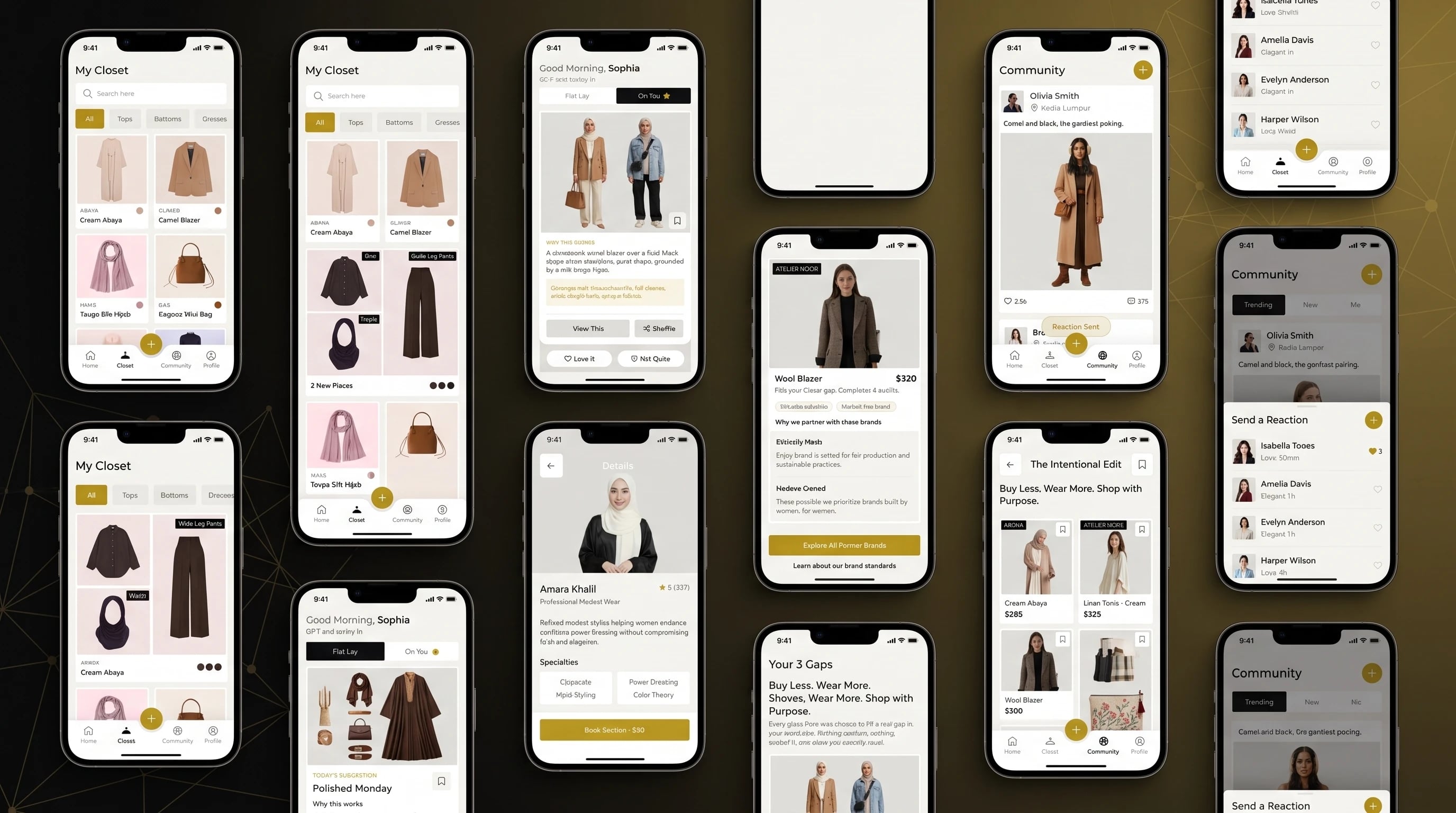
ALIFF AI modest styling app — onboarding, wardrobe closet, generated outfit and AI stylist chat screens
The Context

Building an AI fashion app that styles a woman from the wardrobe she already owns.

ALIFF is a personal stylist for Muslim women and modest dressers. She photographs what she already owns, ALIFF cuts each photo into a clean flat-lay and tags it, and from that closet the AI proposes complete outfits she can actually leave the house in — with a chat stylist to push back on, a weather read on the day, and a subscription behind the deeper usage.

The brief was an investor-ready MVP, not a demo. Real generation from real wardrobes, real closet management, and real money moving through Apple and Google before launch — a product that could hold its first paying users rather than one that survived a pitch meeting. It shipped to both stores in July 2026.

ALIFF app onboarding, wardrobe closet, generated outfit and AI stylist chat screens
The Challenge

Mainstream AI styling has no concept of modesty.

Ask a general image model for an outfit and it returns something a hijabi user cannot wear — sleeveless, sheer, too short, or layered in a way that defeats the hijab entirely. The rules she dresses by are not in the training data. They are not a style preference the model can be nudged toward; they are a hard constraint with a binary outcome.

The obvious approach is to write the rules into the prompt and ask the model to respect them. That gets you compliance most of the time. In a styling app, most of the time is a failure mode. One sleeveless suggestion and she stops trusting the feature — not the outfit, the feature. And once she is checking every suggestion against her own judgement, the app has become work rather than help.

There was a second constraint underneath the first. A wardrobe app is only as good as the wardrobe inside it, and users upload what their camera roll actually contains: a top on a hanger, a dress on a bed, half-shadowed, against a patterned wall. Any product that opens with a data-entry form gets one upload and then silence.

Our Approach

Constrain the model. Don't ask it nicely.

The whole product rests on one decision: modesty is a rule layer the AI has to pass through, not an instruction in a prompt we hope it honours. Everything else was built to make that layer cheap enough to run and fast enough to feel instant.

A Modesty Matrix, not a prompt.

Coverage, layering, hijab and accessory rules are encoded as structured data that generated combinations are filtered against. A non-compliant outfit is rejected by the system before it renders — caught by the architecture, not by the user.

Onboarding that branches on who she is.

A ten-question flow with conditional hijabi and non-hijabi logic sets the rule set once. The app never asks her to re-justify how she dresses, and the two user types are configurations of one rule set rather than two forks of the product.

Her camera roll, catalogued for her.

PhotoRoom cuts every upload to a clean flat-lay on a neutral ground, and auto-tagging runs on the processed image rather than the raw one. The model always sees consistent input, and she never fills in a form.

AI that costs what it should.

Caching, streaming responses and quota tracking sit in front of every AI call. Generation stays fast for the user and the inference bill stays survivable for the business — the two are the same problem.

Real billing before launch, not after.

RevenueCat over Apple In-App Purchase and Google Play Billing: a seven-day free trial, auto-renewal, receipt validation and purchase restoration. The revenue path was proven in the MVP rather than deferred to the thing you do once you have users.

Lifecycle messaging on product events, not a calendar.

Push through OneSignal and email through Resend fire when the flat-lay is ready, when an outfit is ready, when usage hits 80% and 100%, when the trial is ending, and on renewal. Every message is triggered by something that actually happened to her.

The SRS written for this build — product principles, scope boundaries, client responsibilities, non-functional requirements, acceptance criteria and explicit MVP exclusions — is now the template every NLS project is documented against.

The Hard Part

Making a generative model obey a rule it was never taught.

Modesty is not a preference the model can be steered toward. It is binary, and the user knows which side a suggestion landed on within half a second of seeing it. That ruled out the obvious approach immediately, and four problems followed from taking the harder one.

Modesty as prompt instructions

  • Rules live in a prompt string, so compliance is probabilistic — usually right, occasionally not
  • One sleeveless suggestion costs the user's trust in the whole feature
  • Hijabi and non-hijabi users need different rules, so the prompt forks and drifts
  • No way to prove a suggestion was compliant — only to apologise after it wasn't
  • Changing one rule means re-testing every prompt path by hand

Modesty as a rule layer the AI passes through

  • Coverage, layering, hijab and accessory rules are structured data, not prose
  • Generation is filtered against the matrix, so a non-compliant outfit never renders
  • Onboarding sets the rule set once — hijabi and non-hijabi are configurations, not code paths
  • Every suggestion is traceable to the rules it satisfied
  • A rule change applies everywhere at once, without touching a prompt
Cause

Modesty rules were being passed to the model as prompt instructions. The model complied most of the time, which means it failed some of the time: sleeveless tops, sheer layers, hemlines that ignored the rule entirely.

Fix

Moved the rules out of the prompt and into the Modesty Matrix. Coverage, layering, hijab and accessory constraints became structured data, applied as a filter on generated combinations rather than a request to the model.

Result

Compliance stopped being something the model chose and became something the system enforced. Non-compliant combinations are rejected before they reach a screen.

Cause

Users upload what their camera roll contains: items on hangers, on beds, half-shadowed, against patterned walls. Raw photos gave the tagging step nothing consistent to read, so items landed mislabelled or untyped.

Fix

Put PhotoRoom in front of the pipeline to cut every item to a clean flat-lay on a neutral ground, then ran auto-tagging on the processed image instead of the raw one.

Result

A photographed item arrives in the closet already cut out, typed and tagged. No form to fill, and a consistent input for every generation that follows.

Cause

Every outfit request went to the model cold and the user watched an empty screen for the full round trip. Repeat requests over an unchanged wardrobe paid the same cost again.

Fix

Added caching in front of the AI layer and switched the chat stylist to streaming responses, so text arrives as it generates rather than after it completes.

Result

The wait became visible progress instead of a spinner, and repeated work stopped being re-billed to both the user's patience and the client's inference budget.

Cause

Quota is not a billing detail in an AI app; it is the product's economics. Unlimited generation and unlimited chat meant the heaviest users cost the most and paid nothing, and there was no moment where upgrading made sense.

Fix

Built quota tracking into the AI layer itself — weekly chat, weekly outfit generation, lifetime uploads — and wired the free trial to trigger at the quota wall, with RevenueCat handling Apple IAP, Google Play Billing, receipt validation and restoration behind it.

Result

Cost per user is bounded by design, and the upgrade prompt lands at the exact moment the user has proven the feature is worth paying for.

The model still does what models are good at — proposing combinations from a real wardrobe. What it no longer does is decide what counts as modest. That decision sits in the rule layer, where it can be inspected, changed and trusted.

What This Means in Practice
01

Modesty is enforced by the system rather than requested from the model — the difference between a feature a user trusts and one she checks.

02

A wardrobe becomes a usable catalogue from a camera roll alone, with no data entry between her and the first generated outfit.

03

Hijabi and non-hijabi users are configurations of one rule set, not two forks of the product — a new rule ships to both at once.

04

The AI layer is metered where it costs money. Quota tracking, caching and streaming were built with the feature, not bolted on after the first invoice.

05

Real subscription infrastructure — trial, auto-renewal, receipt validation, restoration — means the revenue path was proven before launch, not assumed.

06

Lifecycle messaging fires on product events rather than a marketing calendar, so every notification is about something that happened to her.

07

One Flutter codebase means every rule change, model change and pricing change reaches iOS and Android in the same release.

08

The app cleared review on both the App Store and Google Play, including in-app purchase and data-safety declarations — the part of an AI product that is routinely underestimated.

09

The ALIFF SRS is now the documentation standard every NLS engagement is written against.

Got an AI feature that has to be right, not just impressive?

Built for Every Platform

One app. One AI layer doing the hard part.

Two halves of the same product: the app she touches, and the styling engine that has to be right before anything reaches her. Both shipped from a single Flutter codebase to the App Store and Google Play.

iOS + Android · Flutter

ALIFF Mobile App

01
  • AI outfit generation from her own wardrobe, weighted by colour, fabric, occasion and modesty level
  • Closet upload with automatic flat-lay processing and auto-tagging
  • Quick Style — a complete look generated in seconds from what she has
  • Closet Remix — build a fresh outfit around one piece she already wants to wear
  • AI chat stylist with multi-turn conversation and streaming responses
  • Accept, swap and reject feedback that shapes the next suggestion
  • Weather-aware recommendations for the actual day, not the closet in the abstract
  • Ten-question onboarding with conditional hijabi and non-hijabi logic
  • Email, Google and Apple sign-in with account linking and password reset
  • Seven-day free trial with quota-triggered paywall, auto-renewal, receipt validation and restoration
  • Push and lifecycle email on real product events — flat-lay ready, outfit ready, quota at 80% and 100%, trial ending, renewal
  • Profile, privacy and photo-retention controls
  • Dark and light themes, multi-language ready
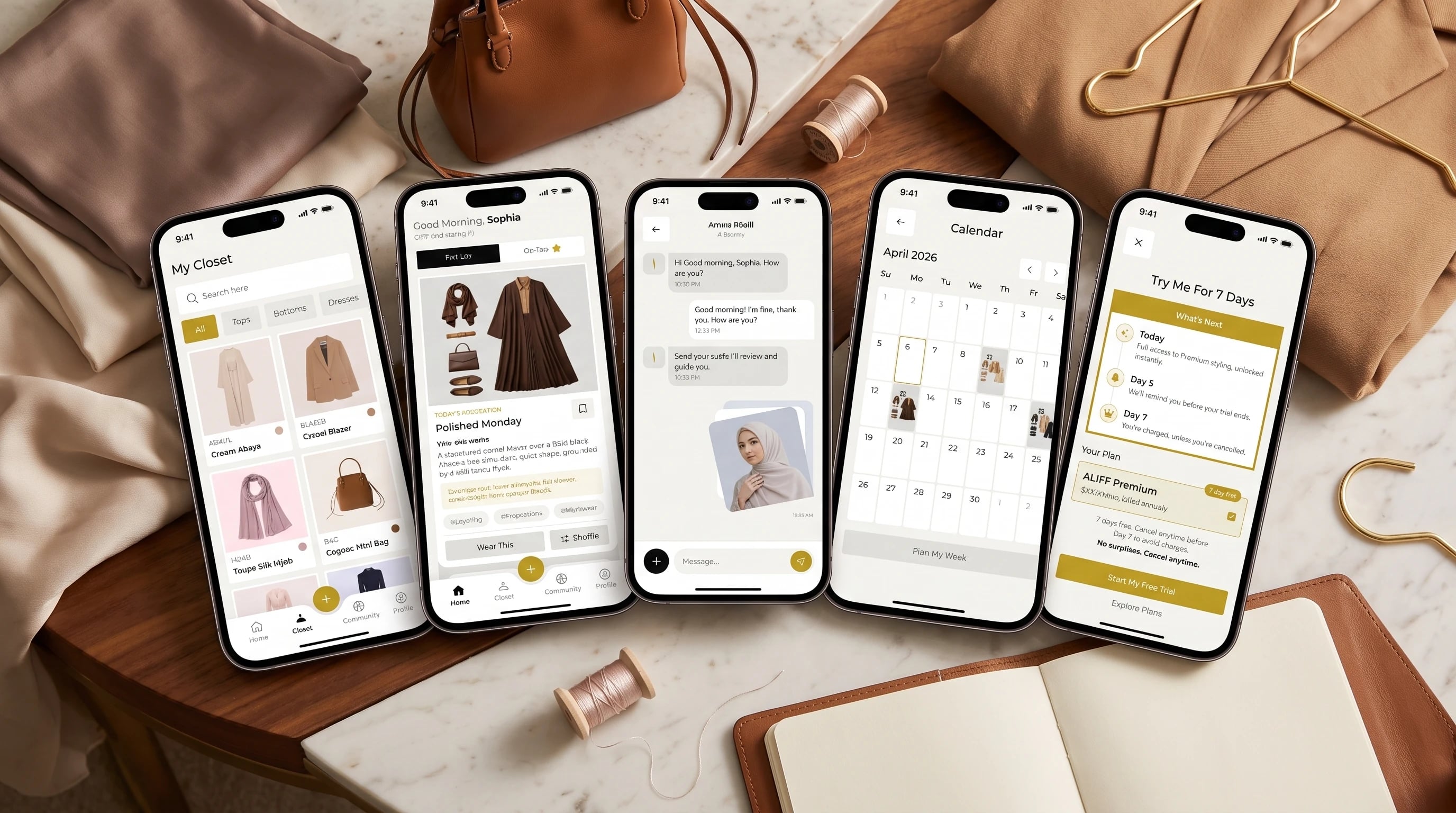
ALIFF AI fashion app — wardrobe, outfit generation and stylist chat on iOS and Android
Why This Is a Partnership

In their own words.

As an all-male team, Khubaib and his team were genuinely open to understanding the specific needs of building a modest fashion app for women, coverage, hijab styling, the details that actually mattered, not just building to a generic spec. That made all the difference in bringing ALIFF to life.

Khubaib himself has been a genuine asset from the ground up, he consistently stepped up whenever needed and helped bring my vision to reality, and his communication throughout the project stood out.

Beyond his own work, he brought a solid team around him, Abdullah as project manager kept things organized, and the Adil on the backend and Usman on the frontend took feedback well and stayed open to new ideas throughout. I'm grateful for what Khubaib and his team helped bring to life, and I'd recommend him to anyone looking for a developer who takes real ownership of a project.

Khansa Khatoon
Khansa Khatoon
Founder of ALIFF
FAQ

AI Fashion & Styling App Development — Questions Founders Ask Us

Have a similar project? Talk to us

You stop asking the model and start constraining it. On ALIFF, modesty rules — coverage, layering, hijab and accessory logic — live in a structured rule layer that generated outfits are filtered against, not in a prompt the model may or may not honour. Prompt instructions give you compliance most of the time, and in a product where one wrong output costs the user's trust, most of the time is a failure mode. The same pattern applies to any AI feature with a hard boundary: legal, medical, brand or cultural.

An AI feature added to an app you already have starts around $8k. A full AI-assisted product like ALIFF — generation, an image processing pipeline, a rule engine, quota tracking and live subscription billing across both stores — is a larger scope, and we quote it fixed after a free scoping call rather than by the hour. You get a number tied to a written scope, not a range.

Only if you process them first. Raw camera-roll photos are inconsistent — bad light, busy backgrounds, items on hangers — and feeding them straight to a model gives you unreliable tagging and unusable results. ALIFF runs every upload through a flat-lay pipeline before anything AI touches it, so the model always sees clean, consistent input. That preprocessing step is usually the difference between an AI feature that works in a demo and one that works in a user's hands.

You design the economics with the feature, not after the first invoice. ALIFF meters at the AI layer — weekly chat, weekly generation and lifetime upload quotas — caches repeated work, and streams responses so users perceive speed without extra inference. The quota wall is also where the free trial triggers, so cost control and the upgrade moment are the same mechanism.

Yes, and we build it early. ALIFF ships through RevenueCat over Apple In-App Purchase and Google Play Billing, with a seven-day trial, auto-renewal, receipt validation and purchase restoration. Billing is the part founders defer and then discover is a project of its own — we treat it as part of the MVP so the revenue path is proven, not assumed.

It will if the parts reviewers actually check are built properly. ALIFF cleared both stores with in-app purchase configured through RevenueCat, restore-purchase implemented, account deletion available in-app, and data-safety and privacy declarations completed for photo and personal data handling. Most AI app rejections come from those four things rather than from the AI itself — we treat store submission as a build task with its own acceptance criteria, not as paperwork at the end.

Building an AI product that has rules it can't break?

We've already solved constrained generation, image pipelines, AI cost control and store billing — and shipped it to both stores.
See exactly how we'd scope yours.

Book a Free Consultation
More Platforms We've Shipped

Two more we built the same way.

Angivore logoHealth & Wellness

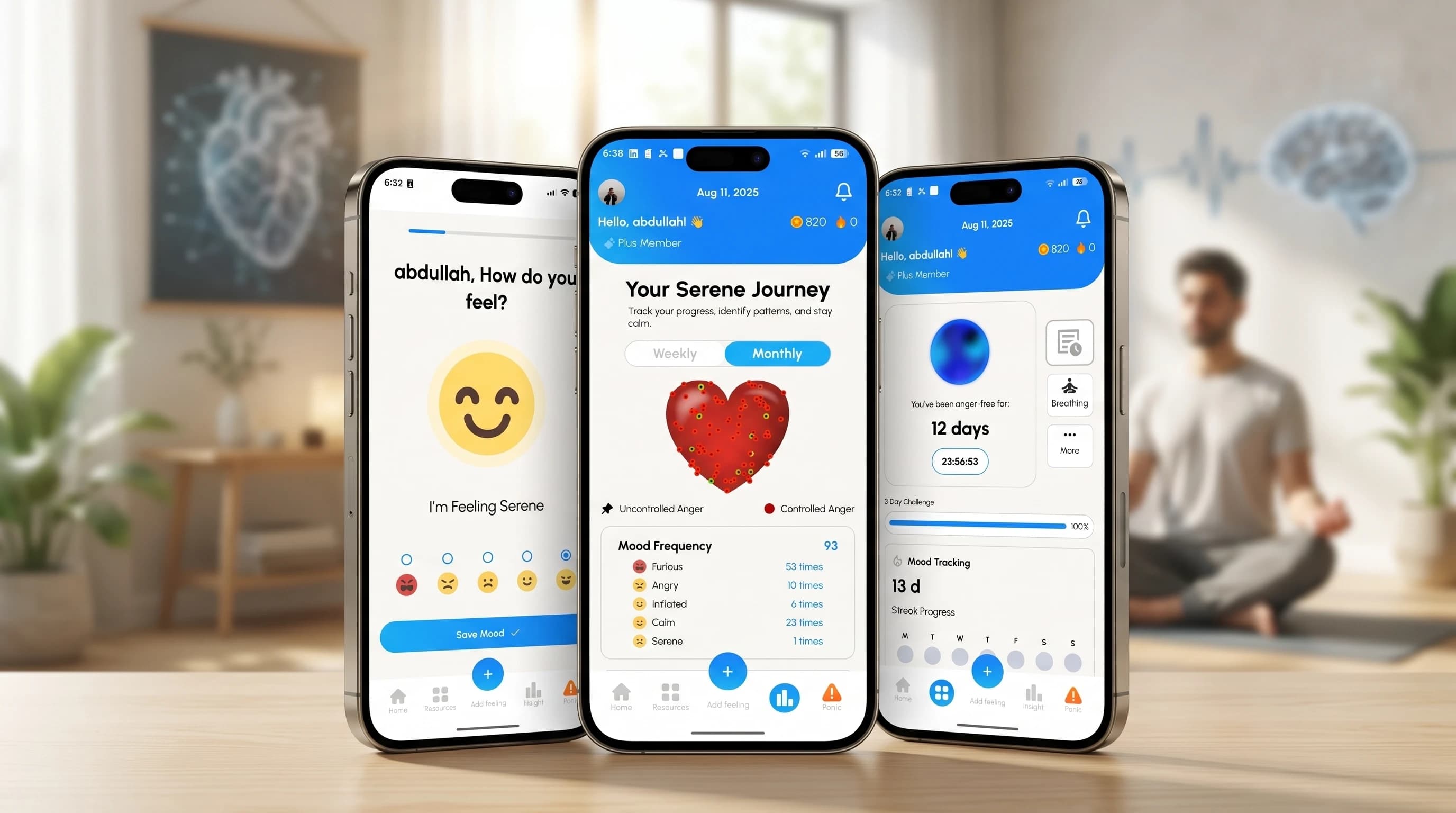
An Emotional Wellness App That Listens Before It Advises

Users journal by voice and get themes back instead of a mood score. Mood tracking, AI chat insights, streaks that don't punish a missed day, and premium subscriptions — shipped to both stores from one Flutter codebase.

View the Work
Angivore mood tracking, audio journaling and AI insight screens
Growth logoHealth & Fitness

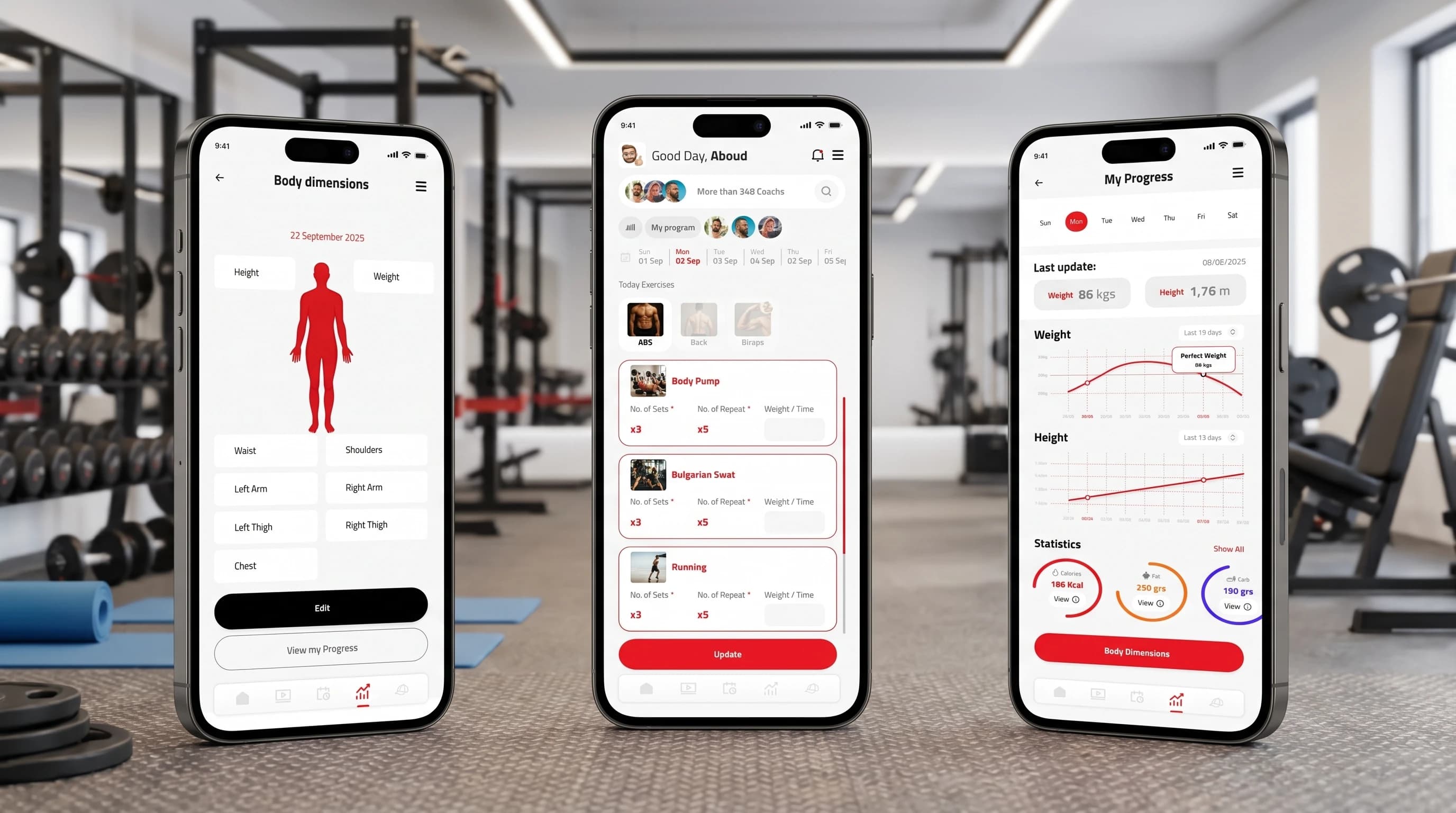
AI Fitness Coaching With a Real Trainer Behind It

  • AI-generated workout and nutrition plans that adapt to logged progress
  • A trainer-side console for managing clients and reviewing plans
  • Subscription tiers separating self-serve from coached users
  • An admin panel that runs the platform without developer involvement
View the Work
Growth AI fitness and nutrition app with trainer and admin panels
Trusted US-Registered Development Agency
5.0 Client Satisfaction on Clutch
Recognized Top Rated Plus on Upwork
100+ Products Delivered
15+ Expert Developers & Designers
6+ Years of Development Excellence
Serving Clients Across the Globe
98% Client Retention Rate
Trusted US-Registered Development Agency
5.0 Client Satisfaction on Clutch
Recognized Top Rated Plus on Upwork
100+ Products Delivered
15+ Expert Developers & Designers
6+ Years of Development Excellence
Serving Clients Across the Globe
98% Client Retention Rate
Logo