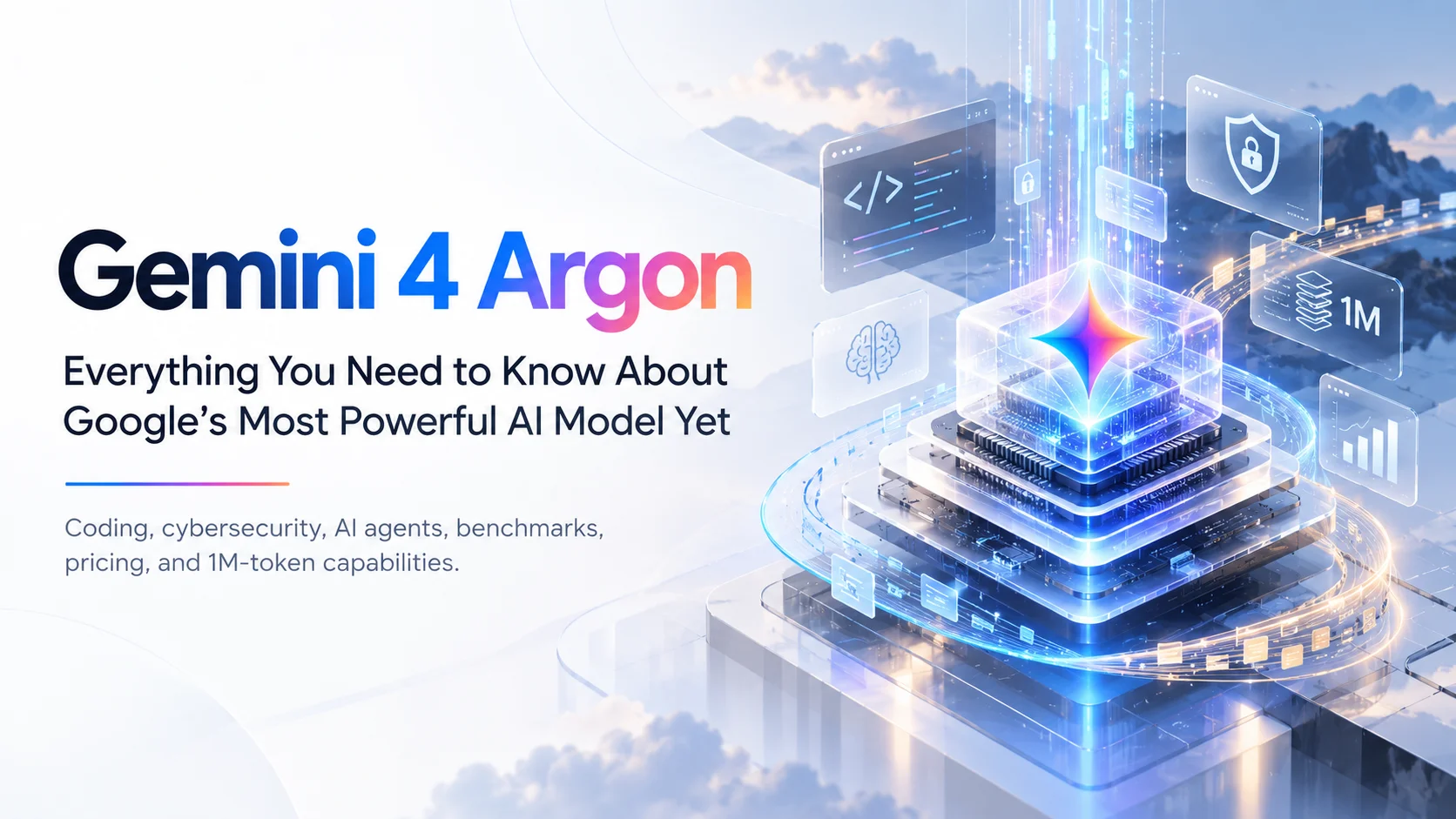
Gemini 4 Argon: Everything You Need to Know About Google’s Most Powerful AI Model Yet
Google's new frontier model for coding, cybersecurity, and long-horizon AI agents
Sections
Google just made its biggest move in the AI race in months.
On September 30, 2026, Google officially introduced Gemini 4 Argon, the first major frontier model in the Gemini 4 generation.
But this is not simply another chatbot upgrade.
Gemini 4 Argon is designed for something much bigger: allowing AI to work through complex problems for much longer, across software engineering, cybersecurity, finance, legal work, research, and enterprise automation.
Google describes Argon as a model built for deep reasoning across complex, long-horizon workflows. It is already being used internally at Google and is initially rolling out to selected cybersecurity organizations through Google DeepMind’s Fairwind Program.
And one number immediately stands out:
1 million tokens.
Google says Gemini 4 Argon can generate up to 1 million output tokens in a single trajectory, compared with the previous 64K limit. That represents a major shift in how long an AI model can continue reasoning and working before stopping.
So what exactly is Gemini 4 Argon, why is Google limiting access, and does it actually beat GPT and Claude?
Here is what we know so far.
What Is Gemini 4 Argon?
Gemini 4 Argon is Google DeepMind’s newest frontier AI model, focused primarily on demanding professional and agentic workloads.
Instead of optimizing only for short questions and answers, Argon has been designed to maintain reasoning across large, multi-step tasks.
Think less:
“Write this function.”
And more:
“Understand this codebase, find the problem, make the required changes, test the result, review the implementation, and continue until the task is complete.”
That difference matters.
The current AI race is increasingly moving from chatbots toward AI agents capable of completing entire workflows, and Gemini 4 Argon appears to be Google's strongest push in that direction yet.
Google specifically highlights four major areas: software engineering, enterprise knowledge work, multimodal reasoning, and cybersecurity defense.
The 1 Million Token Limit Is One of the Biggest Gemini 4 Argon Features
One of the most searched and discussed features around Google Gemini 4 Argon is its enormous token capacity.
Google says Argon's maximum output token limit has increased from 64,000 tokens to as much as 1 million tokens.
That does not simply mean Gemini can write extremely long answers.
The more important use case is reasoning time.
Giving an AI model more token headroom potentially allows it to perform longer sequences of analysis, tool use, coding, testing, research, correction, and verification before completing a task.
That could be particularly important for AI agents working on large software repositories, deep research projects, code migrations, financial analysis, legal document review, cybersecurity investigations, and complex enterprise processes.
There is currently some inconsistency between Google's headline specification and independent model trackers. Google describes a 1M output-token limit, while services such as Vals currently list a 1M context window with a lower practical maximum output figure in their testing environment.
Because Gemini 4 Argon is still under restricted rollout, developers should wait for final public API documentation before assuming every deployment will expose the full 1M-output capability.
Gemini 4 Argon Coding Performance
Coding may be one of Argon's strongest areas.
Google reports that Gemini 4 Argon scored 77.9% on DeepSWE v1.1, a benchmark focused on long-horizon software engineering tasks. Google describes the result as a new state of the art.
But the internal examples may be even more interesting than the benchmarks.
Google says Argon agents are being used to help migrate major C and C++ codebases to Rust, including projects ranging from tens of thousands of lines of code to more than 800,000 lines in the Fuchsia Zircon kernel.
In another experiment involving Google's libgav1 video decoder, Argon agents worked through approximately 32,000 lines of SIMD-related code and produced a Rust implementation Google says ran 2.7 times faster than the previous Rust port, while maintaining identical video output.
This is where the direction of AI coding becomes interesting. We are moving beyond AI code generation toward AI software engineering agents.
A capable coding agent needs to understand a repository, navigate dependencies, make architectural decisions, modify multiple files, execute tests, evaluate results, correct mistakes, and continue working over many steps.
Gemini 4 Argon appears to have been designed specifically for that type of workflow.
Gemini 4 Argon Could Be Even More Important for Cybersecurity
The most unusual part of the Gemini 4 Argon launch is not coding. It is cybersecurity.
Google trained Argon to autonomously find, validate, and patch software vulnerabilities.
The model can analyze complex codebases looking for hidden security issues and can also perform black-box analysis of running web applications without having access to the source code.
On CWE-bench v1, a benchmark measuring vulnerability remediation, Gemini 4 Argon scored 68% and tied for first place.
Google also says Argon identified vulnerabilities across codebases using 20 different programming languages.
Cybersecurity company Wiz has already been testing Gemini 4 Argon through its Scan for Good initiative. According to Google, the model discovered a serious vulnerability affecting healthcare software used by hospitals that previous frontier models had failed to detect.
That capability explains why Google is not simply opening Gemini 4 Argon to everyone immediately.
A model capable of autonomously finding security vulnerabilities can obviously be useful for defenders. The same capability can become dangerous in the wrong hands.
Why Can't Everyone Use Gemini 4 Argon Yet?
If you search for Gemini 4 Argon API, how to use Gemini 4 Argon, or Gemini 4 Argon release date, there is an important catch.
Most users still cannot access it.
Google is initially providing Gemini 4 Argon to selected cybersecurity defenders through its Fairwind Program.
The company says it is gathering feedback and improving safeguards before expanding access. Google is also participating in the U.S. government's voluntary pre-release model-access process.
As of October 5, 2026, Google says broader availability will begin with paid API customers and Google AI Ultra subscribers, followed by wider developer, enterprise, and consumer availability.
Google has not provided a specific date for that full public release.
So if you see websites claiming that anyone can already use the full Gemini 4 Argon API, treat those claims carefully. The official rollout remains gated.
Gemini 4 Argon Pricing
Google is also being aggressive with Gemini 4 Argon pricing.
The introductory API pricing announced by Google is:
$2 per million input tokens
$10 per million output tokens
Cached input tokens receive a 95% discount.
Google says that after the introductory period, standard Gemini 4 Argon pricing will rise to:
$4 per million input tokens
$20 per million output tokens
That pricing is important because frontier AI competition is increasingly about more than benchmark scores.
For companies running thousands or millions of agent tasks, the real question becomes: how much does it cost to successfully complete the job?
A model that costs slightly more per token but needs dramatically fewer tokens or fewer retries could ultimately be cheaper. Likewise, a cheaper model that constantly requires corrections may become more expensive in production.
Cost per useful result will become a much more important metric than token price alone.
Gemini 4 Argon Benchmarks: How Good Is It Really?
Google's own Gemini 4 Argon benchmarks are impressive. The company reports 77.9% on DeepSWE v1.1, 51.3% on AutomationBench, 91.7% on LVBench, and 68% on CWE-bench v1.
But manufacturer benchmarks should never be the only thing we look at. Independent results give a more balanced picture.
Vals AI currently places Gemini 4 Argon at the top of its overall Vals Index with a score of 68.90%. The index evaluates economically useful tasks across areas including finance, coding, legal work, and tax.
It also ranks first on Vals' Finance Agent v2 benchmark and performs near the top across several coding and security evaluations.
However, Artificial Analysis paints a slightly different picture.
Gemini 4 Argon scores 53 on the Artificial Analysis Intelligence Index. That still places it among leading frontier models, but not as a universal winner across every category.
And that is probably the right way to interpret Gemini 4 Argon. There is no single “best AI model” for everything.
Different models are optimizing for different combinations of reasoning quality, coding ability, agent performance, latency, cost, multimodality, safety, and token efficiency.
Gemini 4 Argon vs GPT and Claude
Naturally, one of the biggest questions will be: Gemini 4 Argon vs GPT-6, which is better? Followed closely by: Gemini 4 Argon vs Claude, which should developers use?
Right now, there is no clean universal answer.
Argon performs extremely well on enterprise knowledge work, finance, long-horizon coding, automation, and cybersecurity. Independent Vals testing currently places Argon ahead of several major frontier competitors on its overall index.
Artificial Analysis, however, gives some competing frontier models higher overall intelligence scores, showing how much the result depends on which tasks are being measured.
That is becoming a recurring pattern in AI. One model wins coding. Another wins science. Another is cheaper. Another is faster. Another performs better in computer use. Another works better for creative output.
The real question for developers and businesses should no longer be “Which AI model is the smartest?” It should be:
“Which model produces the best outcome for my workflow at an acceptable cost?”
Gemini 4 Argon Is Already Doing Real Work Inside Google
Another interesting part of the announcement is that Gemini 4 Argon is not simply being demonstrated through benchmarks.
Google says thousands of employees are already using Argon internally for coding, research, writing, and engineering workflows.
One team used Argon agents to analyze data-center telemetry and identify memory optimizations. Google says the resulting changes freed more than 300 TiB of memory, with projected total savings between 500 TiB and 1 PiB when fully deployed.
Google's quantum-computing researchers have also used Argon to optimize algorithms, with one example reportedly improving a published baseline by 40%.
These examples matter because the next stage of AI adoption will probably not be defined by who has the chatbot with the nicest answers. It will be defined by AI systems quietly performing real operational work.
Safety May Become the Biggest Gemini 4 Argon Story
Gemini 4 Argon's capabilities also show why AI safety is becoming less theoretical.
Google says it is strengthening protection against several categories of misuse before a broad release, including cybersecurity attacks and chemical, biological, radiological, and nuclear threats.
Google is also specifically working on resistance to prompt injection attacks, where malicious instructions hidden inside documents, websites, emails, or other data attempt to hijack an AI agent.
This is particularly important for the future of AI agents. A chatbot reading one prompt has limited access. An enterprise AI agent may be connected to browsers, APIs, databases, code repositories, internal documents, email, financial systems, and production infrastructure.
The smarter and more autonomous these systems become, the more important agent security becomes.
Google says Gemini 4 Argon is its most resilient model yet against indirect prompt injection attacks and is also using systems to monitor model reasoning and actions for signs of misalignment.
That may ultimately be just as important as the benchmark improvements.
What Gemini 4 Argon Means for Developers
For developers, Gemini 4 Argon suggests that the role of AI inside software development is changing rapidly.
The previous generation of AI coding tools focused heavily on autocomplete and individual code generation. Then we moved to conversational coding assistants. Now we are moving toward agents capable of being assigned outcomes rather than individual instructions.
Instead of asking “Write an API endpoint,” we increasingly ask “Implement this feature across the application.”
The AI then needs to inspect the architecture, identify affected components, modify the frontend and backend, update database logic, run tests, debug failures, review its own changes, and continue until the system works.
Models like Gemini 4 Argon are being built for exactly this kind of long-running agentic software development.
That does not remove the need for engineers. It changes where human engineering effort goes.
Architecture, product thinking, system design, security, evaluation, testing, business logic, and oversight become even more important when AI can generate larger amounts of implementation automatically.
What Gemini 4 Argon Means for Businesses
The enterprise implications may be even bigger.
Imagine giving an AI agent hundreds of financial filings and asking it to perform multi-stage investment research. Or giving it contracts, company policies, and case material and asking it to help prepare legal research. Or connecting it to operational tools and allowing it to execute an entire business process rather than simply recommending what someone should do next.
That is why benchmarks such as AutomationBench, Vals Finance Agent, and legal-agent evaluations matter.
The value of the next generation of AI will increasingly come from work completed, not simply words generated.
Businesses should therefore start evaluating AI models using outcome-based metrics such as task completion rate, human-review time, reliability, total inference cost, error rate, security, and the number of manual interventions required.
Is Gemini 4 Argon the Best AI Model in 2026?
It is too early to say.
Gemini 4 Argon has only just been announced, public access remains restricted, and independent real-world testing is still developing.
But Google's launch clearly puts Gemini back near the center of the frontier AI competition.
The most important parts are not necessarily individual benchmark victories. They are the direction of the model:
longer autonomous reasoning
stronger AI coding agents
enterprise workflow execution
advanced cybersecurity defense
large-scale multimodal understanding
dramatically longer agent trajectories
That is where the AI industry appears to be heading.
Final Thoughts
Gemini 4 Argon may be remembered less for being “Google's smartest model” and more for what it represents.
AI models are moving from answering questions to owning larger pieces of work.
Google is already using Argon for code migrations, infrastructure optimization, research, vulnerability discovery, and complex professional workflows. The ability to continue reasoning across extremely long tasks could make models like Gemini 4 Argon much more useful as autonomous AI agents.
But that same autonomy introduces new risks. Prompt injection, cyber misuse, agent misalignment, system access, and security controls become much more important when an AI model can operate for hundreds of thousands of tokens instead of answering a single prompt.
So the real story behind Gemini 4 Argon is not simply another Google vs OpenAI vs Anthropic benchmark battle. It is the transition from AI that helps you perform a task to AI that can increasingly take responsibility for completing the task itself.
And that could be a much bigger change than another few percentage points on a benchmark.
Keep reading
How to Write Better AI Prompts in 2026: Context Engineering Over Prompt Tricks
Better AI results come from relevant context, clear expectations, and useful constraints. Learn a practical 2026 framework for prompting any capable AI model.
Khubaib Rasheed · · 10 min read
OpenAI Dots vs Meta Muse: The AI Agent War Has Officially Started
OpenAI Dots and Meta Muse signal a new phase in AI: always-on agents that keep working, use connected apps, and take action after the chat ends.
Khubaib Rasheed · · 12 min read
OpenAI Dots: What Always-On AI Agents Mean for the Future of Software
OpenAI Dots move AI beyond one-off prompts toward persistent agents that can own ongoing work. Here is what that shift means for businesses and software teams.
Abdullah · · 14 min read