 Abdullah
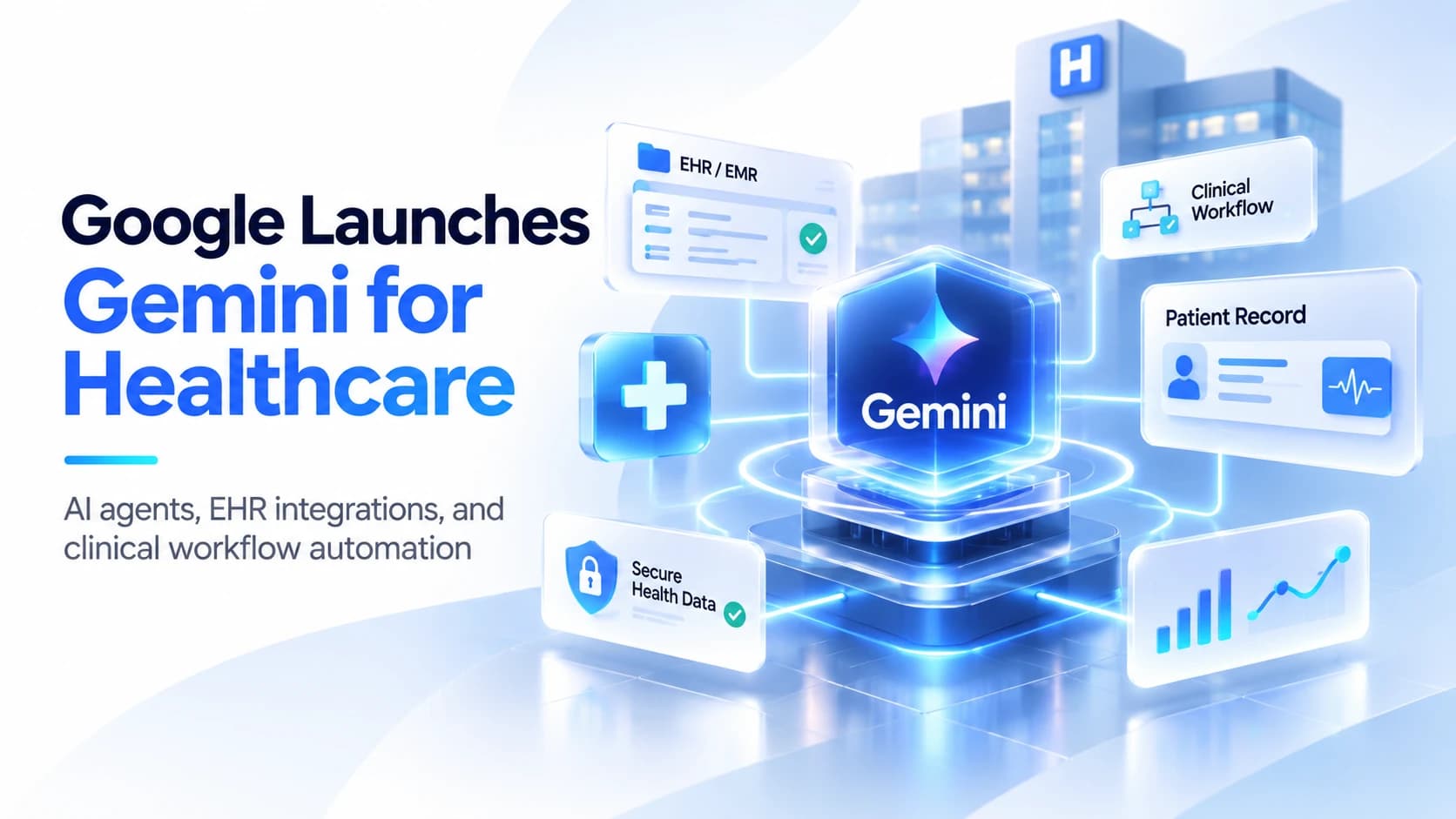
Google has officially launched Gemini for healthcare, introducing a new enterprise AI solution designed to help hospitals, healthcare providers, health insurance companies, and medical organizations manage complex clinical and administrative workflows.
Announced on November 10, 2026, the new Google Cloud healthcare AI solution combines Gemini AI agents, healthcare-specific skills, secure data connectors, and enterprise governance capabilities. Its goal is to help healthcare organizations connect fragmented patient information, automate repetitive administrative tasks, and improve access to clinical and insurance-related information.
Unlike a traditional AI chatbot that primarily answers questions, Gemini for healthcare is designed to work across existing healthcare software systems. It can assemble information from electronic health records (EHRs), clinical documentation, insurance policies, claims platforms, and other connected applications to support multi-step workflows with human oversight.
Google has initially made Gemini for healthcare available in preview in the United States. The launch signals a broader shift toward agentic AI in healthcare, where AI systems do more than summarize information and instead help coordinate work across multiple applications.
What Is Google Gemini for Healthcare?
Gemini for healthcare is a purpose-built Google Cloud AI solution for healthcare providers, health plans, payers, and health technology organizations. It extends Google's enterprise Gemini agent with specialized capabilities for clinical, financial, operational, and administrative healthcare workflows.
Rather than replacing existing hospital management software or electronic health record platforms, Gemini for healthcare connects to systems that healthcare organizations already use. These integrations allow authorized employees to access relevant information, prepare documentation, and coordinate tasks without manually searching multiple disconnected applications.
For example, a physician preparing for an appointment may need to review previous diagnoses, medication histories, laboratory reports, specialist notes, and records from different healthcare facilities. Gemini for healthcare is designed to synthesize this information into a more complete patient timeline, with citations pointing back to the original clinical sources.
Similarly, a health insurance organization can use healthcare-specific AI workflows to review coverage requests against medical policies, organize supporting evidence, and prepare information for a qualified reviewer.
Importantly, Gemini for healthcare is not a newly announced standalone medical foundation model or an independent diagnostic system. It is an enterprise AI orchestration solution that brings together models, healthcare-specific instructions, connected data sources, and security controls.
When Did Google Launch Gemini for Healthcare?
Google Cloud officially announced Gemini for healthcare on November 10, 2026. The announcement was published by Thomas Kurian, CEO of Google Cloud, in the official Google Cloud Blog under the title "Introducing Gemini for healthcare."
The solution became available in preview in the United States on the announcement date. According to Google's product documentation, preview access is intended for eligible Gemini Enterprise Standard and Plus customers, with organizations directed to Google Cloud for deployment and access details.
The release follows Google's broader introduction of its enterprise Gemini agent in October 2026. Gemini for healthcare extends that approach with healthcare-specific workflows, connectors, and governance requirements.
Google's announcement also identifies healthcare organizations and ecosystem participants involved in developing or exploring these capabilities, including HCA Healthcare, Northwell Health, Highmark Health, Blue Cross Blue Shield of Massachusetts, and other healthcare technology partners.
Official announcement: Introducing Gemini for healthcare - Google Cloud Blog.
Why Google Is Bringing Gemini AI to Healthcare
Healthcare organizations manage enormous amounts of information, but that information is often distributed across disconnected software systems. Patient records may be stored in electronic health records, insurance details in payer platforms, medical guidelines in separate databases, and administrative documents in productivity applications.
This fragmentation creates additional work for clinicians, administrative employees, and insurance reviewers. Instead of focusing entirely on patient care or professional decisions, staff frequently spend time locating records, reconciling conflicting information, preparing documents, and checking coverage requirements.
In its launch announcement, Google cites nearly 28 hours per week spent by clinicians on manually reconciling information and administrative work. This is a figure presented by Google in its announcement, rather than an independently established outcome of the new product.
Gemini for healthcare addresses this problem through a governed AI agent that can retrieve information from authorized systems, apply organization-specific instructions, and organize evidence into useful outputs. The intended benefit is less manual information gathering and more time for clinical judgment, patient communication, and other higher-value work.
Four Core Components of Gemini for Healthcare
Google describes four major components that work together to support healthcare AI automation. Each component addresses a different requirement, from understanding healthcare tasks to connecting data and enforcing security policies.
1. Healthcare-Specific AI Skills
Gemini for healthcare includes reusable AI skills designed around clinical and administrative tasks. These skills contain domain-specific instructions and context that guide the AI agent through defined workflows, such as medical records synthesis, appointment preparation, prior authorization review, and insurance benefit determination.
Healthcare organizations can also create custom skills based on their own policies, standard operating procedures, and operational requirements. This allows the same underlying AI platform to support different workflows across hospitals, medical groups, and health insurance organizations.
2. Connectors to Healthcare Systems
The platform includes connectors for electronic health records, claims management platforms, clinical terminology systems, coverage databases, and enterprise applications. These integrations help Gemini access relevant information from existing systems while respecting established permissions.
Supported ecosystem integrations include Epic EHR, Oracle Health EHR, InterSystems FHIR Server, TriZetto Provider Solutions, Salesforce, Microsoft 365, Google Workspace, and numerous specialized healthcare technology providers.
Google emphasizes that organizations can connect to existing systems without requiring a complete migration of their underlying clinical records.
3. Open Healthcare Partner Ecosystem
Healthcare organizations often use different combinations of EHR platforms, financial systems, clinical applications, and internal software. Google's open partner ecosystem is designed to help organizations customize integrations and extend the platform with specialized capabilities.
The ecosystem includes healthcare technology companies, systems integrators, and implementation partners. Google has identified organizations such as Accenture, Cognizant, Deloitte, HCLTech, KPMG, NTT DATA, PwC, Wipro, and other partners supporting enterprise implementations.
4. Secure and Governed AI Platform
Gemini for healthcare includes enterprise identity controls, role-based access permissions, audit logging, source citations, and centralized policy management. The platform is designed to support healthcare organizations with sensitive information and complex governance requirements.
Google also supports model choice, allowing organizations to use different available AI models for different workloads under a common governance framework. For example, routine administrative tasks may use faster, more economical models, while complex analysis may require more capable reasoning models.
Key Features of Google Gemini for Healthcare
The most important Gemini for healthcare features focus on improving clinical information access, reducing administrative workloads, and helping providers and payers coordinate their existing operations.
AI-Powered Medical Records Synthesis
Patient information can be spread across multiple healthcare providers, appointments, laboratories, and electronic health record systems. Gemini for healthcare can synthesize authorized records into a longitudinal patient timeline, highlighting relevant diagnoses, allergies, medications, and clinical history.
The system is designed to distinguish active medical problems from resolved conditions and identify possible medication discrepancies. Findings are connected to their underlying sources so healthcare professionals can review the evidence rather than relying on an unsupported AI summary.
Automated Pre-Appointment Preparation
Before a scheduled appointment or medical procedure, healthcare teams often need to check recent events, current medications, laboratory results, required clearances, and patient documentation.
Gemini for healthcare can help prepare this information ahead of the visit. The intended result is a more organized clinical workflow in which physicians and care teams can review the patient's relevant history without repeatedly searching separate applications.
Prior Authorization Automation
Prior authorization is a common administrative process in which healthcare providers seek approval from an insurer before certain services or treatments are covered. It often requires detailed documentation and comparison against specific insurance policies.
Gemini for healthcare can help assemble relevant medical records, compare supporting information against payer requirements, and identify missing documentation before submission. If a request is denied and the available evidence supports an appeal, the system can help draft an appeal grounded in the clinical record and applicable coverage policy.
These workflows are designed to support human reviewers and existing authorization processes. They do not guarantee approval or eliminate the need for professional review.
AI-Assisted Insurance Coverage Review
Health insurance companies can use Gemini for healthcare to organize submitted evidence against applicable medical policies and coverage guidelines. The system can highlight relevant documentation, identify policy criteria, and prepare traceable findings for clinical reviewers.
This use case is particularly relevant to utilization management, medical necessity reviews, and administrative processes where employees must evaluate large amounts of information before reaching a decision.
Insurance Benefits and Cost Explanations
Patients frequently struggle to understand deductibles, co-payments, provider networks, and estimated out-of-pocket expenses. Gemini for healthcare can help member services teams interpret benefit documents alongside connected eligibility and coverage information.
For example, an authorized representative may use the system to check whether a provider is in-network, review deductible information, and explain an estimated patient financial responsibility using the member's actual plan documentation.
These outputs are estimates and explanations based on available records, not guarantees of final insurance payment or patient cost.
Gemini for Healthcare Integrations: Epic, Oracle Health, FHIR, and More
One of the strongest aspects of Google's healthcare AI announcement is its integration ecosystem. Rather than requiring every hospital to adopt a new electronic health record platform, Gemini for healthcare is designed to connect with existing clinical, administrative, and financial systems.
Electronic Health Record Integrations
Epic EHR: The connector provides authorized, read-only access to patient conditions, medications, laboratory results, clinical notes, and specialist documentation. It does not write information back to the underlying patient chart.
Oracle Health EHR: This integration provides read-only access to authorized patient histories, diagnostic information, laboratory results, and clinical documentation, preserving the integrity of the system of record.
InterSystems FHIR Server: This integration supports standardized clinical data interoperability using FHIR, a widely used healthcare data exchange standard.
Verato: Patient identity matching capabilities help organizations connect records belonging to the same patient across different visits, facilities, and data sources.
Keragon: Google's announced ecosystem includes connectivity to more than 400 healthcare applications through Keragon's healthcare integration capabilities.
Insurance, Eligibility, and Claims Integrations
Google identifies integrations with Optum, TriZetto Provider Solutions, GoodRx, and Infinitus Relay to support coverage verification, coordination of benefits, prescription pricing, and payer communication.
Optum Network Eligibility and Optum Coordination of Benefits were described as being in limited release and testing with Gemini for healthcare at launch. Their inclusion should not be interpreted as universal availability across every customer deployment.
Medical Terminology and Clinical Evidence
Gemini for healthcare also connects to specialized reference systems such as ICD-10-CM diagnosis codes, RxNorm drug terminology, IMO Health, CMS Coverage, and the NPPES NPI Registry.
These integrations support standardized medical terminology, medication identification, provider verification, and access to published Medicare coverage rules. Google also identifies BMJ Digital Health and Optum EvidenceVue among its clinical evidence ecosystem integrations.
Enterprise and Workflow Integrations
Healthcare operations extend beyond clinical records. Google lists integrations with Microsoft 365, Google Workspace, Salesforce, ServiceNow, UiPath, Suki, Synthpop Careflow, Alteryx, and other enterprise technology providers.
These connections can help healthcare teams move prepared information into familiar administrative tools, coordinate workflows, and connect AI-assisted processes to existing enterprise systems.
How Gemini for Healthcare Uses Agentic AI
Agentic AI in healthcare refers to AI systems that can plan and coordinate multiple steps toward a defined objective, using authorized tools and information sources rather than producing only a single text response.
Consider a healthcare organization preparing a prior authorization request. A traditional AI chatbot might explain the general requirements for authorization. An integrated healthcare AI agent can potentially retrieve relevant clinical evidence, check applicable policy requirements, identify missing documentation, and prepare a structured packet for human review.
That distinction is central to Gemini for healthcare. The platform combines an enterprise Gemini agent with healthcare-specific skills, secure connectors, organizational context, and defined approval boundaries.
However, agentic automation does not mean unrestricted autonomy. Healthcare organizations still need to determine which actions are permitted, what information employees can access, which outputs require verification, and when a qualified professional must approve the next step.
Is Google Gemini for Healthcare HIPAA Compliant?
Google states that Gemini for healthcare is built to support HIPAA compliance and runs on Google Cloud's secure infrastructure. This distinction matters because using a healthcare-oriented cloud product does not automatically make an entire hospital, application, or implementation compliant with healthcare privacy regulations.
According to Google's announcement, the platform includes enterprise access controls, role-based permissions, audit logging, and traceable source citations. Google also states that clinical data, prompts, and generated outputs remain within the organization's governed environment and are not used to train or fine-tune Google's foundation models.
The Epic and Oracle Health EHR integrations are read-only, meaning the AI can retrieve authorized information but cannot directly modify the underlying clinical chart through those connectors. Final clinical documentation, orders, and sign-off remain with authorized healthcare professionals.
Organizations considering deployment should still evaluate their own HIPAA obligations, contractual arrangements, business associate agreements where applicable, data access policies, retention settings, security configurations, and required human review procedures.
Gemini for Healthcare vs Traditional Healthcare AI Chatbots
Healthcare organizations have experimented with AI chatbots for patient questions, document summarization, and internal knowledge retrieval. Gemini for healthcare introduces a broader enterprise workflow approach, although the actual capabilities of any competing healthcare AI solution depend on its implementation.
CapabilityBasic AI ChatbotGemini for HealthcarePrimary functionQuestion answeringCoordinated healthcare workflowsClinical informationOften limited to supplied contextConnected authorized healthcare systemsEHR integrationRequires separate implementationHealthcare-specific connector ecosystemPrior authorizationCan explain requirementsCan assemble evidence for reviewInsurance coverageMay provide general informationCan use connected policy and benefit dataGovernanceDepends on the productEnterprise access and audit controlsWorkflow executionOften conversationalMulti-step agent orchestration
The comparison illustrates the difference between a basic standalone chatbot and Google's integrated enterprise solution. It does not imply that other advanced healthcare AI platforms cannot offer similar features.
Who Can Use Google Gemini for Healthcare?
Google is positioning Gemini for healthcare primarily for healthcare organizations rather than individual consumers looking for personal medical advice.
Hospitals and Healthcare Providers
Hospitals, medical groups, academic medical centers, and clinical teams can explore AI-assisted patient record synthesis, appointment preparation, clinical documentation workflows, and authorization packet assembly.
Health Insurance Companies and Payers
Health plans and payers can explore AI-assisted utilization review, medical policy analysis, benefits verification, and coverage explanation workflows. The platform is designed to organize evidence while keeping professional coverage decisions under appropriate oversight.
Healthcare Technology Companies
Healthtech businesses and enterprise software providers may find opportunities in building specialized healthcare workflows, integration services, and applications that operate alongside existing clinical infrastructure.
However, Gemini for healthcare should not be confused with a universally available consumer API for every healthcare startup. Its initial availability and integration capabilities depend on Google's enterprise preview program, customer eligibility, and deployment arrangements.
Gemini for Healthcare Availability and Pricing
As of November 11, 2026, Gemini for healthcare is available in preview in the United States. Google's official product page identifies Gemini Enterprise Standard and Plus customers as the initial eligible customer groups.
Google has not published a universal, standalone per-user or per-request price for Gemini for healthcare in the launch announcement. Organizations interested in using the solution are directed to contact Google Cloud for access and deployment information.
Actual implementation costs may depend on enterprise licensing, enabled services, integration complexity, model usage, security requirements, and operational workload. Any pricing estimate should therefore be based on a current Google Cloud proposal rather than an assumed public rate.
Official product page: Google Cloud Gemini for Healthcare.
What Google's Healthcare AI Launch Means for Healthtech Startups
Google's launch highlights an important change in the healthcare software market. AI functionality is increasingly being designed around real operational workflows rather than being added as a standalone chatbot feature.
For healthtech startups, this creates opportunities in healthcare data integration, AI-assisted patient portals, administrative workflow automation, medical documentation tools, insurance verification software, and specialized clinical support applications.
However, startups should not assume that adding Gemini automatically creates a safe or clinically validated healthcare product. The difficult work still includes identifying a specific user problem, connecting reliable data sources, designing appropriate access controls, testing model outputs, and ensuring that qualified professionals retain responsibility for sensitive decisions.
A startup building a patient-facing application may need a very different architecture from a hospital deploying enterprise AI across several electronic health record systems. Product scope, regulatory obligations, data access, and clinical risk should guide the technology decision.
For founders exploring these opportunities, health app development involves more than integrating an AI model. It requires carefully designed user journeys, secure data handling, reliable backend services, and workflows that fit the intended healthcare environment.
Practical Challenges of Implementing AI in Healthcare
Although Gemini for healthcare introduces significant capabilities, healthcare organizations should evaluate several practical challenges before moving from a preview or pilot to a production deployment.
Data Quality and Interoperability
AI systems depend on the quality and completeness of the information they retrieve. Duplicate patient records, inconsistent terminology, outdated medication lists, and missing clinical documentation can reduce the reliability of generated summaries. FHIR-based interoperability and identity matching can help, but they do not eliminate every data quality problem.
Clinical Accuracy and Human Review
Healthcare AI outputs can contain errors, omit relevant context, or misinterpret clinical information. Source citations make outputs easier to verify, but citations alone do not guarantee medical accuracy. Clinical decisions, diagnoses, treatment plans, and other high-risk activities require appropriate professional oversight and validation.
Security and Patient Privacy
Connecting AI agents to sensitive healthcare systems increases the importance of access permissions, audit trails, encryption, data governance, and secure integration design. Organizations must verify that users and agents can access only the information required for their authorized responsibilities.
Workflow Integration and Staff Adoption
Even technically capable AI systems can fail to deliver value if they disrupt established clinical processes. Healthcare teams need clear approval steps, understandable outputs, training, and measurable operational goals. A successful pilot should demonstrate practical improvements rather than merely showcasing AI capabilities.
How Next Level Software Approaches AI-Powered Health Applications
Google's announcement reinforces a broader product development principle: useful healthcare AI should support a defined user need and work within a reliable software system.
At Next Level Software, our AI application development work focuses on connecting AI capabilities to practical product workflows, including intelligent recommendations, AI-assisted interactions, and application features designed around user requirements.
One relevant example is Growth, an AI-assisted fitness and nutrition platform that combines personalized workout and nutrition planning with access to real trainers. It illustrates how AI-generated recommendations can be integrated into a broader product experience with human involvement.
Another example is Angivore, an emotional wellness application featuring voice journaling, mood tracking, and AI-assisted insights. Its use case differs from Google's enterprise healthcare platform, but it demonstrates the importance of designing AI features around a specific user experience rather than treating the model as the entire product.
These projects are not presented as Gemini for healthcare implementations or as certified clinical systems. They demonstrate relevant experience in building AI-enabled wellness applications and integrating AI functionality into real software products.
The Future of Gemini AI in Healthcare
Gemini for healthcare represents Google's move toward industry-specific AI agents that operate across existing enterprise software environments. Instead of expecting clinicians and administrative teams to copy information between disconnected applications, the platform aims to bring authorized data, instructions, and workflow coordination into one governed system.
Future adoption will depend on factors such as clinical reliability, integration coverage, operational performance, privacy requirements, cost, and measurable outcomes in real healthcare environments. Google's launch announcement describes intended capabilities and early organizational participation, but it does not establish that every advertised workflow has already delivered the same results across all healthcare settings.
For hospitals and insurers, the immediate opportunity is to identify administrative processes where information gathering and document preparation consume substantial time. For healthcare software companies, the opportunity is to build focused solutions that combine useful AI capabilities with dependable integrations, clear human oversight, and appropriate governance.
Final Thoughts
Google's November 10, 2026 launch of Gemini for healthcare is an important development in enterprise healthcare AI. By combining healthcare-specific AI skills, electronic health record integrations, insurance data connectors, and governed agent workflows, Google is moving beyond general-purpose chat interfaces toward coordinated clinical and administrative operations.
The platform's strongest potential applications include medical records synthesis, appointment preparation, prior authorization documentation, payer reviews, and insurance benefit explanations. Its U.S. preview availability also means organizations should distinguish announced capabilities from proven results in their own environments.
For healthcare providers, insurers, and healthtech founders, the central question is not simply whether AI can be added to a product. It is whether AI can safely reduce a specific operational burden while preserving reliable data access, professional judgment, and patient trust.
If you are planning an AI-powered health or wellness application, discuss your project with Next Level Software to explore the appropriate product scope, integrations, and development approach.