What AI Features Really Add to Your App Development Cost in 2026
The AI model is often not the expensive part. Data, integrations, testing, and ongoing usage can matter more.
Sections
Adding AI to an app can sound simple. Connect an LLM, add a chat screen, and the feature is ready.
That approach can work for a prototype. It is rarely the full cost of a production app.
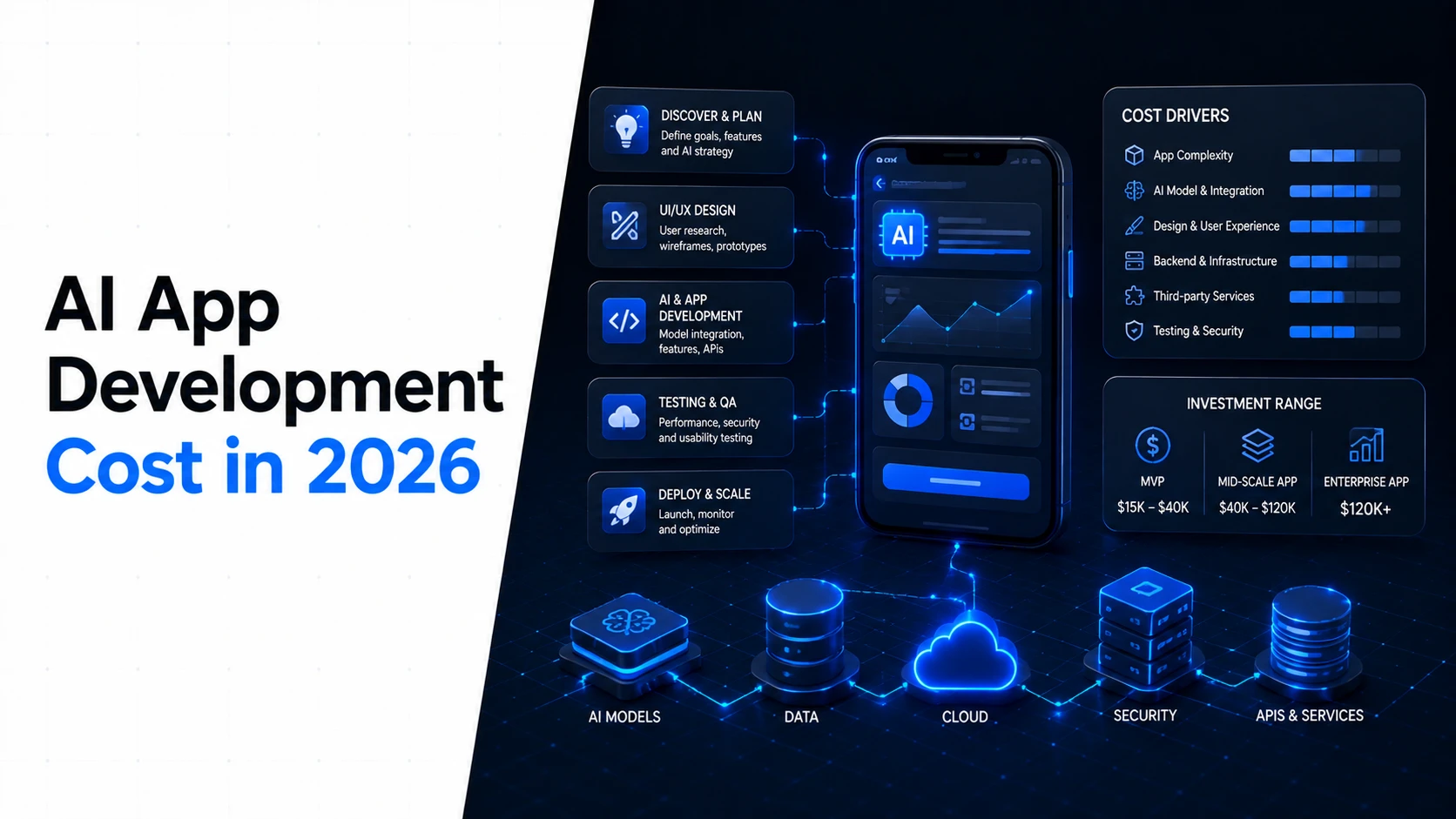
In 2026, the AI app development cost is driven by what sits around the model. Your app still needs an interface, database, authentication, business logic, testing, hosting, and integrations. The AI layer can then add data preparation, retrieval, model calls, safety rules, evaluation, monitoring, and ongoing usage costs.
Current 2026 cost guides put many AI app projects somewhere between roughly $20,000 and $150,000+, while more complex systems can reach several hundred thousand dollars. Those ranges are useful as broad benchmarks, but they do not answer the question most businesses actually have: how much will adding AI to my app cost?
AI does not replace the cost of building the app
Start with an important distinction.
If you already need a mobile or web application, adding AI does not remove the normal product development work. You still need the application around the feature.
For example, an AI customer-support feature may need:
- A customer-facing interface.
- User accounts and permissions.
- A backend and database.
- Connection to customer records.
- Connection to the AI model.
- Rules for what the AI can access.
- Testing and monitoring.
The LLM is one component of that system.
This is why two companies can both say they are building an AI chatbot and have very different budgets. One may be building a simple demonstration. The other may need a secure assistant that works with customer data, follows business rules, and connects to several internal systems.
What does it cost to build an AI app in 2026?
There is no single price, but current published 2026 estimates give a useful starting point. One recent guide places basic AI apps around $10,000 to $40,000 and more complex AI-powered apps around $50,000 to $300,000 or more. Another puts a broad 2026 range at $20,000 to $150,000+, with the final number depending on complexity, AI capabilities, integrations, data, and scale.
For planning purposes, it is more useful to think in terms of the type of AI feature you need:
- Simple LLM feature: usually the lower end when the model receives straightforward input and returns an answer.
- AI chatbot: costs more when it needs business knowledge, conversation history, authentication, or integrations.
- Recommendation engine: becomes more involved when recommendations depend on user behaviour, product data, business rules, or continuous learning.
- AI workflow: costs more when the AI must make decisions, call other systems, update records, and handle exceptions.
- Custom AI or ML system: can become substantially more expensive when you need your own models, training pipelines, large datasets, or specialised infrastructure.
The important point is that these are different engineering problems even though all of them can be described as an AI app.
What an LLM integration actually adds
An LLM integration can be one of the cheaper ways to add AI to an existing application.
If the feature simply sends a user's request to an existing model and displays the response, the engineering scope can be relatively small.
But the cost rises when the model needs context from your application.
Suppose a customer asks, “Which plan should I choose?” A basic integration can generate a general answer. A useful business feature may need to know the customer's account, available plans, eligibility rules, current pricing, previous activity, and company policies.
Now the AI feature needs access controls, data retrieval, business logic, testing, and integration work.
This is why the LLM integration cost should not be estimated from the model API price alone.
The model API is a running cost, not just a development cost
AI usage usually creates an ongoing operating expense.
Models are commonly priced according to usage, such as the amount of input and output processed. Other AI services can add their own charges for search, images, audio, or other capabilities.
A prototype with ten users may generate very little usage. A production app with thousands of users can produce a very different bill.
The actual number depends on the model, request size, response size, number of calls, caching, workflow design, and how often users trigger AI features.
So when calculating the cost to build an AI app, separate these two numbers:
- The engineering cost of integrating and testing the AI.
- The recurring cost of running the AI for real users.
Keeping those numbers separate makes the business case much easier to understand.
What does an AI chatbot add to the budget?
A chatbot is one of the most common AI features, but “chatbot” can describe very different products.
A basic chatbot may answer questions using a fixed prompt and a general-purpose model. A business chatbot may need to answer from company documents. A more advanced assistant may need to check customer records, create tickets, schedule appointments, or trigger other actions.
Those are three different levels of work.
Basic AI chatbot
The app sends a question to an LLM and displays the response.
The main work is the interface, API integration, prompt design, error handling, authentication, and basic testing.
Knowledge-based chatbot
The chatbot needs to answer from your own documents or business data.
This can require document processing, search, embeddings, retrieval, permissions, source updates, and evaluation. One current 2026 benchmark puts AI document Q&A and knowledge assistants around $30,000 to $120,000 depending on the required functionality.
Action-taking assistant
The chatbot can do something after understanding the request.
It might create a booking, update a CRM record, generate a report, or start an internal workflow.
At this point, integration and business rules become a larger part of the project than the chat interface itself.
What does an AI recommendation engine cost?
Recommendation features are another common request.
They can also be deceptively simple.
If the app recommends products using a small set of fixed rules, you may not need a sophisticated machine-learning system at all. A rules-based recommendation feature can sometimes provide the business value without the cost of a custom AI model.
The cost increases when recommendations depend on large amounts of behavioural data, real-time signals, personalisation, ranking, experimentation, or a model that needs to be trained and evaluated.
One 2026 cost guide places AI recommendation engines around $30,000 to $90,000+, depending on the required personalisation and data processing. That is a broad benchmark, not a quote for every project.
The practical question is therefore not, “How much does an AI recommendation engine cost?”
It is, “Do we need machine learning to achieve the recommendation outcome we want?”
When AI is not worth paying for
Adding AI because an app can use AI is a poor reason to add it.
There are situations where a normal software rule is cheaper, easier to test, and more reliable.
For example, suppose an app needs to show customers which subscription they are eligible for. If eligibility depends on three clear rules, traditional application logic may be better than asking an LLM to make the decision.
The same applies to many calculations, fixed workflows, permissions, form validation, and database queries.
AI becomes more useful when the input is difficult to structure or when the system needs to work with natural language, unstructured information, patterns, recommendations, or content generation.
A useful test is simple: if a normal software rule can solve the problem reliably, ask why you need AI before paying for it.
The hidden AI development costs
The biggest budgeting mistake is treating the AI API as the whole AI budget.
Current 2026 cost research repeatedly points to data, integrations, testing, monitoring, infrastructure, and maintenance as major parts of production AI work.
Data preparation
If the AI needs your business data, that data has to be usable.
Documents may need cleaning and processing. Records may need to be standardised. Permissions need to be respected. Outdated information may need to be removed.
Poor data can make an expensive AI feature unreliable.
Retrieval and knowledge systems
An AI assistant that answers from company information usually needs a retrieval layer that finds relevant information before the model generates a response.
This can involve document ingestion, chunking, embeddings, vector search, metadata, access control, and testing.
Not every AI feature needs this architecture. But when it does, it is part of the project cost.
Integrations
AI becomes much more useful when it can interact with the systems the business already uses.
A customer assistant may need a CRM. A booking assistant may need a calendar. An operations assistant may need an internal database. A recommendation engine may need product and customer data.
Each connection adds development and testing work.
AI testing
Traditional software testing often checks whether a known input produces the expected output.
AI systems can produce different answers to similar inputs. Testing therefore needs to consider accuracy, relevance, safety, edge cases, prompt changes, data changes, and failure handling.
This is one reason a production AI feature costs more than a convincing demo.
Monitoring and maintenance
AI applications need ongoing attention after launch.
Teams may need to monitor usage, response quality, errors, latency, token consumption, and changes in the underlying model or data.
The exact maintenance cost depends on the system. It should be included in the budget instead of treated as an unexpected expense.
Why a prototype can give you the wrong cost estimate
AI makes prototypes unusually easy to create.
You can connect an API, write a prompt, and have something working quickly.
That is useful for testing an idea. It can also create unrealistic expectations about the final development cost.
A production application has to answer harder questions:
- Who can use the AI feature?
- What data can it access?
- What happens when the model gives a poor answer?
- How does a user report a problem?
- What happens when the model or API changes?
- How much will the feature cost at higher usage?
- How does the AI interact with the rest of the application?
These questions are where much of the real engineering work appears.
A practical AI app cost model
Instead of asking an agency for one large number, break the project into five parts.
- Core application: the normal product without the AI feature.
- AI feature: the model integration, prompts, AI logic, and user interface.
- Data and integrations: the systems and information the AI needs to use.
- Quality and safety: testing, permissions, monitoring, fallback behaviour, and human review.
- Ongoing usage: model API calls, infrastructure, monitoring, maintenance, and future changes.
This gives you a better view of the real budget than a generic “AI app development costs $X” statement.
Three examples of what AI can add
Example 1: Adding an AI assistant to an existing app
Imagine you already have a customer application and want to add an assistant that answers common questions.
If it only needs a general LLM and does not access private business data, the additional engineering can be relatively contained.
If it needs customer records, company documents, account-specific answers, and human escalation, the scope becomes much larger.
Example 2: Adding AI recommendations
A retail app could start with rules such as “customers who bought X may also like Y.”
Later, if the business has enough customer behaviour data, it may justify personalised recommendations based on user activity.
Starting with the simpler version can validate whether recommendations actually improve the product before funding a more advanced model.
Example 3: Adding an AI operations workflow
An internal application could use AI to read incoming requests, classify them, extract relevant information, and route them to the right team.
The AI is only one part. The application also needs workflow rules, integrations, permissions, logging, and a way for employees to correct mistakes.
For this type of project, AI-assisted application development can be more useful than treating the AI as a separate feature disconnected from the rest of the product.
How to reduce AI app development cost without making the product worse
Start with the smallest useful AI feature
Do not fund the most advanced version before you know whether users need it.
A focused MVP can test the core value with a smaller AI scope. Once the workflow proves useful, you can invest in deeper automation or more sophisticated models.
Use existing models when they are good enough
Training your own model is not automatically better.
For many applications, an existing model accessed through an API is the more practical starting point. Custom models make more sense when the business has a clear reason to own or train a specialised system.
Do not use AI where normal software is better
Keep deterministic tasks deterministic.
Use application logic for calculations, permissions, fixed business rules, and other tasks where predictable behaviour matters more than language or pattern recognition.
Control what the model can access
Giving an AI access to every system increases both risk and complexity.
Connect only the data and tools required for the workflow. This can simplify development, testing, security, and operating costs.
When custom AI development makes sense
There is a point where an AI feature becomes part of the product's core value.
At that stage, it may need to work closely with your application, data, workflows, and customer experience. A generic plug-in may not give you enough control.
Custom software development can make sense when the AI capability depends heavily on proprietary business workflows or needs to integrate with systems that are specific to your operation.
For projects that require more advanced machine learning, prediction, or specialised AI systems, AI and machine learning development may be the more appropriate direction.
The question to ask before adding AI
Do not start with the technology.
Start with the problem.
Ask what the user or employee should be able to do after the AI feature exists. Then ask whether AI is the simplest way to achieve that result.
If the answer is yes, define the smallest version that can prove the value. Estimate the application work, AI work, integrations, testing, and recurring usage separately.
That approach gives you a much more realistic answer to the question, “What will it cost to build an AI app in 2026?”
The model may be the part everyone talks about. In a real product, it is only one part of the bill.
Keep reading

How Much Does It Cost to Build a Mobile App in 2026?
How much does a mobile app cost in 2026? Explore realistic development price ranges, MVP costs, major pricing factors, hidden expenses, and ways to budget smarter.
Khubaib Rasheed · · 17 min read

Old Is Gold: Why Custom Mobile Apps Still Matter in the AI Era
AI can add real value, but it can also add data, vendor, security, and compliance complexity. Here is why some custom mobile apps are better without it.
Khubaib Rasheed · · 17 min read
How to Turn an AI-Generated App Into Secure, Scalable, Production-Ready Software
AI can generate a working app fast. Learn what architecture, security, scalability, testing, and operations are needed before that prototype becomes production software.
Abdullah · · 18 min read