How to Turn an AI-Generated App Into Secure, Scalable, Production-Ready Software
A practical framework for founders who already have a working AI-built prototype and now need secure architecture, reliable scaling, maintainable code, and production operations.
Sections
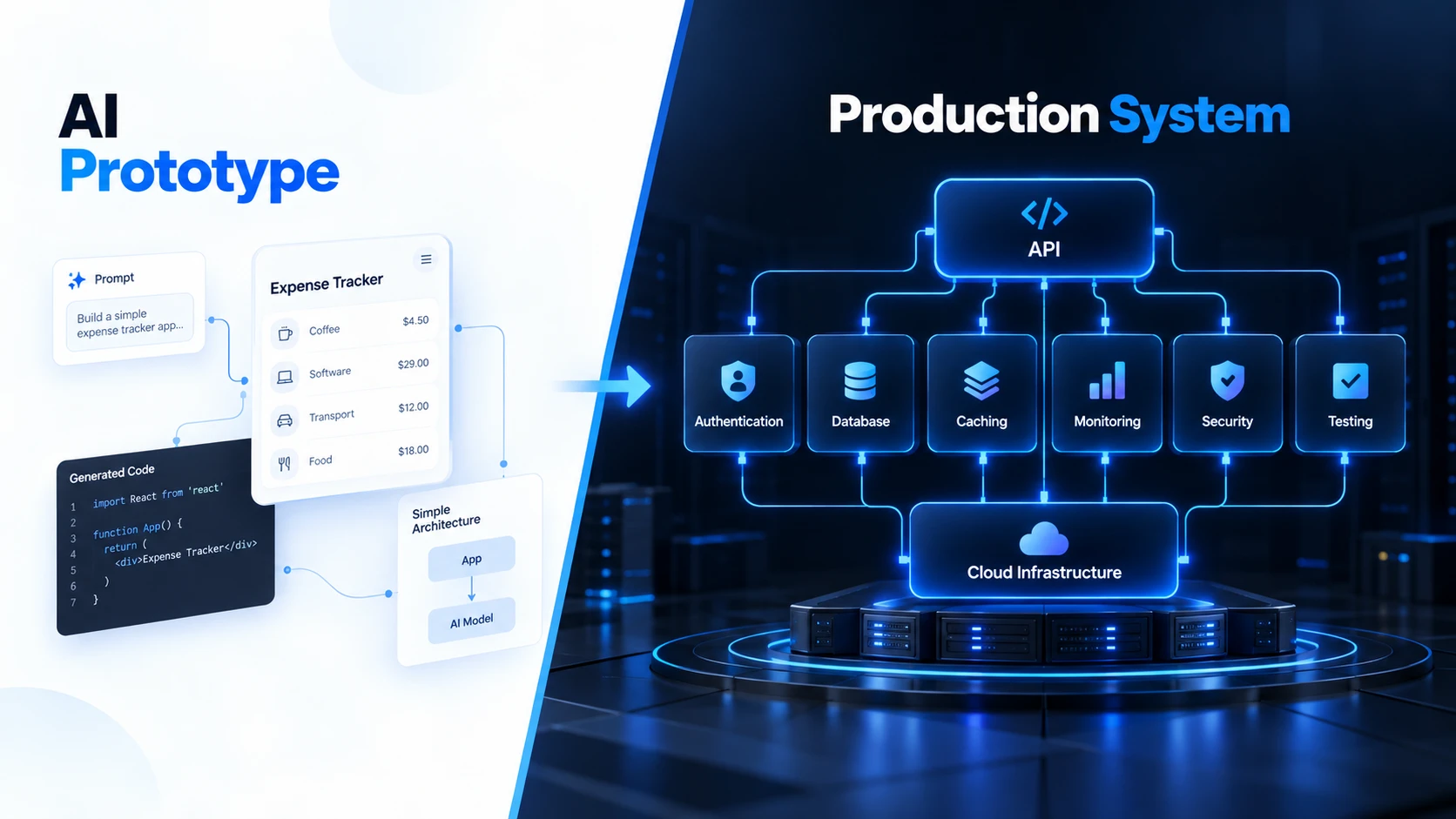
AI coding tools have changed how quickly a software idea can become something you can click, test, and show to customers. A founder can describe a product, generate screens, connect a database, add authentication, integrate APIs, and reach a working prototype much faster than traditional development workflows once allowed. That speed is valuable, especially when the goal is validating an idea before investing heavily in it.
The challenge begins when the prototype stops being an experiment. Real users arrive. Customer data enters the system. Payments may start moving. More developers need to work on the code. Traffic becomes less predictable, integrations fail, operating costs matter, and a small technical decision made during the first week can affect every feature added six months later. At that stage, the important question is no longer whether AI can generate the application. It is whether the application has been engineered to operate reliably as a real product.
Google Cloud has described a similar shift across software development: as AI makes code creation faster, more of the engineering bottleneck moves toward operating software securely, reliably, and at production scale. That distinction is important for founders because a successful prototype and a production-ready system solve different problems.
What Does “Production-Ready” Actually Mean?
A production-ready application is not simply an application that has been deployed to a server or approved by an app store. It is software that the business can reasonably depend on as customers, data, traffic, features, and development activity increase. That requires more than working screens and successful API responses.
Modern cloud architecture guidance usually treats production quality as a combination of several concerns rather than one technology decision. Security matters, but so do reliability, performance, operational visibility, cost, maintainability, and the ability to recover when something goes wrong. An application can be secure but impossible to scale, fast but difficult to maintain, or highly available while costing far more to operate than the business can justify.
For an AI-generated application, production readiness means taking whatever has already been built and evaluating it against those broader requirements. Some parts may already be good enough to keep. Others may need refactoring. A smaller number may need to be replaced completely. The goal should not be to punish the product for being AI-generated; the goal should be to understand what engineering it needs next.
1. Start With an Architecture and Codebase Audit
The first production engineering task should usually be understanding the application before making major changes. AI-assisted development can produce a surprising amount of code quickly, and that speed sometimes creates a codebase whose real architecture is different from the architecture the founder believes was created.
An audit should map how the user interface, backend, APIs, database, authentication, storage, external integrations, cloud infrastructure, and deployment process actually work together. It should identify where business logic lives, how data moves through the system, which services are trusted, where permissions are enforced, and which components create the greatest operational risk.
This is also why immediately rebuilding an AI-generated application is often the wrong first decision. A working prototype may contain useful interfaces, validated workflows, solid integrations, good database structures, and code that is perfectly reasonable to continue using. A proper review gives the team enough information to separate valuable work from technical debt.
If the application is already struggling with bugs, unsafe configuration, unclear ownership, or difficult changes, our guide to what happens after an AI-built app starts going wrong goes deeper into the takeover and cleanup process.
2. Create Clear Architectural Boundaries Before You Scale
One of the easiest ways to make an application difficult to maintain is to let business logic spread everywhere. A prototype may place important rules in the frontend, call databases directly from places that should go through a backend, duplicate the same logic across multiple screens, or tightly couple external services to core product functionality.
Those decisions may not matter much during the first demo. They matter considerably once several developers are changing the product and customers depend on consistent behavior. Production architecture should make it clear which part of the system owns authentication, business rules, data access, external integrations, asynchronous work, and user-facing presentation.
That does not mean every startup needs microservices, Kubernetes, event streaming, and an enterprise cloud architecture on day one. Overengineering a young product can be just as damaging as underengineering it. A well-structured monolith can support a significant product when the boundaries inside it are clear, while poorly designed microservices can create additional networking, deployment, debugging, and data-consistency problems.
The better question is whether the architecture makes the next stage of the product easier or harder. Can features be changed without touching unrelated systems? Can expensive tasks move into background processing when necessary? Can one integration fail without taking down the entire application? Can a future developer understand where a new business rule belongs? Production architecture should provide answers to questions like these without introducing complexity purely for appearance.
3. Treat Security as Architecture, Not a Final Checklist
AI can generate authentication screens, API endpoints, database queries, admin panels, and permission logic quickly. The existence of those features does not prove that the security boundaries between them are correct. Security needs to be reviewed as part of the architecture and the development lifecycle rather than something added immediately before launch.
OWASP's current guidance for AI-assisted coding reflects how much broader the risk surface has become. Modern coding agents can edit files, install packages, execute commands, interact with development tools, and modify configuration. That makes secure development about more than inspecting individual functions. Teams also need to understand dependencies, secrets, tool permissions, build pipelines, infrastructure configuration, and what access the development environment itself has.
Authentication and authorization are different problems
Authentication determines who the user is. Authorization determines what that user is allowed to see and do. An AI-generated application can successfully log customers in while still exposing another customer's records through a poorly protected endpoint or giving a standard account access to an administrative operation.
Production systems should enforce ownership, account boundaries, roles, and sensitive permissions on trusted backend layers rather than relying on what the interface happens to hide. This becomes particularly important in multi-role systems containing customers, vendors, employees, administrators, trainers, drivers, merchants, or other account types.
Secrets should not live inside the application code
Database credentials, API tokens, signing secrets, cloud keys, payment credentials, and private service accounts need appropriate secret management. They should not appear in frontend bundles, repositories, prompts, shared configuration files, or places where a coding agent receives broader access than it requires.
Dependencies also become part of the security boundary
AI coding tools can add packages with very little friction. Every package becomes another component the product depends on, so teams should understand why it exists, whether it is maintained, which version is installed, and whether known vulnerabilities or unnecessary privileges are involved. Production engineering means owning the dependency graph rather than accepting every generated installation command as permanent architecture.
These concerns become even more important in products working with highly sensitive information. For example, healthcare and wellness applications may handle personal data where weak permissions, excessive logging, insecure storage, or poorly controlled integrations can have much higher consequences than the same mistake in a simple content application.
4. Design Scalability Around Real Usage, Not Hypothetical Millions
Scalability is often misunderstood as preparing an application for millions of users from the first release. That can lead founders toward unnecessary infrastructure, complexity, and cost. A better approach is to understand how the system behaves today, estimate the next realistic stage of growth, identify which components are likely to become bottlenecks, and create clear paths for increasing capacity as demand changes.
There are several different forms of scale to consider. Application servers may need to handle more concurrent requests. Database queries may become slower as records accumulate. File storage can grow independently from database usage. Expensive third-party API calls may need caching. Video, image, AI, reporting, or notification work may need to move out of synchronous requests and into queues or background workers.
Application scaling
Where appropriate, backend services should avoid unnecessary dependence on one server's local memory or file system. That makes it easier to run additional instances when traffic increases and reduces the chance that one machine becomes the product's permanent bottleneck.
Database scaling
Many scalability problems begin in the data layer rather than the application server. Missing indexes, inefficient queries, repeated requests for the same information, poor relationships, uncontrolled connections, and large unbounded operations can turn a database that performed well during testing into the slowest part of the product.
Workload scaling
Not every operation needs to happen while the user waits. Image processing, report generation, large imports, email delivery, notifications, AI processing, synchronization jobs, and other expensive tasks can often be moved into controlled background workflows. That makes the interactive parts of the application more predictable while providing the system with better control over bursts in demand.
Operational scaling
There is also a form of scalability that infrastructure diagrams often ignore: can the development team continue operating the product as it grows? A system is not truly scalable if only one person understands how to deploy it, every database migration is risky, production failures cannot be diagnosed, or developers are afraid to change existing features. Architecture needs to scale with the organization as well as the traffic.
5. Build for Failure, Not Only the Happy Path
Prototype development naturally focuses on proving that the main workflow succeeds. Production engineering also asks what happens when it fails. An external API can time out. A payment provider can return an unexpected state. A user can submit the same request twice. A database connection can disappear during an operation. A notification service can be unavailable even though the customer's core transaction succeeded.
A reliable application needs explicit behavior for those situations. Depending on the product, that can include sensible timeouts, controlled retries, idempotency for operations that must not run twice, queues for temporary failures, transaction boundaries, fallback behavior, backups, recovery procedures, and graceful degradation when a non-critical dependency becomes unavailable.
The important principle is that failure should be expected as part of normal software operation. Reliable architecture reduces the size and duration of those failures rather than assuming they will never happen.
6. Add Observability Before You Need It
A prototype can be debugged by opening a console and reproducing a problem manually. That approach stops working once real users are experiencing different devices, network conditions, workflows, accounts, and integrations. Production teams need enough visibility to understand what the application is doing without guessing.
Useful observability normally combines structured logs, error monitoring, application metrics, infrastructure health, performance measurements, and alerts for conditions that require attention. More complex distributed systems may also benefit from tracing requests across services. Product analytics answer a different set of questions by showing where users are succeeding or abandoning important workflows.
The objective is not to collect every possible metric. It is to make important product failures diagnosable. If a payment fails, an API becomes slow, a queue stops processing, login errors suddenly increase, or one deployment creates a new crash pattern, the team should be able to find evidence rather than depend on customer screenshots.
7. Introduce Testing That Protects the Product From Future Changes
An AI-generated application may pass a manual demo while having very little automated protection against regression. That becomes expensive once the product is being changed frequently because every new feature can unintentionally affect existing behavior.
Production test coverage should follow business risk rather than chasing a percentage for its own sake. Critical authentication, payment, booking, subscription, data ownership, marketplace, onboarding, or workflow logic deserves stronger protection than a cosmetic component with little business impact.
A practical testing strategy can combine unit tests for important logic, integration tests around databases and external services, end-to-end tests for critical user journeys, permission tests, API tests, and targeted load or performance testing when the expected traffic justifies it. Security scanning and dependency checks can then become part of the normal delivery process rather than an occasional manual task.
This verification layer becomes even more valuable as AI increases the speed at which teams can generate changes. Faster implementation is useful only when the organization can still determine whether those changes preserved the behavior the business depends on.
8. Separate Development From Production
A production system should not be treated like an extension of the developer's local environment. Development, staging, and production environments have different purposes, different data sensitivity, and different acceptable levels of experimentation.
A staging environment can provide a controlled place to validate migrations, integrations, release candidates, configuration, and critical workflows before exposing those changes to customers. Production credentials should remain isolated. Real customer data should not casually appear in development environments, and deployment permissions should be limited to the people and systems that actually require them.
This separation also makes AI-assisted development safer. Developers can continue benefiting from AI tools while reducing the chance that an experimental command, incorrect migration, generated script, or broad agent permission directly affects live customer systems.
9. Automate Deployment Without Removing Control
Manual deployment can be workable during the earliest prototype stage, but it becomes increasingly risky as releases become more frequent. Production delivery should make it clear what version is running, which tests were completed, which configuration is required, what changed in the database, and how the team can respond if the release causes an unexpected problem.
Continuous integration and deployment pipelines can automate builds, testing, static analysis, dependency checks, environment configuration, and deployments. Automation should not mean removing every approval or safety boundary. High-risk changes may still require deliberate review, and production access should remain controlled.
The objective is a repeatable release process. The business should not depend on one developer remembering a private sequence of terminal commands every time the application needs to change.
10. Make the Codebase Maintainable by Humans
One of the hidden risks of rapid AI development is not that every generated function is bad. It is that the codebase can accumulate many locally reasonable decisions without a consistent system-level structure. One feature may use one pattern, the next feature another. Similar logic can be duplicated. Naming conventions can drift. Components can become too large. Business rules can be spread across several layers.
The application may continue working while every new change becomes more difficult. Eventually the founder experiences the problem indirectly: estimates get longer, seemingly simple changes cause unexpected bugs, onboarding another developer becomes painful, and nobody is confident about which part of the system owns an important behavior.
Production engineering should therefore reduce unnecessary complexity, establish understandable boundaries, remove duplicated logic where useful, document important decisions, and create conventions future contributors can follow. The objective is not perfectly elegant code. It is code that the team can safely understand and extend.
11. If the App Also Uses AI, the AI Layer Needs Its Own Production Controls
There is an important distinction between an application that was built using AI and an application that also provides AI features to its users. If the product itself depends on language models, recommendation models, image generation, AI agents, or similar capabilities, additional production concerns appear.
AI output can be variable. Model providers can introduce latency or outages. Inference has an ongoing cost. Users can trigger unexpected inputs. Some requests may require business rules that the model cannot be trusted to infer independently. Production AI systems therefore need controls around model selection, prompts, validation, quotas, caching, monitoring, fallbacks, and the actions an AI system is allowed to perform.
Our ALIFF case study is a useful example of this distinction. The product includes AI outfit generation, but production implementation also required a modesty-rule layer, wardrobe processing, user feedback through accept, swap, and reject actions, AI quota management, caching, and streaming. The model is one component of the product; the surrounding engineering determines whether that intelligence behaves like a dependable feature.
12. Decide What to Keep, Refactor, and Rebuild
After the audit, architecture review, and risk assessment, the team needs to make one of the most important decisions in an AI-generated product: which existing work still deserves to be part of the production system?
Keep
Keep components that are understandable, appropriately structured, testable, secure enough for their role, and not creating unnecessary restrictions on the next stage of development. There is no benefit in replacing code simply because AI helped generate it.
Refactor
Refactor components where the underlying product decision is correct but implementation quality is creating risk. This may involve separating business logic, improving queries, tightening permissions, removing duplication, adding tests, improving error handling, or changing how a service communicates with the rest of the application.
Rebuild
Rebuild a component when preserving it would cost more, create more risk, or restrict the product more severely than replacing it. Examples can include unsafe authentication models, fundamentally unsuitable data structures, tightly coupled integrations that block required changes, or code that cannot be understood well enough to maintain safely.
This keep, refactor, or rebuild approach is more useful than assuming either extreme. “Never rebuild” can preserve dangerous technical debt, while “rebuild everything” can throw away weeks or months of validated product work.
A Practical Production-Readiness Checklist
Before an AI-generated application becomes a serious production product, founders should be able to answer the following questions with confidence. Not every system needs the same level of sophistication, but unanswered questions in these areas should be deliberate rather than accidental.
- Architecture: Do we understand how the frontend, backend, database, infrastructure, integrations, and business logic fit together?
- Authentication: Can we reliably identify users and services?
- Authorization: Can each user access only the data and actions appropriate to their role?
- Data: Is the data model reliable, validated, backed up, and capable of supporting expected growth?
- Secrets: Are credentials and private keys stored and accessed safely?
- Dependencies: Do we understand the packages and external services the product depends on?
- Scalability: Do we know which components are likely to become bottlenecks at the next realistic level of usage?
- Reliability: What happens when a payment, API, database connection, queue, AI provider, or other dependency fails?
- Testing: Are critical user and business flows protected against regression?
- Observability: Can we identify and investigate production failures?
- Deployment: Is there a controlled, repeatable process for releasing changes?
- Recovery: Do we have backups, rollback options, and a plan for significant failures?
- Maintainability: Can a new engineer understand and safely extend the system?
- Ownership: Does the development team understand and take responsibility for the code, even when AI generated part of it?
When Should You Harden an AI-Generated App?
The answer is usually before the cost of getting it wrong becomes large. A prototype used internally by a founder can tolerate risks that would be unacceptable once hundreds of customers depend on it. The right level of engineering should increase as the business impact increases.
A production-readiness review is particularly valuable before launching publicly, accepting payments, storing sensitive information, onboarding important customers, substantially increasing traffic, hiring additional developers, raising investment based on the product, or investing months into the next feature roadmap. These are transition points where hidden architectural problems become more expensive to discover later.
The mistake is waiting until scaling problems appear before thinking about scalability, or waiting for a security incident before reviewing access control. Production engineering is most effective when it happens just before the product's risk profile changes, not months after.
AI Did Not Remove the Need for Software Engineering
AI has made building software faster, and that is a meaningful improvement. Founders can test ideas earlier, developers can automate repetitive work, and teams can explore more solutions before committing to one. None of those benefits require pretending that generated software automatically arrives with the architecture, security, testing, operational controls, and long-term maintainability required by a growing product.
The role of engineering is shifting accordingly. When code becomes easier to generate, architectural judgment, verification, security boundaries, reliability, observability, and technical ownership become more important rather than less. The question is not whether humans or AI typed the individual lines. The question is whether someone understands the system well enough to be responsible for what those lines do in production.
For founders, that leads to a practical approach: use AI to move quickly when speed creates value, then introduce the engineering discipline appropriate to the next stage of the business. Audit what already exists. Preserve what is solid. Refactor what can be improved. Replace only what truly needs replacing. Then add the security, scalability, testing, monitoring, and operational foundations the product needs to grow.
Your Prototype Does Not Need to Stay a Prototype
If you already have a working AI-generated application, you may be much closer to a real product than starting from scratch. The next step is understanding what is safe to keep and what must change before more users, data, traffic, and features are added.
Next Level Software works with existing applications that are stalled, difficult to extend, poorly structured, or generated quickly with AI tools and now need production engineering. Our Fix Your App service starts with the existing product rather than assuming a rewrite, then identifies what should be preserved, refactored, secured, or rebuilt.
If your AI-generated application works but you are uncertain about its architecture, security, scalability, or readiness for real customers, talk to our team about the product you already have. The first useful question is not “How quickly can we rebuild it?” It is “What does this application actually need to become production-ready?”
Keep reading

How iPhone Duo Resolution Changes Responsive Mobile App and Website Design
The iPhone Duo moves between compact and tablet-like displays, changing how apps and websites should handle layouts, safe areas, images, breakpoints, and performance.
Abdullah · · 12 min read
Top Things to Consider When Approaching a White Label Mobile App Development Service
Choosing a white label mobile app development service affects more than your development budget. Here is what to evaluate before trusting another team with a product that will carry your brand.
Khubaib Rasheed · · 9 min read
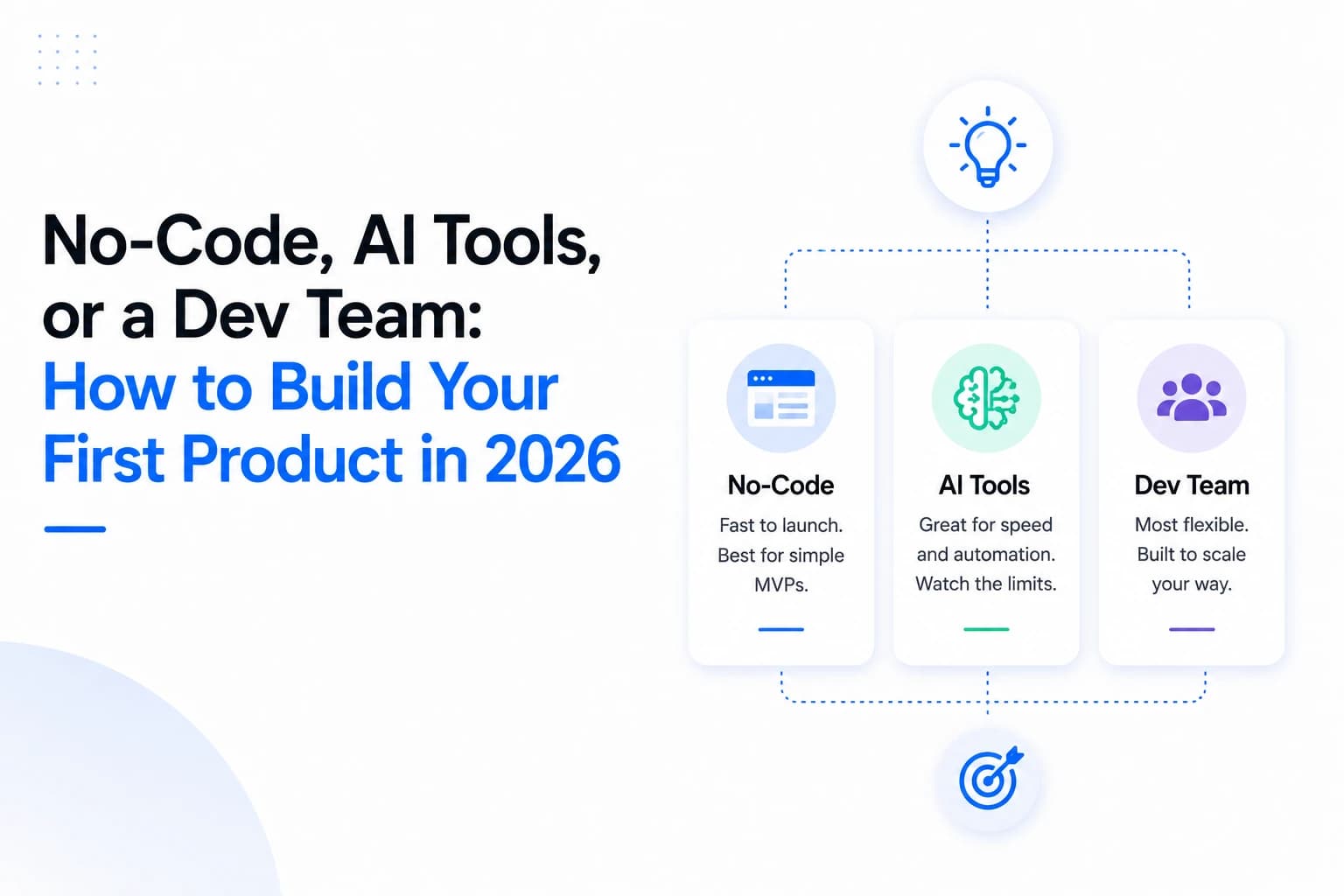
No-Code, AI Tools, or a Dev Team: How to Build Your First Product in 2026
No-code, AI coding tools, and development teams can all be valid ways to build an MVP in 2026. The right choice depends on what you need to learn, how complex the product is, how much technical risk you can accept, and what you plan to build next.
Abdullah · · 13 min read