No-Code, AI Tools, or a Dev Team: How to Build Your First Product in 2026
A practical guide for non-technical founders choosing between no-code, AI-assisted tools, and professional MVP development.
Sections
If you are a first-time founder without a technical background, the hardest part of building an MVP may not be finding someone to build it. It may be deciding how it should be built.
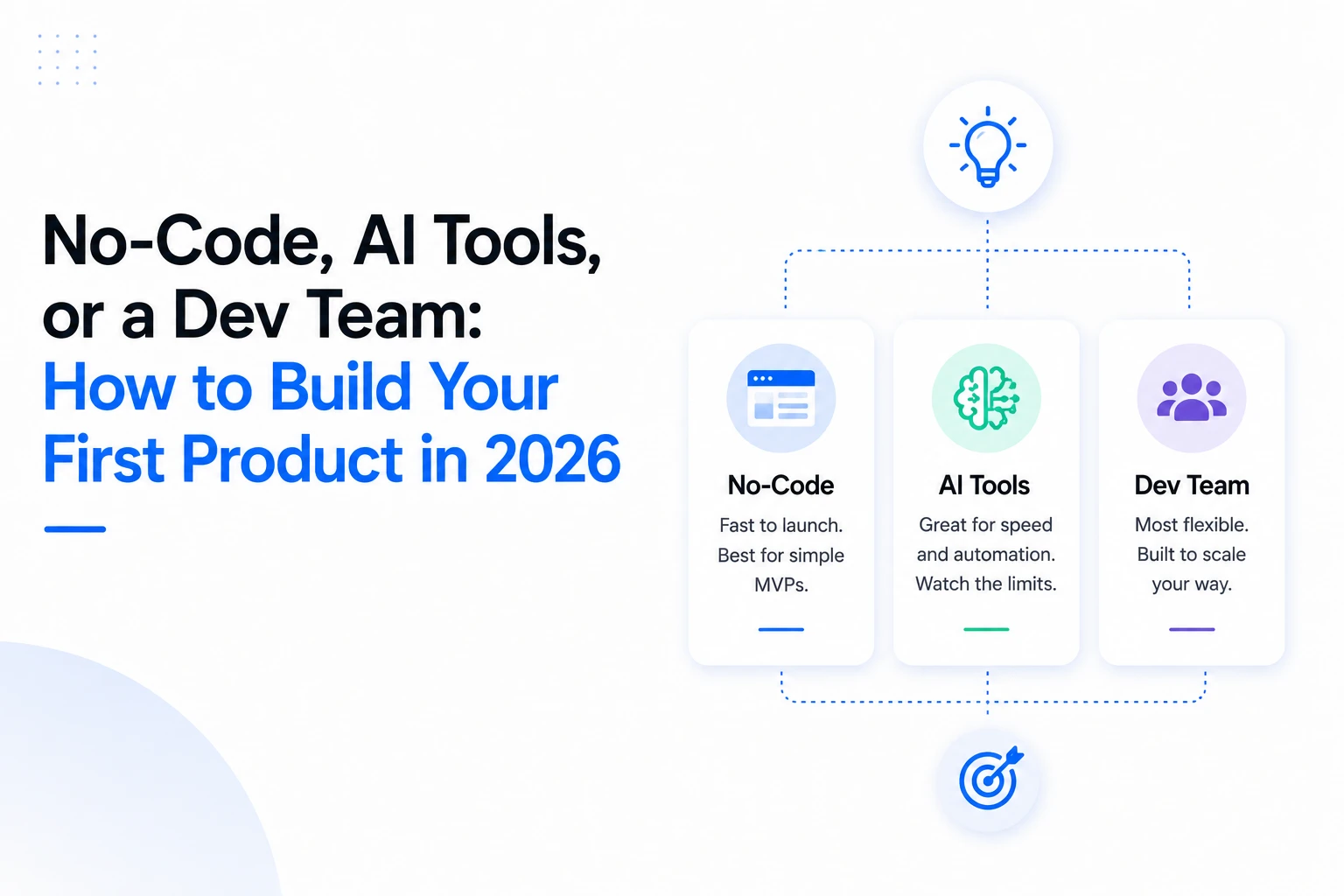
In 2026, you have more options than before. You can build with a no-code platform, use an AI coding tool to generate much of the application, or hire a development team to build the product for you.
All three can work. The mistake is assuming that one option is always cheaper, faster, or better.
The right choice depends on what you are trying to prove, how complex the product is, who will maintain it, and what happens if the MVP succeeds.
First, decide what your MVP needs to prove
An MVP should answer an important business question with a real product.
Maybe you need to find out whether customers will pay for a service. Maybe you need to test a new marketplace workflow. Maybe you need to prove that an AI feature can solve a specific problem.
That decision should come before the technology choice.
Write down four things:
Who is the first user?
What problem does the product solve?
What is the one workflow that delivers the main value?
What do you need to learn after people use it?
If you cannot answer these questions, choosing between Bubble, an AI coding tool, or a development team is premature. You may still be defining the product.
The three ways to build an MVP in 2026
For a non-technical founder, there are three practical routes.
No-code: assemble the product using visual tools and pre-built components.
AI-assisted development: use AI coding tools to generate and modify software with your direction.
A development team: work with developers who handle the technical implementation while you own the product decisions.
These options are not completely separate. A founder may use no-code to test an idea, use AI tools to explore a prototype, and later bring in developers when the product needs stronger engineering.
When no-code is genuinely the right choice
No-code gets dismissed too easily because people often compare it with products that need much more technical control.
For a simple MVP, no-code can be a sensible choice.
It can work well when the product mainly involves forms, basic workflows, dashboards, simple databases, content, or straightforward marketplace interactions. If your goal is to test whether people understand and use the core idea, you may not need a custom codebase on day one.
No-code is particularly useful when:
You have a very limited budget.
The workflow is relatively simple.
You need to test the idea before making a larger investment.
You can accept the platform's limits.
You are comfortable managing some of the product yourself.
There is nothing wrong with using a no-code tool for validation. The important question is whether you understand what you are buying into.
The cost of choosing no-code
The first invoice is not the full cost of a technology decision.
A no-code platform may reduce your initial development work, but you are also accepting its database structure, integrations, hosting model, feature limits, pricing, and rules.
That may be fine while the product is small.
The problem starts when the business grows beyond what the platform was designed to handle. You may need custom integrations, more control over the data, better performance, more complex permissions, or features the platform cannot support.
At that point, moving away from no-code can involve more than exporting your content. Depending on the platform and product, the application logic, workflows, integrations, and user experience may need to be rebuilt.
This is the part founders often miss when comparing a low initial build cost with custom development. The cheaper option is only cheaper if it remains suitable for the product you eventually need.
When AI coding tools make sense
AI coding tools have changed what a non-technical founder can do alone.
You can describe a screen, workflow, or feature in normal language and get working code in return. That makes AI tools useful for exploring an idea, creating a prototype, testing a user flow, or learning what is technically possible.
They are especially useful when you want to move quickly and you are willing to stay hands-on.
But generated code is still software that needs to be understood, tested, secured, deployed, and maintained.
A prototype can look finished while important parts of the product are still fragile. Authentication edge cases, data handling, permissions, third-party integrations, deployment, error handling, and security are not solved simply because the application runs on your screen.
AI tools are excellent at the first version
The strongest use of AI coding tools for many founders is exploration.
You can use them to turn an idea into something tangible. That can help you show the concept to potential users, test a workflow, and discover what needs to change before spending more money.
They can also help a founder communicate with a development team. A working prototype can make the intended experience easier to discuss than a written description alone.
The risk comes when a prototype becomes the production product without anyone checking what is underneath it.
If customers are going to trust the application with personal information, payments, business data, or important workflows, technical review becomes much more important.
When you should hire a development team
A development team becomes more useful when the product has requirements that are difficult to manage through a visual platform or generated code alone.
This can include:
Complex business logic.
Several third-party integrations.
Custom backend services.
Mobile applications that need reliable device behaviour.
Detailed user roles and permissions.
Products that need to support a growing user base.
AI features that depend on structured data and custom workflows.
Security or reliability requirements that cannot be treated as an afterthought.
The main benefit is not simply that someone else writes the code. A good development process also forces important technical decisions to be considered before they become expensive problems.
For founders who want a product that can become a longer-term business, MVP development can provide a more controlled path from product idea to a working release.
No-code vs AI tools vs a development team
There is no universal winner. Think about the decision this way.
Choose no-code when validation matters more than ownership
If you need to test a simple idea and your main question is whether people will use it, no-code can be enough.
You are deliberately trading some technical flexibility for speed and a lower starting cost.
Choose AI tools when you want to prototype and learn
If you enjoy experimenting and want to turn ideas into working screens or early prototypes yourself, AI coding tools can be useful.
They are also useful when you understand that a generated prototype may need engineering work before it becomes a dependable product.
Choose a development team when the product itself is the test
If users need a reliable application to test your business model, the quality of the product matters from the beginning.
A development team makes more sense when the MVP needs real authentication, data handling, integrations, custom workflows, or an architecture that can support the next stage.
What does MVP development cost in 2026?
There is no single MVP development cost in 2026 because the scope can be radically different from one product to another.
A simple no-code experiment may cost little beyond the tools and the founder's time. An AI-assisted prototype may also have a low initial cash cost, although it still creates a maintenance and technical review requirement if it becomes a real product.
A professionally developed MVP costs more because you are paying for engineering, product implementation, testing, deployment, and the ability to build around requirements that a platform may not support.
Published 2026 estimates show how wide the market can be. One current guide places production-grade MVPs in roughly the $30,000 to $85,000 range for lean and standard products, with more complex AI, real-time, or regulated products going higher. Another 2026 guide presents custom development estimates reaching $50,000 to $150,000 while positioning no-code and AI builders at much lower starting costs. These figures are useful for understanding the spread, not as fixed market prices or NLS pricing.
The more useful way to estimate your own budget is to define the core workflow first. Then price the actual product you need rather than comparing tools by their monthly subscription alone.
The hidden cost is often the second build
Suppose you build a simple no-code product and it proves that customers want it.
That is a good outcome.
But now you have a new problem. The product needs to handle more users, support new integrations, introduce better permissions, or add a feature the platform does not support.
If the original architecture cannot support those requirements, you may need to rebuild large parts of the product.
The same can happen with an AI-generated codebase that was created without a clear structure. The application may work, but changing it safely becomes difficult because nobody has a clear understanding of the underlying code.
This is why the cheapest way to build version one is not always the cheapest way to reach version two.
Build for the next decision, not the final product
This does not mean you should over-engineer an MVP.
You should not spend months designing infrastructure for a product that has not been tested.
The better approach is to build only what you need while avoiding decisions that make the next step unnecessarily expensive.
For example, if you know an AI feature may become important later, your MVP does not need every AI capability on day one. But it can be structured so that adding AI later does not require throwing away the whole product.
The same principle applies to payments, integrations, user accounts, data storage, and mobile or web expansion. You do not need to build every future feature. You do need to avoid making the current product impossible to extend.
What Smoove shows about planning for the next stage
Smoove is a useful example of why the initial architecture matters.
The project moved from a standalone AI-agent implementation to a fuller five-layer architecture with the AI agent and related services integrated into the main application. The project discussions also show that the AI layer had to deal with real issues such as model availability, API limits, data quality, fallback logic, and integration with existing application flows.
That is a useful lesson for founders. Adding AI later is easier when the first product has been structured with future capabilities in mind.
The goal is not to predict every future feature. It is to avoid building the MVP in a way that makes sensible future changes unnecessarily difficult.
What a non-technical founder should own
You do not need to become a developer to lead an MVP.
Your responsibility is to stay close to the product decisions.
Define the user and problem.
Decide what the MVP must prove.
Keep the scope under control.
Decide which features can wait.
Test the product with real users.
Define what a successful first release looks like.
The technical team can decide how the product should be implemented, which tools fit the requirements, and which technical risks need attention.
If the product requires custom architecture, integrations, or long-term flexibility, custom software development can be a better fit than forcing the product into a platform that was not designed for it.
A simple decision framework
Use these questions before choosing your build method.
Is the product simple? If yes, no-code may be enough.
Are you still testing the idea? If yes, a no-code or AI-assisted prototype may reduce the cost of learning.
Will real customers depend on it? If yes, think carefully about security, reliability, ownership, and maintenance.
Does the product need complex logic or integrations? If yes, custom development becomes more attractive.
Will AI be central to the product? If yes, consider the data, model integration, evaluation, fallback behaviour, and architecture before choosing the simplest build tool.
Do you expect the product to grow if the MVP works? If yes, make sure the first build does not create unnecessary migration costs later.
There is also nothing wrong with changing approaches. A founder can validate with no-code, learn from users, and then commission a properly engineered version. What matters is knowing that this transition may be a second build, not a simple export.
When an AI-first product needs more than AI tools
If AI is the main reason users will pay for the product, the engineering problem becomes more than generating a user interface.
You may need to manage model calls, prompts, structured data, user context, output validation, permissions, usage limits, fallbacks, and monitoring.
That is where an AI-assisted application approach can be useful. The AI should be part of the product architecture and workflow, not simply a feature pasted onto a prototype.
For products that require deeper AI systems or machine learning, AI and machine learning work may also be relevant.
What should you choose?
If your idea is simple and you only need to test demand, start small. No-code can be a perfectly reasonable decision.
If you want to experiment quickly and are comfortable getting hands-on with generated code, AI tools can help you learn and prototype faster.
If you need a real product that customers can depend on, especially when the product includes complex workflows, integrations, custom data, or important AI functionality, a development team is usually the safer choice.
The important question is not, “Which option is cheapest?”
Ask instead, “What is the cheapest way to learn what I need to learn without creating a problem I will have to pay to rebuild later?”
FAQs
Can a non-technical founder build an MVP without a developer?
Yes. No-code platforms and AI coding tools can help a founder create prototypes and, for some simple products, working MVPs. The more important question is whether the chosen approach can support the product's users, data, integrations, security, and future requirements.
Is no-code better than custom development for an MVP?
Not always. No-code can be the right choice for simple validation, especially when the goal is to test demand with limited investment. Custom development is more appropriate when the product needs technical flexibility, complex logic, custom integrations, or a foundation that can support future development.
Are AI coding tools good enough to build an MVP in 2026?
They can be very useful for prototypes and some small products. However, generated code still needs testing, security review, deployment, maintenance, and technical ownership. The closer the product gets to handling real users and important data, the more important professional engineering becomes.
What is the biggest hidden cost of no-code?
The biggest potential cost is migration. If the product succeeds and later needs capabilities the platform cannot support, you may need to rebuild workflows, integrations, data handling, and parts of the user experience.
How much does MVP development cost in 2026?
There is no standard price. A simple self-built or no-code validation product can have a low cash cost, while a professionally developed MVP can cost tens of thousands of dollars or more depending on scope. AI, real-time features, complex integrations, security requirements, and regulated workflows can increase the cost substantially.
Should I build for future features in my MVP?
You should not build every future feature before validating the product. However, you should avoid technical decisions that make likely future changes unnecessarily difficult. A focused MVP with a sensible foundation is usually a better balance than either extreme.
Final thought
In 2026, the barrier to creating an MVP is lower than it has been before. That is useful, but it also creates more choices for founders to navigate.
No-code is useful. AI coding tools are useful. Development teams are useful.
The best option depends on what you need the first product to prove and what happens if that test succeeds.
Start with the problem, keep the MVP focused, understand the trade-offs, and make sure the technology supports the next decision without forcing you into an unnecessary rebuild.
Keep reading
Top Things to Consider When Approaching a White Label Mobile App Development Service
Choosing a white label mobile app development service affects more than your development budget. Here is what to evaluate before trusting another team with a product that will carry your brand.
Khubaib Rasheed · · 9 min read
Adding AI to an App You Already Have
You do not need a new app to start using AI. Learn how to identify the right AI features, prepare your existing system, choose an integration approach, and roll out AI without disrupting the product your users already depend on.
Abdullah · · 11 min read
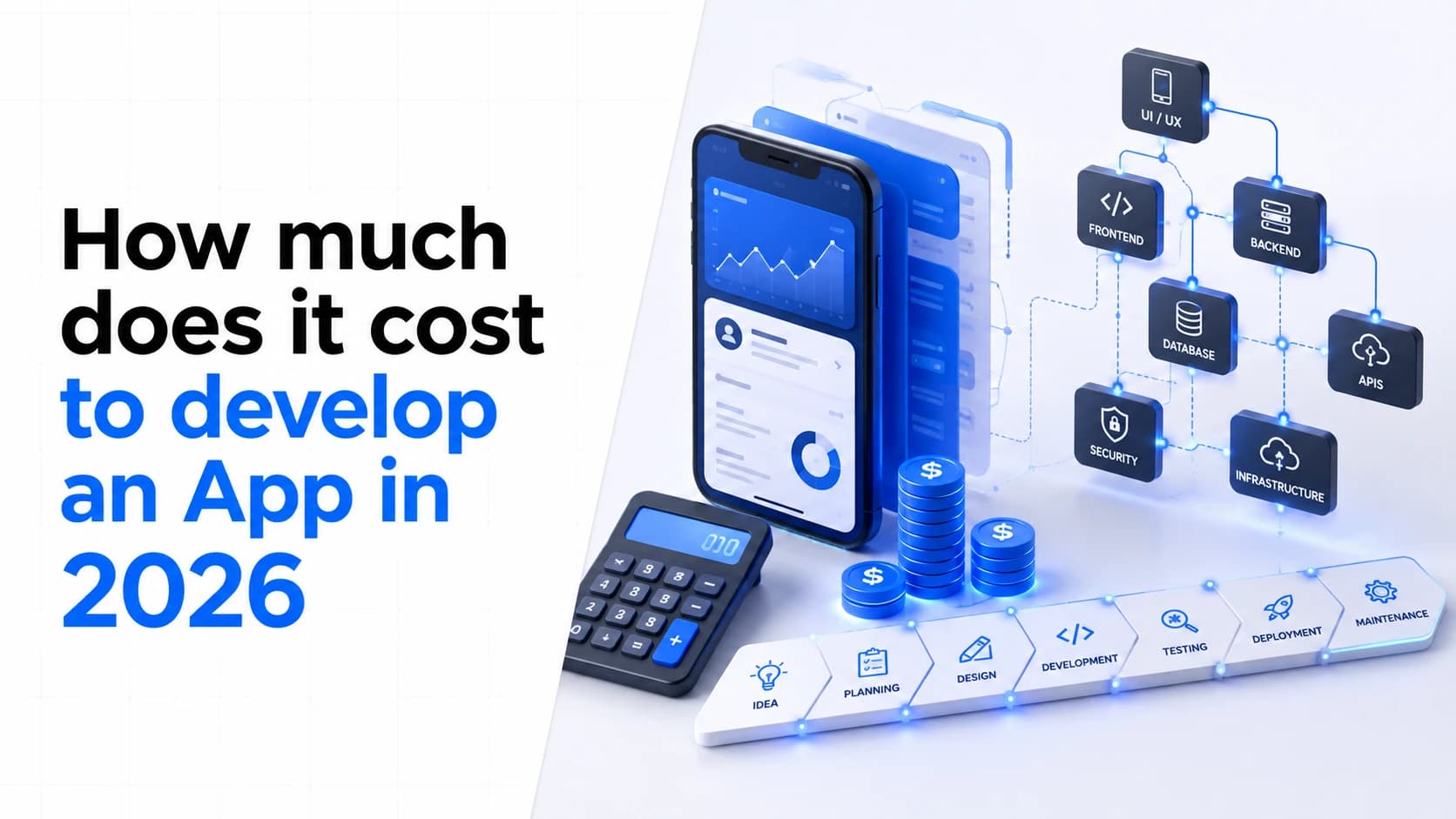
How Much Does It Cost to Develop an App in 2026?
App development costs vary widely because every product has a different scope. Learn what affects the cost of building an app and how to plan a realistic budget before development starts.
Abdullah · · 9 min read