How to Build a Ride-Hailing Application in 2026: Features, Cost & Development Guide
A practical guide to planning, designing, developing, and launching a ride-hailing platform with passenger and driver apps, real-time tracking, payments, and admin controls.
Sections
Building a ride-hailing application in 2026 involves much more than creating a mobile app where passengers can book a taxi. Behind every successful ride is a connected system managing driver availability, real-time locations, ride requests, fare calculations, payments, safety, and daily operations.
Applications such as Uber, Lyft, and other regional taxi platforms have made on-demand transportation a familiar service. However, building a new ride-hailing business does not mean recreating every feature these companies offer. For startups and transportation operators, the better approach is to identify a specific market problem and build a reliable platform around it.
In this guide, we explain how to build a ride-hailing app from planning to launch, which features matter most, what technology to use, how much development may cost, and what founders can learn from real ride-hailing software projects.
What Is a Ride-Hailing Application?
A ride-hailing application is a digital platform that connects passengers who need transportation with available drivers. Passengers request rides through their smartphones, while drivers receive booking requests, navigate to pickup locations, and complete trips.
Unlike a traditional taxi booking system that may depend on telephone calls or manual dispatchers, a ride-hailing platform can automate much of the booking process. It coordinates requests, driver assignments, route information, payments, notifications, and trip records through a central backend.
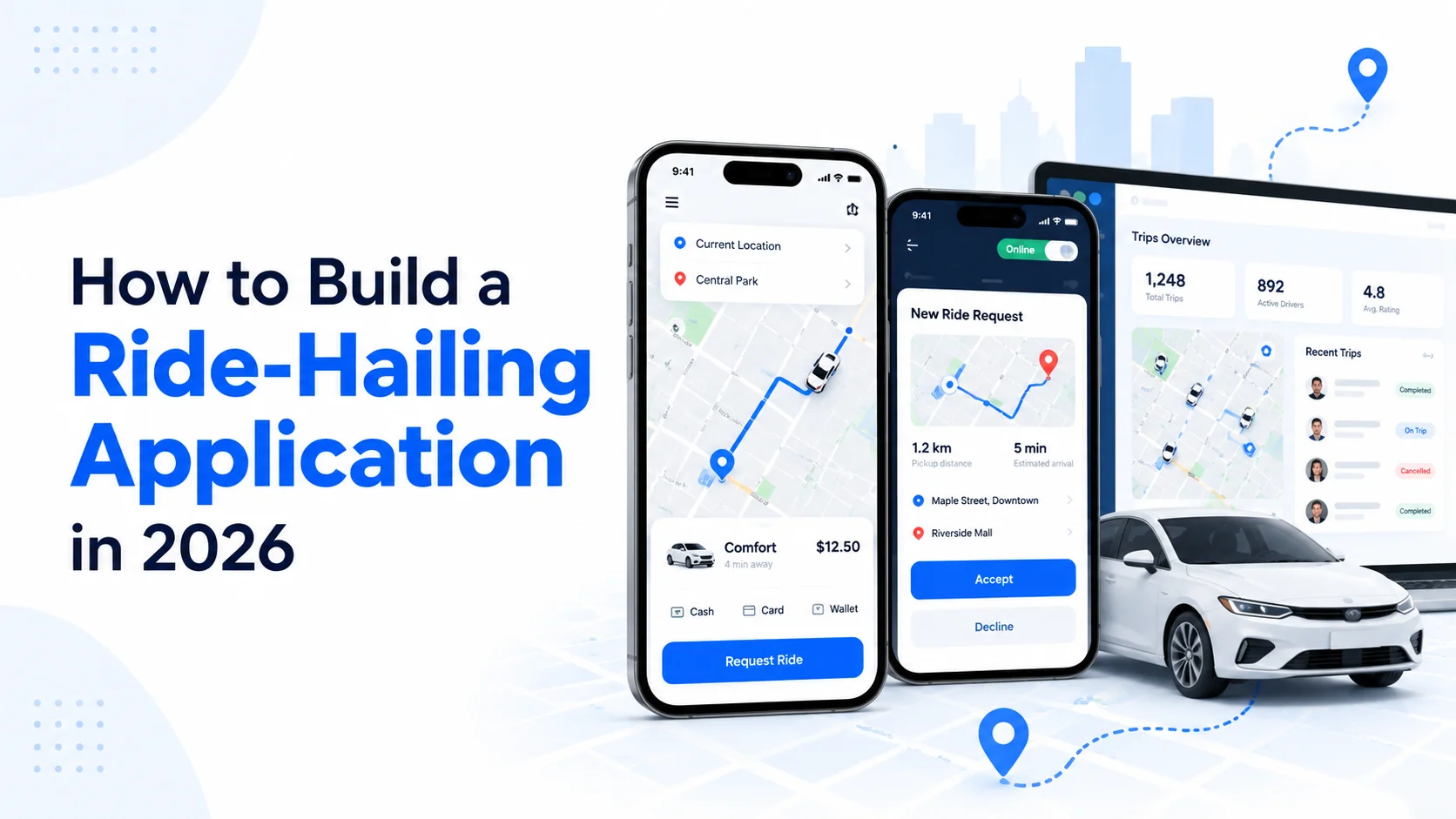
A typical ride-hailing platform consists of three connected products:
Passenger application: Allows customers to book rides, view fare estimates, track drivers, make payments, and manage their trips.
Driver application: Helps drivers receive requests, manage availability, navigate routes, track earnings, and complete rides.
Admin dashboard: Gives the business control over drivers, passengers, bookings, pricing, payments, complaints, and platform performance.
These products communicate through one shared backend. When a passenger requests a ride, the system identifies eligible drivers, sends the request, confirms the assignment, and updates both applications as the trip progresses.
Why Build a Ride-Hailing Application in 2026?
Ride-hailing is already a large and established part of the transportation industry. Uber's investor relations figures for the quarter ended June 30, 2026, reported approximately 42 million trips per day and 208 million monthly active platform consumers across its broader platform. Those numbers include activities beyond passenger ride-hailing, but they demonstrate the scale that app-based transportation and delivery services have reached.
For new businesses, the opportunity is not necessarily to compete with Uber across an entire country. Regional transportation gaps may create more practical opportunities for companies that understand the needs of a particular city, customer group, or driver network.
For example, a transportation business might focus on airport transfers, corporate transportation, women-focused ride services, scheduled rides, university transportation, or licensed taxi fleets. These business models may require different booking workflows, pricing rules, verification methods, and operational controls.
However, strong technology alone does not guarantee success. A ride-hailing business must also attract drivers and passengers in the same areas, maintain acceptable pickup times, manage transportation regulations, and establish a sustainable revenue model.
Step 1: Define Your Ride-Hailing Business Model
Before choosing a technology stack or hiring developers, decide exactly how your transportation business will operate. The business model affects the application's features, backend architecture, payment systems, and development budget.
Choose the Type of Ride-Hailing Platform
There are several models worth considering:
On-demand taxi booking: Passengers request immediate rides from nearby available drivers.
Scheduled transportation: Customers book trips in advance for airports, business meetings, or planned journeys.
Fleet-based transportation: A taxi or vehicle operator manages its own drivers and vehicles through a central platform.
Driver marketplace: Independent drivers join a platform that connects them with passengers.
Specialized transportation: Services designed for a defined audience or vehicle category, subject to local regulations.
Next, decide how the platform generates revenue. Common options include commissions on completed trips, booking or service fees, subscriptions for fleet operators, and contracted transportation services.
Pricing can also vary. Some platforms calculate fares automatically using distance, time, and applicable pricing rules. Others allow negotiated or quoted fares. These decisions must be made early because pricing and matching rules influence the system's design.
Step 2: Identify the Essential Ride-Hailing App Features
One of the biggest mistakes when developing a ride-hailing application is building too many features before testing the core booking experience. A focused first release should allow passengers to request rides, drivers to accept them, and administrators to manage the entire process safely and reliably.
Passenger App Features
Registration and login: Account creation through phone number, email, or supported authentication providers.
Pickup and destination selection: Map-based location selection with address search and manual corrections.
Fare estimation: Estimated trip cost before booking, with clear pricing conditions.
Ride booking: A simple workflow for requesting and confirming transportation.
Driver assignment: Driver details, vehicle information, and estimated arrival time.
Live ride tracking: Map updates showing the assigned driver's location during relevant trip stages.
Payments: Cash, card, or other locally supported payment methods.
Trip history: Previous bookings, receipts, and completed ride information.
Ratings and support: Driver feedback, complaint reporting, and access to assistance.
Driver App Features
Driver onboarding: Registration, identity verification, and document submission.
Availability controls: Online and offline status for receiving ride requests.
Incoming ride requests: Clear information about pickup location, estimated journey, and applicable earnings.
Ride acceptance: Accepting or declining requests under the platform's dispatch rules.
Navigation: Directions to pickup and destination locations.
Trip status management: Arrival, passenger pickup, ride start, and completion.
Earnings dashboard: Completed trips, driver earnings, commission deductions, and payout status.
Notifications and support: Operational alerts and help with trip-related issues.
Admin Dashboard Features
Passenger and driver account management
Driver verification and approval
Real-time trip and booking oversight
Fare configuration and service area management
Commission and payout management
Refund, complaint, and dispute workflows
Reporting and operational analytics
Role-based access for support and operations teams
The admin dashboard should not be treated as an optional feature. Transportation businesses need visibility into failed bookings, unavailable drivers, payment disputes, and operational problems without depending on developers for routine decisions.
Step 3: Choose the Right Technology Stack
The technology stack determines how the ride-hailing application handles mobile interfaces, data management, real-time communication, location tracking, and integrations. There is no single stack suitable for every transportation business, but several technologies are commonly used for scalable mobile platforms.
ComponentTechnology OptionsPurposeMobile applicationsFlutter, React Native, Swift, KotlinPassenger and driver applicationsBackendNode.js, NestJS, Java, GoBooking, dispatch, and business logicDatabasePostgreSQL/PostGIS, MongoDBUsers, trips, drivers, and location-related dataReal-time communicationWebSockets, Socket.ioLive tracking and trip status updatesCaching and temporary stateRedisDriver availability and fast state lookupsMaps and routingGoogle Maps Platform, MapboxLocation search, directions, and ETA calculationsPaymentsStripe Connect or local providersPayment collection, commissions, and payoutsNotificationsFirebase Cloud Messaging, Apple Push Notification serviceRide requests and booking alertsInfrastructureAWS, Google Cloud, AzureHosting, storage, monitoring, and deployment
Flutter vs. Native Development
Flutter can be a practical choice for startups that need passenger and driver applications on both iOS and Android. A shared codebase can reduce duplicate interface development and help teams maintain consistent functionality across platforms.
Native development with Swift and Kotlin may be suitable when a product requires extensive platform-specific functionality or has existing native engineering teams. Neither approach eliminates the need for careful testing of GPS tracking, permissions, battery usage, and background behavior.
The final technology decision should consider the team's experience, expected number of users, available budget, required integrations, and long-term maintenance plans.
Step 4: Design the Real-Time Ride-Matching System
The ride-matching system is one of the most important parts of a ride-hailing application. It connects a passenger's booking request with a suitable available driver while handling competing requests, driver responses, cancellations, and changing locations.
A typical ride request follows this process:
The passenger enters a pickup point and destination.
The backend calculates an estimated fare and available ride options.
The passenger confirms the booking request.
The system identifies eligible drivers within the service area.
The dispatch engine selects candidates using availability, location, estimated pickup time, and business rules.
A driver receives the request and accepts it.
The backend confirms the assignment and updates both applications.
The driver navigates to the passenger, completes the journey, and finalizes the trip.
Several problems must be handled carefully. A driver may receive multiple requests at nearly the same time. Two drivers may attempt to accept the same booking. GPS information may become outdated, or a passenger may cancel while dispatch is still running.
A reliable backend should use controlled trip states, atomic driver assignment, request expiration, retry logic, and idempotent operations to prevent duplicate bookings or inconsistent trip records.
For an MVP, a rule-based dispatch system that considers eligibility and estimated arrival time is often sufficient. More advanced matching algorithms can be introduced after the platform has enough operating data to evaluate improvements.
Step 5: Implement GPS Tracking, Maps, and Navigation
GPS and mapping services are central to a ride-hailing application's user experience. Passengers want to know where their driver is and when the vehicle will arrive. Drivers need dependable directions and accurate pickup information.
Google Maps Platform and similar providers offer APIs for location search, routing, distance estimation, and travel-time calculations. Developers can combine these services with their own backend and real-time communication layer to maintain ride status and share driver locations.
However, real-time tracking requires more than repeatedly requesting GPS coordinates. The application must handle weak network connectivity, delayed updates, mobile operating system restrictions, inaccurate locations, and battery consumption.
Driver location updates should be collected only when necessary, transmitted securely, and adjusted to the current operational state. For example, tracking requirements may differ when a driver is offline, waiting for bookings, approaching a passenger, or completing an active trip.
Map API costs also require planning. Google Maps Platform uses usage-based pricing across services such as Routes, Places, and Maps. Its Routes API can charge by request or route-matrix element, depending on the service used. Unnecessary route calculations can therefore become an avoidable operating expense as usage increases.
Step 6: Build Secure Payments and Driver Payouts
Ride-hailing payments are more complex than a typical online checkout because the platform may collect a fare, retain a commission, pay a driver, process refunds, and reconcile transactions across multiple parties.
The payment architecture should account for both digital and cash-based trips where supported. Digital payments might involve authorization, capture, refunds, platform fees, and driver transfers. Cash payments require different accounting workflows because the driver may receive the money directly while still owing a platform commission.
Stripe Connect is one example of a platform payment solution supporting connected accounts, payment routing, commissions, and payouts. However, provider availability, supported features, licensing requirements, and settlement rules differ by country.
For founders launching in regional markets, payment provider selection should happen during product planning rather than near the end of development. A platform that supports the wrong payment methods can struggle even when its booking experience works correctly.
Financial records also need careful engineering. Payment events should be processed idempotently, transaction statuses reconciled against provider records, and refund or payout failures made visible to administrators. Any stored-value wallet must be reviewed separately for potential financial regulatory requirements.
Step 7: Prioritize Passenger Safety, Driver Verification, and Privacy
A ride-hailing application operates in the physical world. The platform's responsibilities extend beyond software performance because passengers and drivers interact in person, often without knowing each other beforehand.
Safety features should be planned from the beginning. Depending on the operating market, these may include driver identity checks, vehicle document verification, emergency assistance options, ride sharing with trusted contacts, trip-related support, and reporting mechanisms.
Driver onboarding may also require checks of commercial licenses, insurance, driving records, vehicle eligibility, and other jurisdiction-specific documents. The software can support collection, approval, expiry reminders, and record management, but regulatory compliance depends on the actual transportation business and local rules.
Location privacy deserves particular attention. Google Play restricts background location access to situations where it is necessary for important application functionality and requires suitable disclosure and review. Apple's location framework also requires appropriate user authorization and careful handling of background updates.
Developers should apply data minimization, secure transmission, role-based access, appropriate retention policies, and restricted administrative visibility. A passenger's location should not remain available to unrelated drivers or staff after it is no longer required for the service.
Step 8: Test the Complete Ride Experience
Testing a ride-hailing platform requires more than checking whether individual screens work. The most serious failures often happen when multiple users interact with the same booking or when devices lose connectivity during a trip.
Important scenarios include a driver accepting a ride just before a timeout, the passenger cancelling after assignment, a payment succeeding while the application loses network access, and two drivers competing for the same booking. The application should also recover correctly when it is reopened after being closed during an active journey.
Testing should cover functional workflows, automated backend tests, real-device GPS behavior, payment-provider sandbox cases, permission handling, security checks, and load tests for peak booking periods. Administrators should also be able to resolve interrupted trips and investigate incorrect charges through documented operational procedures.
A controlled pilot with real drivers and a limited service area can expose operational problems that ordinary testing environments do not reveal.
Step 9: Launch an MVP Before Expanding
A Minimum Viable Product, or MVP, should support one complete transportation workflow instead of offering many partially developed features. Its purpose is to test whether riders can consistently find available drivers, complete rides, and use the service again.
A practical first release might include passenger and driver registration, verification, ride requests, basic automated matching, fare estimates, live trip status, one or two payment methods, notifications, and an admin dashboard.
Features such as advanced surge pricing, loyalty programs, multi-stop rides, ride pooling, subscription packages, sophisticated demand prediction, and large multi-city management can be evaluated after the core service has been tested.
Launching in one geographic area can also simplify driver onboarding and operational support. It allows the business to measure actual pickup times, booking completion rates, driver utilization, passenger complaints, and the cost of acquiring active users.
Teams should prioritize marketplace liquidity: enough suitable drivers must be available when and where passengers request transportation. A technically complete application without dependable driver supply will struggle to deliver a good customer experience.
How Much Does It Cost to Build a Ride-Hailing App in 2026?
The cost of ride-hailing app development depends on the number of products, supported platforms, dispatch complexity, payment methods, administrative workflows, security requirements, and target countries.
For early budgeting, the following are illustrative custom-development planning ranges in US dollars. They are not audited industry averages or binding quotes, and actual proposals can fall outside these ranges.
Development ScopeIllustrative BudgetWhat It CoversLimited pilot / basic MVP$15,000–$30,000Core booking workflows, simplified dispatch, driver app, basic admin functions, limited integrationsProduction-focused ride-hailing MVP$30,000–$60,000Passenger and driver apps, live tracking, fare calculation, payments, verification, and operational dashboardAdvanced multi-market platform$60,000–$150,000+More complex dispatch, flexible pricing, multiple markets, enhanced payments, analytics, and advanced controls
These estimates assume custom software development rather than purchasing an existing white-label platform. Costs can change significantly with engineering location, integrations, compliance requirements, performance targets, and the depth of testing required.
Next Level Software's published iTaxi MX project page indicates that a production ride-hailing MVP typically starts around $30,000 with its team. A detailed estimate should still be based on a written feature scope, market requirements, and technical assessment.
What Are the Ongoing Costs?
Development is only one part of the total cost of operating a ride-hailing platform. Businesses should also plan for cloud hosting, database and storage services, map API usage, SMS verification, payment processing fees, monitoring, customer support, maintenance, and security updates.
Some expenses grow with activity rather than simply with the number of registered users. For example, repeated routing requests, payment transactions, and driver location events can create usage-based costs as the service becomes busier.
Before launch, founders should model the financial performance of an individual trip, including fare revenue, driver compensation, platform fees, payment costs, discounts, support expenses, and any applicable taxes. A growing number of rides is not the same as a profitable business.
How Long Does Ride-Hailing App Development Take?
A focused ride-hailing MVP may require approximately three to five months, while a more complex multi-role platform can take six months or longer. These are planning estimates rather than guaranteed delivery timelines.
Development generally includes discovery and requirements planning, UI/UX design, backend and mobile development, integration work, quality assurance, and launch preparation. Some activities run in parallel, but critical workflows such as dispatch, tracking, and payments still require end-to-end integration and testing.
The timeline becomes easier to manage when founders approve a defined first-release scope, choose supported payment providers early, and separate essential functionality from future improvements.
Real Project Example: How Next Level Software Built iTaxi MX
Understanding the architecture of a real product is useful when deciding how to build a new transportation application. At Next Level Software, our experience includes iTaxi MX, a ride-hailing platform developed for the Mexican market.
The project required more than a basic taxi booking interface. Passengers needed booking, fare visibility, driver tracking, and payment options. Drivers needed a separate application for receiving requests, navigating trips, and monitoring earnings. The operating business needed a dashboard to supervise users, bookings, payments, and disputes.
Three Products Connected Through One Backend
The platform was structured around three products: a passenger app, a driver app, and an administrative web panel. Both mobile applications were developed using Flutter, while the shared backend handled the interactions between the different user roles.
The implementation used Node.js and Express for backend services, MongoDB for data storage, and Socket.io for real-time communication. Firebase supported notifications, while cloud infrastructure supported the deployed application.
Live communication enabled driver location and trip status updates between the applications. The platform also integrated Stripe and Intercash for payment-related workflows, addressing market-specific payment requirements rather than assuming that one payment method would serve every user.
What the Project Demonstrates
The iTaxi MX case study reports that the passenger and driver applications launched on iOS and Android, supported by the admin platform. It also reports a 4.6-star passenger rating on the App Store at the time documented in the case study.
The main lesson is architectural: a ride-hailing business needs connected passenger, driver, payment, and operational workflows. Building these systems around a shared backend helps keep trip records consistent and provides a foundation for introducing additional capabilities over time.
For founders considering a similar project, the iTaxi MX ride-hailing case study demonstrates how separate user applications and central business controls can work together as one transportation platform.
Common Mistakes to Avoid When Building a Ride-Hailing App
1. Copying Every Uber Feature
Large ride-hailing companies have invested in extensive operational systems over many years. A startup does not need every feature to prove that its business model works. Prioritize reliable ride booking, dispatch, tracking, payments, and support before adding advanced capabilities.
2. Ignoring Driver Acquisition
A passenger application has limited value when drivers are unavailable. Driver onboarding, earnings transparency, incentives, availability management, and local fleet relationships should be part of the business strategy, not left until after the app launches.
3. Choosing Payments Too Late
Different countries have different payment preferences and provider availability. Delaying this decision can force major changes to checkout, commission handling, driver onboarding, and accounting workflows.
4. Underestimating Real-Time Complexity
A live map may appear straightforward, but reliable location updates, dispatch decisions, network interruptions, and booking state synchronization require careful backend design. These components should be tested under realistic operating conditions.
5. Launching Without Administrative Controls
When a driver disputes a payment or a passenger reports an issue, operations staff need access to accurate trip information and clear resolution workflows. Without a proper dashboard, the business can become dependent on manual database changes or developer intervention.
6. Expanding Before Validating One Market
Operating across multiple cities increases driver supply requirements, support complexity, pricing configurations, and regulatory obligations. Proving the service in a limited area usually provides more useful operating data than launching across a large geography immediately.
Should You Build Custom Ride-Hailing Software or Use a Clone Script?
Some businesses choose prebuilt taxi booking software or Uber-style clone scripts to reduce initial development costs. These products may provide a faster starting point when their existing workflows closely match the intended business model.
However, the lower initial price does not automatically mean a lower long-term cost. Founders should investigate source-code ownership, customization restrictions, security maintenance, upgrade support, third-party licensing, and whether the dispatch and payment systems can support their target market.
Custom development requires a larger initial investment but gives the business more control over pricing models, user experiences, integrations, operational workflows, and the technical roadmap.
The right decision depends on how different the intended product is from an existing solution. A small fleet with standard booking requirements may benefit from established software. A business introducing specialized dispatch, regional payment methods, or unique operating rules may find a custom platform more suitable.
How Next Level Software Can Help Build Your Ride-Hailing App
At Next Level Software, we provide mobile and backend development services for businesses building transportation and on-demand platforms. Our work includes passenger and driver applications, real-time tracking, payment integrations, multi-role systems, and operational dashboards.
Our logistics and transportation software experience includes iTaxi MX and other products involving location-based workflows, driver operations, and connected business systems.
We approach product development through requirements planning, design, development, testing, deployment, and continued improvement. For early-stage founders, the initial focus is defining an MVP that supports a complete ride workflow without introducing unnecessary complexity.
If you are planning a taxi booking platform, regional ride-hailing marketplace, or custom transportation system, explore our software development services or discuss your ride-hailing project with our team.
Frequently Asked Questions
How much does it cost to build a ride-hailing app like Uber in 2026?
A custom production-focused ride-hailing MVP may require an illustrative budget of $30,000 to $60,000, depending on scope and delivery team. A more advanced platform can cost significantly more. A written requirements document is needed for a reliable estimate.
Can I build a ride-hailing app using Flutter?
Yes. Flutter supports iOS and Android development from a shared codebase. It is suitable for many passenger and driver application interfaces, although real-time location behavior and platform-specific integrations still require careful engineering and testing.
What are the most important features of a taxi booking app?
Essential features include passenger booking, driver onboarding, automated matching, fare estimates, live tracking, trip management, supported payment methods, notifications, ride history, and an admin dashboard.
How long does it take to develop a ride-hailing app?
A focused MVP can take approximately three to five months, while more sophisticated products may require six months or longer. Final timelines depend on design complexity, integrations, testing, regulatory requirements, and supported platforms.
Do I need separate passenger and driver applications?
Separate applications are common because passengers and drivers have different workflows, permissions, and interface requirements. Both can share backend services, which helps keep trip and payment data consistent.
Can AI improve a ride-hailing application?
AI may help with demand forecasting, fraud detection, support automation, and pricing analysis when sufficient reliable data is available. However, a startup should first prioritize dependable booking, dispatch, tracking, and payment workflows. AI is not necessary for every initial ride-hailing MVP.
Can a ride-hailing business operate in multiple countries?
Yes, but expansion requires more than translating the application. Businesses must evaluate transportation licensing, insurance, driver eligibility, payments, currency, taxation, data protection, and operational requirements separately for each jurisdiction.
Final Thoughts
Building a ride-hailing application in 2026 requires a combination of product planning, mobile development, reliable backend architecture, and practical transportation operations. The passenger interface is only one part of the system. Real-time dispatch, driver workflows, payments, safety, and administrative controls determine whether the platform can support everyday business activity.
For founders, the most practical approach is to start with a clear market, define one complete ride-booking journey, launch a focused MVP, and improve the platform using real operating data. Projects such as iTaxi MX demonstrate the importance of connecting multiple applications through one reliable backend rather than treating ride-hailing as a collection of independent mobile screens.
If you are exploring a new transportation product, contact Next Level Software to discuss your business model, essential features, technical requirements, and development scope.
Research Sources and Further Reading
Keep reading

Fitness Apps Rank #2 in ACSM's 2027 Trends: What Gym Owners Should Do
ACSM's 2027 Worldwide Fitness Trends report ranks mobile exercise apps second. Learn what it means for gym owners, which app features matter, and when custom fitness software makes sense.
Abdullah · · 19 min read

Can You Build a Mobile App Without Coding in 2026? AI App Builders vs. Professional Developers
Can you build a mobile app without coding in 2026? Compare AI app builders, no-code platforms, and professional developers on cost, security, scalability, and app launch.
Khubaib Rasheed · · 22 min read

How Much Does It Cost to Build a Mobile App in 2026?
How much does a mobile app cost in 2026? Explore realistic development price ranges, MVP costs, major pricing factors, hidden expenses, and ways to budget smarter.
Khubaib Rasheed · · 17 min read