Fitness Apps Rank #2 in ACSM's 2027 Trends: What Gym Owners Should Do
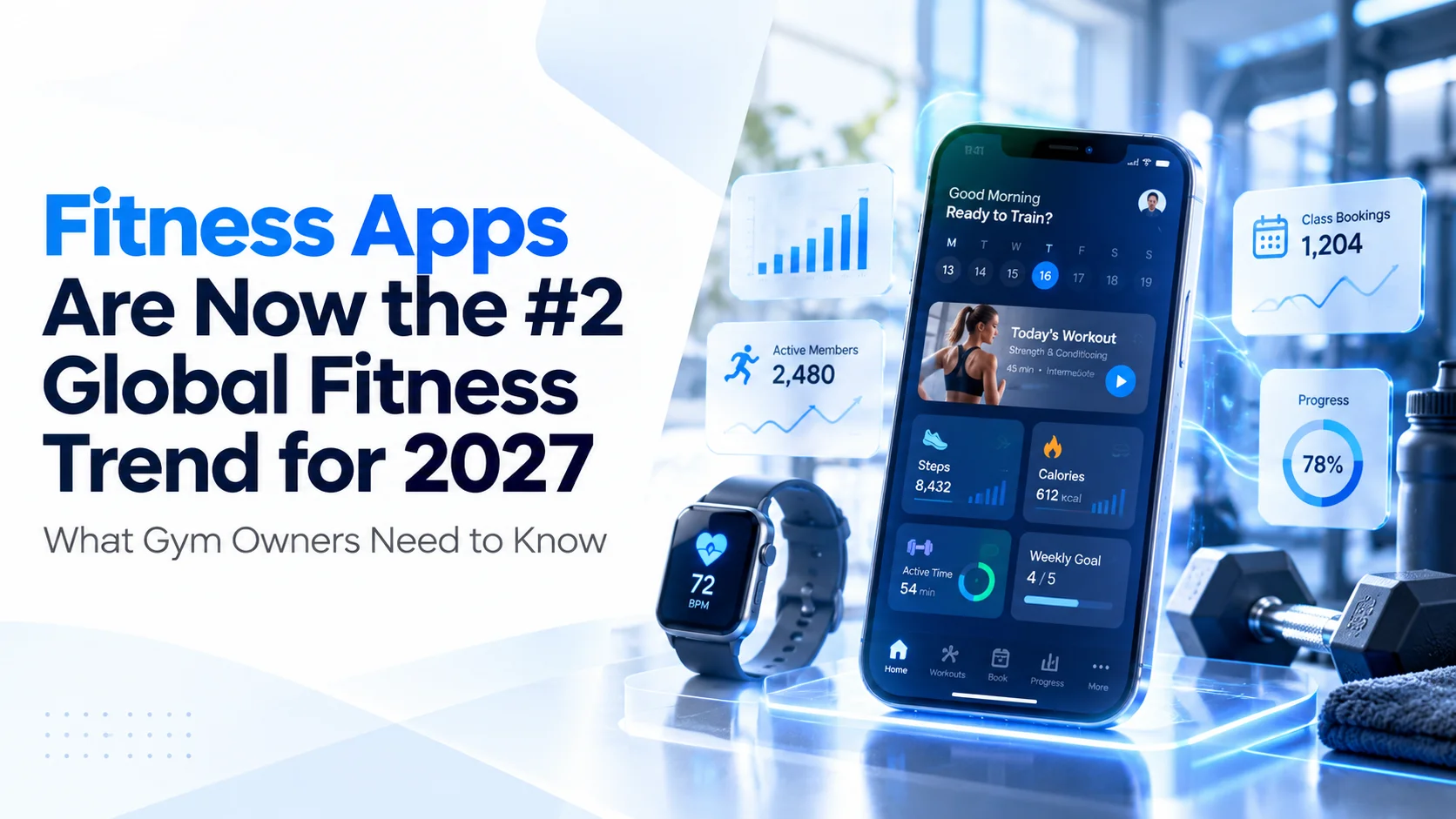
ACSM ranks mobile exercise apps second for 2027. Here is what the report says, what it means for gyms, and how to decide between custom and ready-made fitness software.
Sections
The fitness industry is entering 2027 with a clear signal: mobile exercise apps are becoming one of its most influential trends. For gym owners, the bigger question is no longer whether fitness technology matters. It is how digital tools can improve the experience members receive before, during, and after their workouts.
On October 20, 2026, the American College of Sports Medicine (ACSM) released its 2027 Worldwide Fitness Trends report. Mobile exercise apps ranked second, climbing from fourth place in 2026. Wearable technology retained the top position, while group fitness classes and balance-focused activities also gained ground.
These findings give gym owners, fitness studios, personal trainers, and academy operators a useful opportunity to examine how their services are delivered. Members increasingly have access to workouts, progress tracking, and fitness guidance through their phones, but physical gyms still offer something an app cannot fully replace: equipment, professional instruction, motivation, and in-person community.
The opportunity is to connect these experiences rather than treat digital fitness and physical gyms as competitors.
What Does the ACSM 2027 Fitness Trends Report Actually Say?
The American College of Sports Medicine publishes an annual worldwide fitness trends survey to identify developments expected to influence the fitness industry. Its 2027 report, now in the survey's 21st year, draws on responses from more than 1,400 fitness professionals who evaluated 50 potential trends.
Respondents ranked trends based on how widely they observed them across the industry. This is an important distinction: the findings represent professional assessments of industry trends, not a direct survey of every gym member or proof that one fitness technology delivers better outcomes than another.
ACSM's Top 10 Fitness Trends for 2027
Wearable Technology: Smartwatches and fitness trackers that monitor activity, workout intensity, sleep, and recovery.
Mobile Exercise Apps: Mobile platforms offering workout programs, on-demand classes, and virtual fitness instruction.
Balance, Flow, and Core Strength: Activities including Pilates, yoga, barre, and mobility training.
Fitness Programs for Older Adults: Exercise programs supporting strength, mobility, independence, and healthy aging.
Traditional Strength Training: Resistance-based workouts using weights and other equipment.
Exercise for Weight Management: Fitness programs supporting weight management and physical function.
Group Fitness Classes: Instructor-led exercise sessions that combine coaching with social interaction.
Data-driven Training Technology: Using fitness and recovery measurements to help guide training decisions.
Exercise for Mental Health and Well-Being: Physical activity supporting emotional well-being and stress management.
Influencer/Ambassador-led Fitness Programs: Fitness programs connected to creators and online communities.
Source: American College of Sports Medicine, 2027 Worldwide Fitness Trends, published October 20, 2026.
Three rankings are especially relevant to gym operators. Wearables hold the number-one position, mobile exercise apps have returned to number two, and group fitness classes have jumped from number 13 to number seven. Together, these movements suggest that technology, individual training, and shared fitness experiences can all play important roles in the same business.
Why Mobile Fitness Apps Are Gaining Importance in 2027
Mobile exercise apps are not new. People have used them for workout videos, activity tracking, personal training, and fitness challenges for years. What makes the latest ranking meaningful is that mobile apps continue to hold a prominent position alongside traditional training services and wearable technology.
ACSM ranked mobile exercise apps seventh in 2024, second in 2025, fourth in 2026, and second again in 2027. Their movement within the top ten demonstrates continuing industry relevance, although the ranking does not by itself measure growth in app revenue, downloads, or individual gym adoption.
1. Fitness Needs to Fit Around Members' Schedules
Not every member can visit a gym at the same time every day. Work, family commitments, travel, and changing routines can interrupt a traditional workout schedule. Mobile apps make it possible to access training instructions, view exercise plans, or complete certain workouts outside the facility.
For a gym owner, this creates an opportunity to support members between visits. A person who misses a class may still be able to follow a trainer-approved workout at home. Someone travelling for work can continue tracking their routine without losing access to their gym's training guidance.
This does not mean the gym becomes less important. It means a membership can provide value beyond access to a physical location.
2. Members Want a Clearer View of Their Progress
Many fitness goals take weeks or months to achieve. Without a record of completed sessions, lifting progress, or training consistency, members can find it difficult to recognize their improvement.
A well-designed fitness app can bring workout history, personal goals, achievements, and trainer feedback into one accessible place. Instead of relying entirely on memory or handwritten notes, members can review their progress and understand what they have accomplished.
Gym operators can also use appropriate participation data to identify when members may need additional support. However, any insights should lead to useful coaching or service improvements rather than excessive notifications or intrusive monitoring.
3. Wearable Technology and Mobile Apps Complement Each Other
The number-one and number-two trends for 2027 are closely related. Wearable devices collect activity and fitness information, while mobile applications can organize that information into a more useful experience.
For example, a member might use a smartwatch to record a workout and an app to review training history alongside their weekly plan. With the member's permission, appropriate integrations can reduce duplicate data entry and help trainers understand relevant activity patterns.
Still, wearable data should not automatically be treated as perfectly accurate or as a substitute for professional judgment. Device compatibility, measurement limitations, privacy permissions, and data quality all need consideration before a gym uses such information in coaching decisions.
What Does the #2 Fitness App Ranking Mean for Gym Owners?
The ACSM ranking is not an instruction for every gym to develop an application immediately. It is a reason to examine whether the current member experience matches changing expectations.
A gym may provide excellent training but still require members to call the front desk to book a class, send messages to confirm payments, or contact staff to understand their membership status. These disconnected steps create friction for customers and administrative work for employees.
Digital tools can help remove some of that friction, allowing gym staff to spend less time managing routine requests and more time supporting members.
Make Class Booking and Scheduling Easier
For gyms offering instructor-led sessions, booking is often one of the first workflows worth improving. Members should be able to check class availability, reserve a space, review upcoming bookings, and understand cancellation rules without having to contact reception each time.
On the operational side, trainers and managers need reliable schedules, attendance records, capacity limits, and booking updates. A connected booking system can help prevent conflicting reservations and reduce manual coordination.
This becomes particularly useful for businesses operating multiple training rooms, instructors, branches, or academy programs.
Give Members Better Control Over Memberships
Membership management can become frustrating when renewal dates, payment records, packages, and access permissions exist in separate systems. A member-facing application or portal can simplify these interactions by displaying membership details and supporting eligible renewals, upgrades, and purchases.
For the business, membership records need to remain accurate across the payment provider, administration system, and member interface. A successful payment should update the correct access privileges, while refunds, failed payments, cancellations, and expired memberships should follow clearly defined rules.
This is why fitness software requires more than attractive mobile screens. The workflows behind the application directly affect the customer experience and the business's financial operations.
Extend Personal Training Beyond the Gym Floor
Personal trainers can benefit from a system that connects individual workout plans, client progress, and communication. Instead of distributing workout instructions through disconnected messages or documents, a trainer can manage clients through a structured platform.
Members can review assigned sessions, log completed workouts, and share relevant feedback. Trainers can then make adjustments using their professional judgment and the information available to them.
For facilities offering premium coaching, this can create a more consistent service between face-to-face appointments. It may also support additional membership tiers when the service provides genuine value and customers are willing to pay for it.
Seven Fitness App Features Gym Owners Should Consider for 2027
A fitness app should be designed around the services the business actually provides. A boutique Pilates studio, a large commercial gym, and a personal training academy will have different requirements. Still, several capabilities deserve consideration when evaluating fitness software.
1. Membership and Subscription Management
Members need a convenient way to view plans, purchase eligible packages, check renewal dates, and review payment history. Administrators need reliable records for access, renewals, cancellations, and billing exceptions. Membership management is often a strong starting point when the existing process involves substantial manual work.
2. Class Booking and Attendance Tracking
A practical booking system should display schedules, available spaces, reservation status, and cancellation policies. Gym staff should be able to manage class capacity, instructor availability, and attendance from a connected dashboard.
3. Workout Plans and Progress Tracking
Workout plans can help members understand what to do during each session, while progress tracking gives them a record of completed training. The level of detail should match the business. Some facilities may need simple attendance and workout logs, while coaching-focused platforms may require detailed exercise histories.
4. Trainer and Staff Dashboards
The member experience is only one part of the product. Trainers may need to assign workout plans, view client activity, manage schedules, and respond to feedback. Managers may need access to membership information, payments, promotions, and reports. Appropriate role-based permissions should keep each user focused on the information they are authorized to access.
5. Wearable and Health Platform Integrations
Integrations with supported health and wearable ecosystems can make activity tracking more convenient. However, integration requirements should be based on real member needs. If wearable syncing adds little value to the core service, it may be better introduced after more important booking or membership problems have been solved.
6. Useful Reminders and Member Communication
Class reminders, membership updates, schedule changes, and training notifications can help members stay informed. Communication should be timely, relevant, and easy to control. Sending more notifications does not automatically create better engagement, and members should have appropriate choices about nonessential messages.
7. Business Reporting and Operational Insights
Gym owners need to understand how their services are performing. Useful reports may include membership renewals, attendance patterns, booking utilization, payment status, and participation across different programs.
These measurements become more valuable when they help operators make specific decisions, such as adjusting underused class times, reviewing membership packages, or improving the onboarding experience for new members.
Will Fitness Apps Replace Physical Gyms in 2027?
The latest ACSM findings do not support the conclusion that apps are replacing physical gyms. In fact, the same report places traditional strength training at number five and group fitness classes at number seven. Balance, flow, and core strength activities, many of which are commonly delivered through in-person instruction, also rank third.
These trends highlight different needs rather than a single model of fitness. Some people value exercising independently, while others prefer professional instruction, equipment access, group motivation, and structured classes.
For many gym businesses, a hybrid approach may be worth exploring. Members continue attending physical sessions while using digital tools to manage bookings, follow training plans, track progress, and maintain contact with trainers.
The goal should not be to turn every gym into an online workout company. It should be to make the existing gym experience easier, more connected, and more useful to members.
Real Fitness Software Examples: FitFinds and Growth
At Next Level Software, fitness product development has shown us that two applications serving the same broad industry can require very different platforms. A fitness marketplace focuses on discovery, transactions, and business operations, while a coaching application may prioritize training plans, personalization, and ongoing client engagement.
FitFinds: Connecting Gym Memberships, Classes, and Shopping
FitFinds is a Kuwait-based fitness marketplace built around a common operational challenge: gym memberships, training classes, and fitness products were being managed through separate channels.
Customers needed a way to discover gyms, purchase subscriptions, book classes, and shop for fitness products within one experience. At the same time, gym and academy operators needed tools to manage their listings, schedules, promotions, and financial activity.
Next Level Software developed a bilingual platform consisting of a customer application, a merchant dashboard, and an administration system connected through one shared backend. The product supports Arabic and English experiences and integrates payment methods including KNET and MyFatoorah.
The platform reached the Kuwait market in 12 weeks, with three connected products delivered for the member, merchant, and administrator experiences.
The lesson for gym owners: A fitness mobile app can be part of a wider business platform rather than an isolated customer-facing tool. Booking, payments, subscriptions, and staff operations need to work together if the application is going to solve operational problems.
Growth: Combining Digital Fitness With Human Coaching
Growth demonstrates a different approach. This fitness application combines personalized workout and nutrition experiences with access to real trainers.
The platform includes AI-assisted workout and nutrition planning, user progress tracking, subscription options, and a trainer-side system for managing clients. Instead of treating automation as a complete replacement for coaching, the product connects digital functionality with human support.
Its design illustrates how fitness applications can serve members and professionals simultaneously. Users receive tools for following their routines, while trainers have a structured system for managing and adjusting their services.
The lesson for gym owners: Personalization does not require eliminating the trainer relationship. Technology can help organize plans and progress while keeping qualified professionals involved in important coaching decisions.
Should Your Gym Build a Custom Fitness App or Use Existing Software?
One of the most important decisions is whether the business needs its own application at all. The growing popularity of fitness apps does not make custom software the right investment for every operator.
If your gym primarily needs standard membership billing, class scheduling, attendance records, and basic customer communication, an established gym management platform may already provide the necessary functionality at a reasonable cost.
Custom development becomes more relevant when the business has workflows that available software cannot support effectively. Examples include a network of gyms sharing a membership model, a fitness marketplace connecting independent merchants, specialized trainer-management workflows, or a branded platform combining multiple services.
When Existing Gym Management Software May Be Better
Your business operates a single location with straightforward memberships and schedules.
Your required features are already available in an established platform.
You need to launch quickly without developing unique technology.
Your current budget is better spent validating demand or improving member services.
When Custom Fitness App Development May Make Sense
You manage multiple locations or business types with complex shared workflows.
You need unique subscriptions, packages, or booking rules.
You are building a marketplace connecting gyms, trainers, academies, and members.
Your business depends on a differentiated digital coaching or fitness experience.
Existing tools require too many workarounds or disconnected integrations.
You need greater control over the product roadmap, integrations, and customer experience.
Before commissioning software, compare the total cost of ownership rather than only the initial development price. Custom products require ongoing maintenance, hosting, security updates, store compliance, support, and feature development. Subscription software has its own costs and limitations, including recurring fees, integrations, and potential migration challenges.
The better choice depends on the business model, current operational problems, and realistic expectations for usage.
How Gym Owners Can Prepare for the 2027 Fitness App Trend
For fitness businesses that want to respond to the trend, the most useful starting point is an operational review rather than a large feature list. Understanding member behavior and staff workloads can reveal which digital improvements are most likely to matter.
Step 1: Identify Where Members Experience Friction
Review the process of joining, booking, attending, renewing, and communicating with your gym. Find out where members need staff assistance for tasks that could reasonably be self-service. Look for repeated complaints, abandoned bookings, membership confusion, and scheduling problems.
Step 2: Examine the Tools Your Business Already Uses
List your membership software, booking system, payment provider, spreadsheets, communication tools, and trainer workflows. Determine which systems already integrate and which require repeated manual entry. You may find that improving an existing integration solves the problem without requiring an entirely new application.
Step 3: Choose One Core Problem to Solve
A fitness business should avoid building every possible feature at once. If class booking is the largest problem, prioritize a reliable booking experience. If personal training is your strongest service, prioritize workout delivery, progress tracking, and trainer tools. Your initial scope should reflect an actual member or operational need.
Step 4: Start With a Focused First Release
A minimum viable product, or MVP, is a useful option when a business needs to validate a custom software concept. It should include a complete, usable version of the most important workflow rather than a collection of unfinished features.
For example, a booking-focused gym app might initially support member registration, available classes, reservations, cancellations, essential notifications, and a basic staff dashboard. More advanced functionality can follow when usage demonstrates a need.
Step 5: Measure Business Outcomes
After launch, evaluate whether the product is solving the intended problem. Relevant indicators might include the percentage of members using digital booking, failed booking attempts, staff time spent on administration, membership renewal behavior, and the number of members actively using training features.
Measure these against a baseline where possible. An increase in downloads may look encouraging, but it does not necessarily mean members are receiving better service or the gym is operating more efficiently.
Step 6: Improve the Product Based on Real Usage
Once members are actively using the system, identify which features deserve attention. Better onboarding, faster booking, improved trainer tools, or more reliable payments may create more practical value than immediately adding AI or advanced wearable integrations.
For gym owners evaluating a new product, our guide to building a fitness app explains how to plan features, platforms, integrations, and the initial development scope.
What About AI-Powered Fitness Apps in 2027?
Artificial intelligence may play a useful role in digital fitness, particularly where an application needs to personalize information or help professionals manage repetitive work. Examples include adapting training suggestions to user preferences, organizing progress information, and assisting with routine administrative tasks.
However, the ACSM ranking of mobile exercise apps should not be interpreted as a ranking of AI fitness applications. The two concepts are related in some products but are not interchangeable.
AI also introduces responsibilities. Workout recommendations must account for the limits of available user information, sensitive data requires appropriate handling, and users should not be given the impression that automatically generated content is equivalent to individual clinical assessment.
Gym owners should introduce AI when it addresses a specific service problem. A straightforward booking rule, membership expiration check, or class-capacity limit is usually better implemented through reliable application logic than through an AI model.
Fitness App Development in 2027: The Business Opportunity
The biggest opportunity for gym owners is not simply selling access to another mobile application. It is improving how the business connects with members and delivers its existing services.
For a local gym, that might mean simpler renewals, more reliable class bookings, and better communication. For a personal training company, it could mean offering structured support between appointments. For a multi-location fitness operator, it might involve shared memberships, connected reporting, and consistent customer experiences across facilities.
Fitness entrepreneurs building new business models may see different opportunities in multi-gym marketplaces, digital training subscriptions, sports booking platforms, or hybrid coaching products.
Each opportunity requires a different approach to software architecture, payments, administration, and user experience. The most sustainable product decision is the one that aligns technical investment with a clear business need.
Final Thoughts: The Future of Fitness Is Connected, Not Just Digital
Mobile exercise apps reaching the number-two position in ACSM's 2027 fitness trends is an important development for gym owners to understand. It confirms the continued relevance of mobile fitness experiences within a broader industry that still values wearables, strength training, guided classes, and personal interaction.
But the ranking does not mean every fitness business must launch a custom mobile application in 2027. The more important question is whether your current systems make it easy for members to book, train, track progress, manage memberships, and stay connected with your services.
Gyms that identify real friction and invest in the right digital tools can work toward a better member experience without losing the value of in-person fitness. Whether that means improving existing software, integrating disconnected systems, or developing a custom application depends on the business.
At Next Level Software, we design and build mobile and web platforms for businesses that need connected member experiences, bookings, payments, and operational workflows. Our work on FitFinds and Growth shows how different fitness business models require different software solutions.
If you are exploring a custom fitness platform, learn more about our health and fitness app development services, or contact our team to discuss your requirements and the most practical starting point.
Frequently Asked Questions About Fitness Apps in 2027
What is the number-two fitness trend for 2027?
Mobile exercise apps are the number-two worldwide fitness trend for 2027 according to the American College of Sports Medicine. The category moved up from fourth place in 2026. Wearable technology remains the top-ranked trend.
Why are fitness apps popular in 2027?
Mobile exercise apps provide convenient access to workouts, training guidance, progress tracking, and fitness content. They can support people who want to exercise around work, family, and other responsibilities. Their value depends on the quality of the experience and how consistently users engage with it.
Does every gym need a mobile app?
No. A small gym with straightforward operations may be better served by established membership and booking software. A custom mobile app becomes more relevant when the gym has unique member experiences, specialized workflows, or business models that existing tools cannot support effectively.
What features should a gym mobile app include?
Depending on the business, important features can include membership management, class booking, payment integration, schedules, workout plans, progress tracking, trainer dashboards, and member communication. The first version should focus on the features that solve the most important business problems.
Can fitness apps improve gym member retention?
Fitness apps may support retention by making workouts easier to follow, helping members track progress, simplifying bookings, and improving communication. However, retention improvements are not guaranteed. Gym owners should measure renewal rates and member activity to understand whether a particular digital feature is delivering value.
Should a gym choose custom app development or ready-made software?
Ready-made software is often suitable for standard memberships, scheduling, and payments. Custom development may make sense for multi-location businesses, specialized coaching systems, fitness marketplaces, or unique operational requirements. The decision should consider initial costs, recurring expenses, integrations, maintenance, and long-term business goals.
Are AI and wearable integrations necessary for fitness apps?
Not always. Wearable integrations are useful when activity data improves the user experience or reduces manual entry. AI can support personalization and selected workflows, but neither is essential for every fitness product. Reliable core functionality should come first.
Sources and Further Reading
Keep reading
How to Build a Ride-Hailing Application in 2026: Features, Cost & Development Guide
Learn how to build a ride-hailing application in 2026, including essential features, technology stack, development costs, timelines, and lessons from our iTaxi MX project.
Abdullah · · 20 min read
Can You Build a Mobile App Without Coding in 2026? AI App Builders vs. Professional Developers
Can you build a mobile app without coding in 2026? Compare AI app builders, no-code platforms, and professional developers on cost, security, scalability, and app launch.
Khubaib Rasheed · · 22 min read

How Much Does It Cost to Build a Mobile App in 2026?
How much does a mobile app cost in 2026? Explore realistic development price ranges, MVP costs, major pricing factors, hidden expenses, and ways to budget smarter.
Khubaib Rasheed · · 17 min read