Old Is Gold: Why Custom Mobile Apps Still Matter in the AI Era
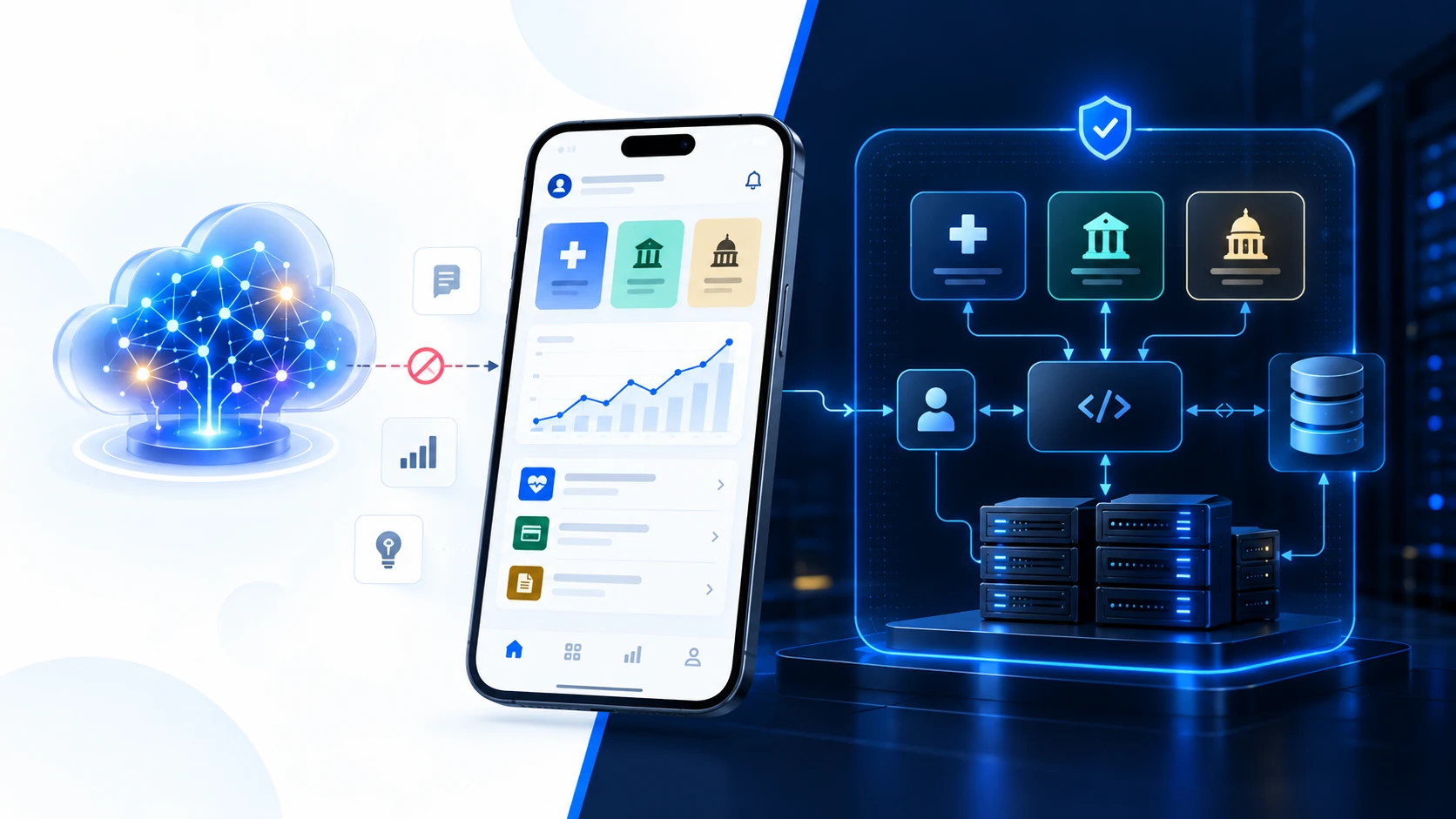
For government, financial, healthcare, and other sensitive systems, the smartest product decision may be keeping AI outside the critical data path.
Sections
AI is becoming so common in software conversations that not adding AI can almost sound old-fashioned. Every product roadmap seems to need an assistant, an agent, a recommendation engine, a generative search experience, or some other feature carrying an AI label.
But old-fashioned is not always a criticism. Sometimes it means proven. Sometimes it means predictable. And sometimes, especially when software handles sensitive government, financial, healthcare, operational, or confidential business data, the best engineering decision is not to introduce another intelligent layer between the user and the system at all.
This is where the phrase old is gold has real meaning in software development. There is still enormous value in a carefully designed, human-engineered custom application where the rules are explicit, the architecture is understood, the data flows are intentional, and AI is not inserted simply because the market currently expects every product to have it.
This is not an argument against artificial intelligence. AI can solve valuable problems, and we build AI-assisted products when those capabilities genuinely improve the application. The more important principle is simpler: not every software problem is an AI problem. Sometimes the right product is still a well-engineered custom mobile application built around secure APIs, controlled data access, deterministic business logic, reliable integrations, and exactly the workflows the business requires.
AI Should Be a Product Decision, Not a Checkbox
Before adding AI to a mobile application, there should be a clear answer to one question: what problem becomes meaningfully better because AI is involved? If the answer is vague, the product probably does not need AI yet.
An appointment application does not need generative AI simply to allow people to select an available time. A delivery application does not need an LLM to calculate a known delivery fee. A banking workflow does not need a probabilistic model to enforce an account permission that can be represented as an explicit rule. A government system does not need a chatbot merely to make a structured approval process appear more modern.
Traditional software is extremely good at problems where the rules are known. It can authenticate a user, verify permissions, calculate values, validate forms, execute transactions, schedule appointments, manage inventory, generate reports, record audit events, send notifications, integrate payments, and move data between approved systems without asking a language model to interpret what should happen next.
That distinction is important because every new component creates another responsibility. If AI solves an important problem, that responsibility may be justified. If it does not, adding AI can make a simple system more difficult to secure, test, understand, monitor, and maintain without delivering meaningful value to the customer.
What Changes When AI Enters the Data Flow?
A traditional application might have a relatively clear path: the mobile application sends authorized information to an API, the backend applies business rules, the database stores the required records, and approved integrations perform specific functions. The architecture can still be complex, but each component has a defined purpose.
Introduce a generative AI service and another set of questions appears. What information will be sent to the model? Which provider receives it? Is the information logged? How long is it retained? Can it be used for training? Where is it processed? What happens when the model returns an incorrect answer? Can a malicious input influence the model? Can the AI access other tools or records? Which actions can it perform automatically? How will model changes be tested? What happens when the external AI service becomes unavailable?
These are solvable engineering and governance questions. They are not reasons to avoid AI universally. But they are real work, and a business should accept that work because the AI feature creates enough value to justify it—not because AI happens to be fashionable.
The OWASP GenAI Security Project, for example, identifies sensitive information disclosure and prompt injection among major risks affecting large-language-model applications. NIST's Generative AI risk guidance similarly addresses data privacy, information security, reliability, monitoring, and evaluation as areas organizations need to manage when deploying generative systems.
That means AI is not simply another screen in the application. When it touches business data or is allowed to perform actions, it becomes part of the application's trust boundary.
Sensitive Data Changes the Equation
The decision becomes more important when an application handles information that has legal, contractual, operational, or personal sensitivity. Government records, financial information, health data, identity documents, business secrets, internal operational data, and customer records can all create requirements that are very different from those of a consumer entertainment application.
A privacy-first product team should therefore ask whether sensitive information needs to reach an AI system in the first place. Data minimization has been a useful security and privacy principle long before generative AI became popular: if a component does not need a piece of information to perform its job, do not give it that information unnecessarily.
The same logic applies to AI. Sometimes the correct answer is to sanitize or limit what reaches the model. Sometimes it is to use an approved private or enterprise architecture. Sometimes on-device processing may be appropriate. And sometimes the best answer is even simpler: this workflow does not need AI.
Healthcare: HIPAA Does Not Ban AI, but It Does Not Remove Your Responsibilities Either
Healthcare is a useful example because discussions about AI and medical data often become too absolute. HIPAA does not say that healthcare organizations cannot use cloud services, mobile applications, or artificial intelligence. The U.S. Department of Health and Human Services explicitly allows covered entities and business associates to use cloud services for electronic protected health information when the applicable HIPAA requirements are satisfied.
Those requirements matter. If a cloud service provider creates, receives, maintains, or transmits electronic protected health information on behalf of a covered entity or business associate, a HIPAA-compliant business associate agreement may be required along with appropriate administrative, physical, and technical safeguards. The organization must also understand the environment and perform appropriate risk analysis and risk management.
So the question is not simply, “Can we use AI with healthcare data?” The better question is, “Why does this particular healthcare workflow need AI, what information will the AI receive, who will process that information, what agreements and safeguards apply, and what additional risk does the feature create?”
If a patient application needs authenticated access to appointments, prescriptions, documents, payments, care instructions, secure messages, or known health records, much of that functionality can be implemented as ordinary application logic. Generative AI may later add useful capabilities, but it should not become a mandatory architectural dependency simply because the product operates in healthcare.
Removing AI from a workflow does not automatically create HIPAA compliance. A non-AI application can still be insecure. Poor authorization, exposed APIs, weak access controls, unprotected credentials, missing auditability, or badly configured infrastructure can create serious problems regardless of how the code was written. The benefit of avoiding unnecessary AI is narrower but important: you remove an entire category of data processing and AI-specific risk that the product did not need in the first place.
Financial Software: Predictability and Governance Matter
Financial applications create a similar decision. AI can be useful for document analysis, information retrieval, customer support, fraud analysis, internal productivity, and other well-defined tasks. But financial organizations also operate under significant requirements involving supervision, records, security, customer information, third parties, and internal controls.
FINRA's 2026 regulatory guidance makes the principle clear for its member firms: existing securities laws and FINRA rules continue to apply when GenAI is used just as they do when other technologies are used. FINRA also highlights governance, formal review, testing, monitoring, model reliability, human oversight, prompt and output logging, and controls over agent access and data handling as areas firms may need to consider.
There is another layer as well: third-party risk. In September 2026, U.S. banking regulators including the OCC, Federal Reserve, FDIC, and NCUA proposed revised guidance intended to help banking organizations align third-party risk management with the risk level of their relationships. An AI provider is not magically outside that vendor-risk conversation because the technology is innovative.
For a financial product, that means a rule-based workflow can sometimes be the stronger engineering choice. If the system knows exactly how a value must be calculated, exactly who can authorize a transaction, exactly which records must be stored, and exactly which conditions allow an action to proceed, explicit application logic can provide a level of predictability that a generative model does not improve.
AI should enter the system where its probabilistic abilities are actually valuable, not where deterministic software already solves the problem more safely and clearly.
Government and Critical Systems: Control Can Be More Important Than Novelty
Government software often has requirements that go beyond ordinary consumer applications. Depending on the system and jurisdiction, teams may need to consider data residency, access boundaries, procurement restrictions, auditability, infrastructure control, identity management, operational continuity, classified or sensitive information, and long system lifecycles.
The increasing attention regulators and standards bodies are giving AI in critical environments demonstrates that AI adoption creates governance work of its own. In 2026, NIST continued developing AI-specific cybersecurity guidance and a trustworthy-AI profile for critical infrastructure. The U.S. National Security Agency's Artificial Intelligence Security Center has also published guidance specifically addressing data security for AI systems.
Again, that does not mean government organizations should reject AI. It means “add AI” should never be treated as a harmless cosmetic enhancement.
A government system whose real purpose is connecting organizations, managing submissions, validating records, controlling approvals, tracking transactions, and reporting activity may derive most of its value from strong custom software architecture rather than generative intelligence.
Our Subvention Maroc Lait case study is a useful example of the scale custom software can address. The platform connects more than 2,000 cooperatives through five products sharing one backend. The important engineering problem is not making the application appear intelligent. It is coordinating multiple roles and operational workflows through dependable digital infrastructure.
“Handmade Software” Should Mean Human Ownership, Not Typing Every Character Manually
There is an important distinction to make when we talk about handmade or human-built software in 2026. Professional development teams use frameworks, libraries, IDEs, automation, code generators, testing tools, cloud platforms, and increasingly AI-assisted development tools. The goal should not be to measure software quality by whether a developer physically typed every character.
The valuable part of human-engineered custom software is ownership of the decisions.
Someone should understand why the architecture looks the way it does. Someone should know where customer information is stored. Someone should be able to explain every external service that receives data. Someone should understand the authentication model, authorization boundaries, business rules, failure scenarios, deployment architecture, backup strategy, and operational risks.
If AI helps an engineer produce a harmless utility function faster, that is fundamentally different from designing an application where sensitive production records are automatically sent to an external AI service. Development tooling and production architecture are separate decisions, and privacy-conscious organizations should establish clear rules around both.
The goal is not software untouched by modern tools. The goal is software whose critical decisions remain deliberate, reviewable, testable, and owned by the engineering team.
Traditional Custom Software Still Has Important Advantages
1. Explicit business rules
When a workflow can be represented as known conditions, traditional application logic lets engineers encode those conditions directly. That makes important behavior easier to test and reason about. If a user needs a particular role to approve a transaction, that requirement can exist as an explicit authorization rule rather than an instruction a model is expected to interpret correctly.
2. A smaller data-processing surface
Every external processor and service expands the system's data map. Removing an unnecessary AI provider does not eliminate security risk, but it can reduce the number of places sensitive information needs to travel and the number of external relationships that need to be evaluated.
3. Predictable outputs
A normal calculation or validation routine should produce results according to its programmed rules. Generative models are intentionally designed to produce probabilistic outputs. That capability is extremely useful when generating, interpreting, summarizing, or reasoning over unstructured information, but it is unnecessary for many transactional workflows.
4. Easier functional testing
When expected behavior is explicit, teams can write tests around defined inputs and outputs. AI systems often require additional evaluation because a response can be plausible without being correct, and model behavior may change as prompts, retrieval data, configurations, or model versions change.
5. Fewer runtime dependencies
An application that depends on an external AI service also depends on that provider's availability, latency, pricing, usage limits, model changes, contractual terms, and service behavior. Sometimes those dependencies are acceptable. When AI provides little value, they are unnecessary.
6. Clearer auditability
Regulated and operational systems often need to answer straightforward questions: who performed an action, when did it happen, which rule allowed it, what data changed, and what was the previous value? Traditional software can be designed directly around that requirement.
7. More predictable operating costs
Most applications already have infrastructure costs, but AI inference can introduce an additional usage-based cost layer. The economics can make sense when AI saves substantial work or creates product value. They make less sense when a deterministic function could have completed the same task.
The Strongest Architecture May Be AI-Ready Without Being AI-Dependent
Choosing not to use AI today does not mean permanently closing the door.
A well-designed application can keep its core systems modular. Authentication, permissions, business rules, data storage, integrations, notifications, and operational workflows can form the dependable foundation. Later, if a real use case appears, an AI capability can be added behind a controlled service boundary.
For example, a healthcare product might initially provide structured record access and later add a carefully governed summarization feature. A financial platform could operate entirely through explicit transaction rules while later introducing AI for internal document classification. A government system could keep authoritative workflows deterministic while testing an AI assistant against a strictly limited, non-sensitive information source.
That is usually a healthier strategy than making the entire application dependent on AI from the beginning.
For teams that do have a clear use case, our guide to adding AI to an existing application explains how AI capabilities can be introduced into an established product without rebuilding everything around the model.
When AI Actually Does Earn Its Place
AI becomes much easier to justify when the problem itself involves ambiguity, unstructured information, language, complex pattern recognition, personalization, or tasks that would otherwise require substantial manual interpretation.
Useful examples can include summarizing large documents, natural-language search, assisting customer support teams, classifying unstructured requests, extracting information from documents, creating recommendations, supporting human decision-making, or helping users interact with a complex body of knowledge.
Even then, the architecture should ask how much information the model actually needs and how much authority it should have. An assistant that recommends a next step is different from an autonomous agent that can execute financial transactions, modify patient information, or approve a government request.
The more sensitive the data and the more consequential the action, the more important permissions, verification, logging, human review, testing, and clearly defined boundaries become.
A Practical Decision Framework: Does This Feature Really Need AI?
Before adding AI to a mobile product, a founder, product owner, or engineering team should evaluate the feature against a few practical questions rather than beginning with the technology.
Can normal software solve this reliably? If explicit rules can produce the required result, understand why a probabilistic model would be better.
What user or business outcome improves? Identify the measurable value rather than adding AI for positioning.
What data must the model receive? Map the minimum information required and determine its sensitivity.
Who processes that information? Understand every AI, cloud, logging, analytics, retrieval, and infrastructure provider involved.
What happens when the AI is wrong? Determine whether an incorrect answer is inconvenient, expensive, dangerous, or legally consequential.
Does the model need permission to take actions? More agency means a larger security and governance problem.
Can the feature operate without the AI provider? Plan for downtime, service changes, rate limits, and degraded operation.
Can the behavior be tested and monitored? AI functionality requires evaluation beyond simply confirming that the API returned a response.
Do regulations or contracts change the architecture? Healthcare, finance, government, employment, education, and other domains may introduce additional obligations.
Is the benefit large enough to justify all of the above? If not, ordinary software may be the better technology.
Privacy-First Mobile Development Still Requires Serious Engineering
A traditional custom application is not secure merely because it does not contain AI. Strong engineering fundamentals still matter.
A privacy-conscious architecture should start by determining what information genuinely needs to be collected. It should establish authentication and authorization around each role, protect data in transit and at rest where appropriate, separate production environments from development, secure credentials and secrets, minimize third-party access, maintain useful audit logs, define retention policies, test APIs and permission boundaries, manage dependencies, prepare backups and recovery procedures, and continuously patch vulnerabilities.
When regulated data is involved, technical controls also need to be considered alongside the organization's legal and compliance requirements. For healthcare organizations subject to HIPAA, that can include appropriate risk analysis, safeguards, policies, documentation, and business associate relationships. Financial and government systems can carry their own sector-specific and jurisdiction-specific obligations.
Custom architecture gives a business the opportunity to design those controls around its real requirements. That flexibility is one of the reasons custom mobile app development remains valuable even as AI development accelerates.
Complex Software Does Not Need an AI Label to Be Innovative
There is also a broader product lesson here. Innovation should not be measured by how many fashionable technologies appear in an architecture diagram.
A platform that replaces a fragmented manual operation with a reliable digital workflow is innovative. A mobile application that safely connects several user roles is innovative. A marketplace that coordinates customers, vendors, payments, inventory, and administration is innovative. A government system that digitizes a nationwide process is innovative. A financial platform that gives businesses dependable access to complex functionality is innovative.
NLS's work on BBX Connect, for example, involves a B2B cashless trading, networking, and marketplace platform used across multiple countries. Its product value comes from solving a difficult business and platform problem. AI does not need to be the headline for custom software to deliver meaningful technological value.
The same principle should guide new applications: start with the problem, understand the users, understand the data, design the architecture, and then choose the technologies that actually improve the solution.
Old Is Gold Does Not Mean Staying in the Past
Software engineering has always changed. We moved from desktop applications to the web, from physical servers to cloud infrastructure, from native-only development to mature cross-platform frameworks, and now into an era where AI can help developers and products perform tasks that previously required substantial manual effort.
Good engineering does not reject those changes. It also does not adopt every new capability automatically.
Sometimes the right product needs AI recommendations, AI search, an intelligent assistant, or automated document processing. Sometimes it needs none of those things. It needs a fast interface, strong authentication, carefully designed permissions, reliable APIs, dependable infrastructure, a secure database, clear business logic, and engineers who know exactly how the system works.
That is not outdated software.
That is deliberate software.
Build What the Product Actually Needs
At Next Level Software, we believe AI should solve a product or business problem rather than become a compulsory ingredient in every application. If AI creates meaningful value, it should be designed into the product responsibly. If it does not, there is nothing wrong with building a fully custom mobile application around proven software engineering instead.
For businesses handling sensitive government, financial, healthcare, operational, or proprietary information, that decision can be especially important. The goal should not be to build the application with the most AI. The goal should be to build the application that gives the business the right combination of functionality, control, security, maintainability, reliability, and room to evolve.
If your product needs a custom mobile application but AI does not belong in its critical data path, talk to Next Level Software about an architecture designed around the requirements you actually have.
Keep reading
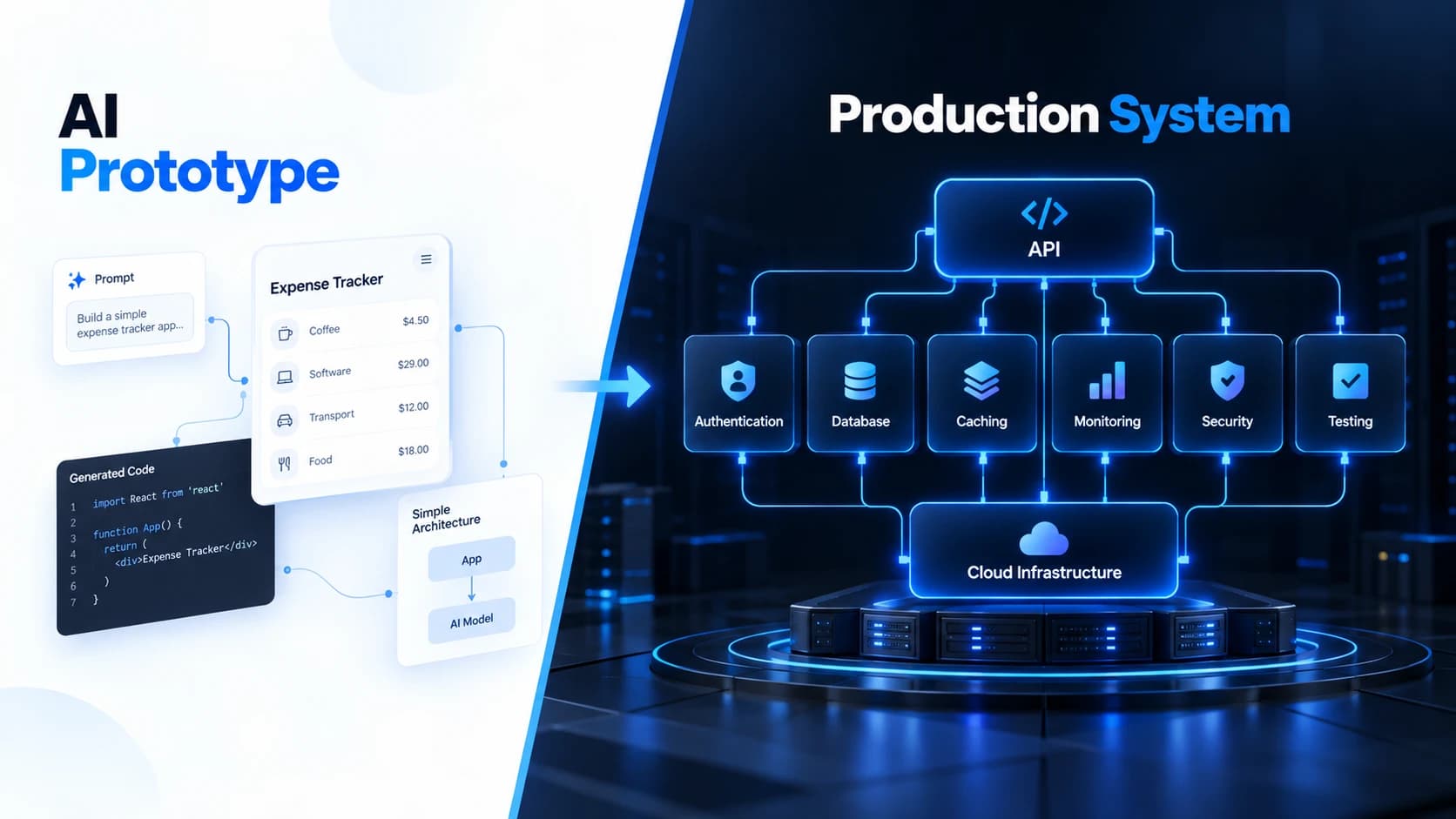
How to Turn an AI-Generated App Into Secure, Scalable, Production-Ready Software
AI can generate a working app fast. Learn what architecture, security, scalability, testing, and operations are needed before that prototype becomes production software.
Abdullah · · 18 min read

How iPhone Duo Resolution Changes Responsive Mobile App and Website Design
The iPhone Duo moves between compact and tablet-like displays, changing how apps and websites should handle layouts, safe areas, images, breakpoints, and performance.
Abdullah · · 12 min read
Top Things to Consider When Approaching a White Label Mobile App Development Service
Choosing a white label mobile app development service affects more than your development budget. Here is what to evaluate before trusting another team with a product that will carry your brand.
Khubaib Rasheed · · 9 min read