AI Voice Agents for Bookings: What They Handle Well and Where They Still Fail
A practical look at what AI phone agents can automate for service businesses, where they still need people, and what makes a booking workflow reliable.
Sections
A customer calls your business at 8:30 in the evening. They want to know if you have an appointment tomorrow, what it costs, and whether they can move an existing booking.
If nobody answers, the customer has two choices: leave a message or call someone else.
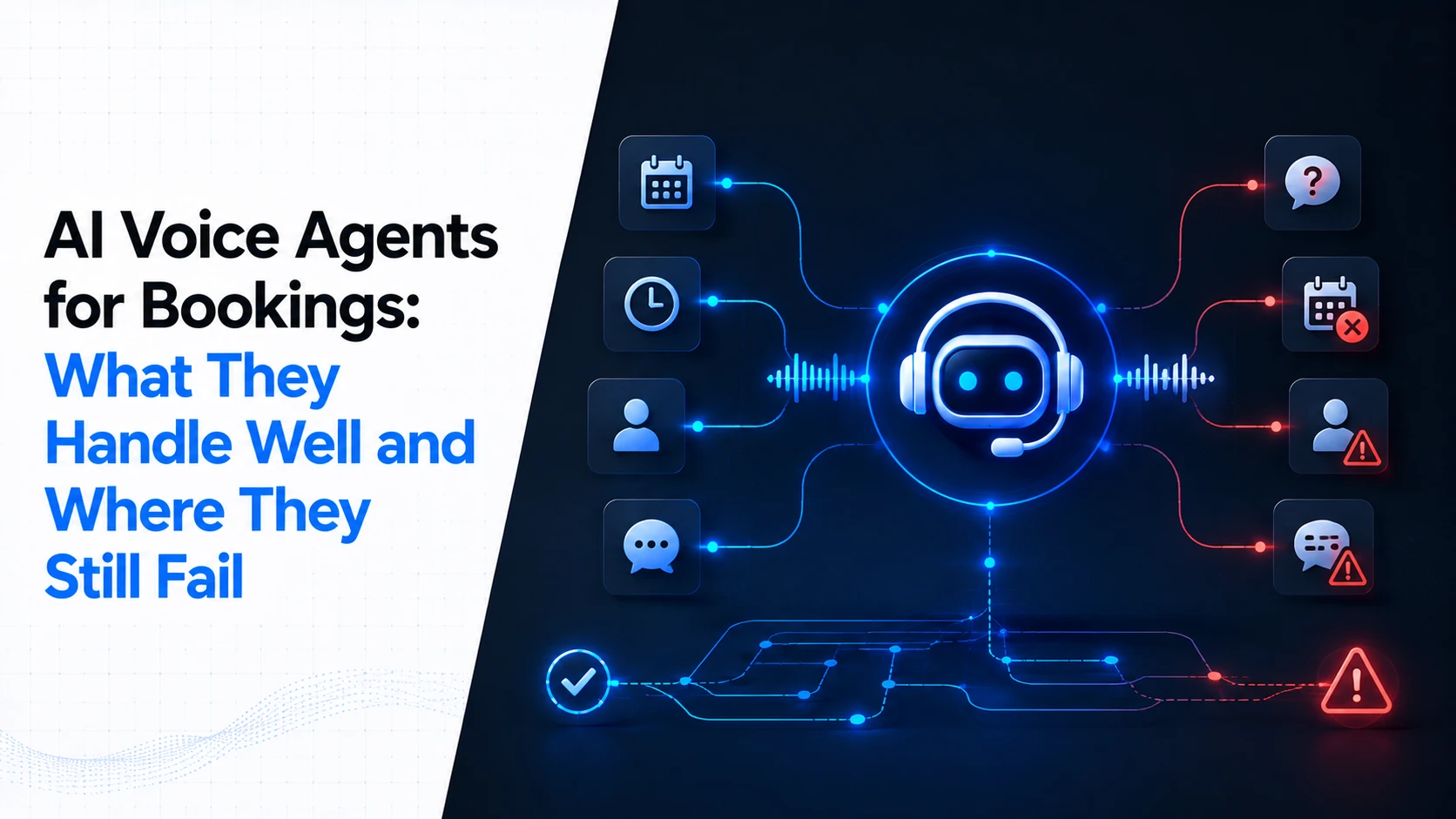
An AI voice agent appointment booking system changes that part of the process. It can answer the phone, understand what the caller wants, check the live calendar, offer available times, create the booking, and send a confirmation.
That sounds straightforward. In a controlled workflow, it can be.
The harder question is what happens when the caller asks something unexpected, the calendar is wrong, the customer wants an exception, or the AI is not confident about what to do.
That is where the difference between a useful AI receptionist for business and an expensive phone chatbot becomes clear.
What an AI voice agent can actually do
A modern AI phone agent can hold a spoken conversation instead of forcing the caller through a menu of fixed options.
For appointment booking, the basic workflow is usually:
- The caller phones the business.
- The AI answers and identifies the reason for the call.
- It asks for the information required to make the booking.
- It checks the connected calendar or booking system.
- It offers available times.
- The caller chooses a slot.
- The AI creates the appointment.
- The customer receives confirmation.
Current 2026 voice-agent systems support this type of live calendar workflow. CloudTalk, for example, documents a booking skill that checks Google or Outlook availability, proposes times, confirms the caller's choice, and creates the event during the call.
The important word is connected. The AI should not guess whether an appointment is available. It should check the actual scheduling system.
Where AI voice agents work well
Simple appointment booking
This is the strongest starting point.
If a customer wants the next available haircut, consultation, training session, inspection, or service visit, the process usually has a clear sequence.
The AI can collect the required details, check availability, and book the slot without asking an employee to answer a routine call.
This is especially useful for businesses where the front desk is busy serving customers who are already there.
Rescheduling and cancellations
Existing appointments can also be handled when the booking system exposes the information the agent needs.
The caller can say that they need to move their appointment. The agent can locate the booking, check alternative times, confirm the change, and update the calendar.
The important part is confirmation. The agent should verify which appointment the customer means and confirm the new slot before changing anything.
Common business questions
An AI receptionist for business can also answer predictable questions around the booking process.
Examples include opening hours, service availability, locations, cancellation rules, appointment length, and other information the business has clearly defined.
CloudTalk's current AI receptionist documentation also describes agents answering common questions, capturing caller intent, and routing callers to the right person.
This is where a good knowledge base matters. If the business information is outdated, the agent can confidently give the wrong answer.
After-hours calls
Appointment businesses do not stop receiving calls when the front desk closes.
An AI phone agent can answer those calls and complete simple bookings without requiring an employee to stay available.
This can be useful for gyms, salons, clinics, home-service businesses, and consultants where customers often make appointments outside normal office hours.
The value is not simply that the AI works at night. The value is that the customer can complete a useful action instead of waiting for a callback.
Where AI voice agents still fail
The technology has improved, but a voice agent is still a system operating inside a business. It does not automatically understand every exception your staff deals with.
Unusual requests
A customer may ask for something outside the normal booking rules.
They may want a special price, request a service that is not listed, ask for an exception to the cancellation policy, or explain a complicated situation.
These are poor situations for an agent to improvise.
The safer approach is to define the boundary and hand the call to a person.
Calendar problems
If the calendar contains incorrect availability, the AI can only work with the information it receives.
There is also a difference between calendar availability and operational availability.
A technician might appear free on a calendar but be unavailable because they are travelling between jobs. A clinic might have an open appointment slot but require a specific staff member or room. A trainer might have an opening that does not match the class capacity.
The booking system needs to represent the actual business rules. Otherwise, the AI may make a technically valid booking that is operationally wrong.
Ambiguous conversations
People do not always speak clearly on the phone.
They change their minds, interrupt, give incomplete information, mention several requests at once, or refer to an appointment without giving enough detail.
A good agent should clarify when it can. When it cannot, it should stop rather than continue guessing.
Emotion and complaints
A caller who is upset may not want an AI to solve the problem.
The agent can collect basic information and route the call, but there is little value in forcing a difficult conversation through automation.
A human handoff should be easy and visible.
The human handoff is part of the product
One of the biggest mistakes in an AI phone agent 2026 project is treating human escalation as a failure.
It is actually part of the design.
The agent should know which situations require a person and what information to pass along when that happens.
For example, if a customer calls to reschedule a booking but also complains about a previous service, the agent can handle the simple scheduling part and then route the complaint to the right employee.
Modern voice-agent platforms increasingly provide explicit transfer, routing, knowledge, and guardrail features because these boundaries are necessary for real-world use.
The goal is not to keep every call away from employees. The goal is to keep employees focused on the calls that actually need them.
What a reliable booking workflow needs
A live calendar connection
This is the foundation.
The agent needs access to real availability and the ability to create or modify bookings through the system the business actually uses.
Without that connection, the agent is only taking messages.
Clear booking rules
The business needs to define the rules before the AI goes live.
That includes appointment length, working hours, buffer periods, staff availability, service types, cancellation rules, and any information required before a booking can be confirmed.
Not every business has simple rules. That is fine. The rules just need to be represented somewhere the system can use.
Accurate business information
The AI should have access to current information about services, prices, locations, opening hours, and policies.
CloudTalk's current implementation guidance makes the same point from another angle: an AI agent is only as useful as the information and rules it is given, which is why knowledge bases and guardrails are part of the setup.
A clear escalation path
Every business should decide what happens when the AI cannot complete the request.
Possible actions include transferring the caller, scheduling a callback, taking a message, or sending the relevant information to a staff member.
The correct choice depends on the business. A clinic may need a different escalation process from a gym or home-service company.
Call logging
The business should be able to see what happened after the call.
At minimum, that can mean the booking outcome and basic call information. More advanced systems can also connect the conversation to a CRM or internal workflow.
This makes it easier to find failed bookings, improve the agent, and understand which requests still need human attention.
What an AI receptionist should not do
An AI receptionist should not be given unlimited authority just because the technology allows it.
There are good reasons to keep some actions behind a human review.
- Making unusual refunds or financial decisions.
- Giving professional medical or legal advice.
- Changing important customer records without verification.
- Making exceptions to business policies without approval.
- Handling sensitive information beyond what the workflow requires.
- Making promises about services or outcomes that the business has not approved.
These boundaries are not signs that the AI is weak. They are signs that the system has been designed around the real risks of the business.
What does an AI voice agent cost?
There is no single price for an AI booking agent.
The cost depends on whether you use an off-the-shelf voice platform or build a custom workflow, how many calls you handle, which AI and telephony services are involved, and how deeply the agent needs to connect to your existing systems.
Some current voice-agent vendors advertise per-minute pricing, while others combine usage with platform or subscription fees. The published prices are therefore difficult to compare without looking at what is actually included.
Leadlock's 2026 booking guide, for example, publishes an all-in rate starting at $0.12 per minute on its platform, while other providers use different combinations of voice, model, telephony, and subscription charges. Those figures are vendor-specific and should not be treated as a general market price.
For a business evaluating the technology, the more useful calculation is:
- How many calls do we receive?
- How many are currently missed?
- How many of those calls are booking-related?
- How much staff time goes into routine calls?
- What percentage of calls can the agent realistically complete?
- What will the AI, telephony, integration, and maintenance costs be?
That gives you a business case instead of a software price comparison.
Do not compare AI against a receptionist in isolation
It is tempting to ask whether an AI agent is cheaper than hiring a receptionist.
That is not always the most useful comparison.
A better question is what work you want the system to handle.
If your front-desk employee spends most of the day dealing with customers in person, an AI agent can take routine phone calls without replacing the person.
If the business already has a receptionist answering a manageable number of calls, an AI agent may not create enough value to justify the change.
If the business regularly misses calls during busy periods or after hours, the calculation can look very different.
The right deployment depends on the workflow, not on the assumption that AI should replace a particular job.
Where this works particularly well
Gyms and fitness businesses
Gyms receive repetitive questions about memberships, classes, trial sessions, schedules, and bookings.
An AI agent can handle many of those conversations and send the more complex requests to staff.
For businesses building a broader digital fitness experience, fitness and sports software can provide a foundation for combining customer-facing and operational workflows.
Clinics and wellness businesses
Appointment requests are a natural use case, but healthcare requires stricter boundaries.
An agent can help with administrative scheduling and basic information. It should not be treated as a replacement for professional medical judgment.
When booking is part of a larger digital workflow, healthcare and wellness software can support a more controlled approach.
Home-service businesses
For plumbers, repair companies, cleaning businesses, maintenance providers, and similar services, a booking is often connected to staff or technician availability.
The agent may need to collect the customer's location, service type, urgency, and other details before offering a time.
When the workflow becomes more complex, on-demand services software can provide the wider application layer around the booking process.
When an off-the-shelf voice agent is enough
You probably do not need custom development if your workflow is simple.
An existing voice-agent platform can be a good fit when you need a standard receptionist, basic questions, appointment booking, and straightforward calendar integration.
This approach lets you test the workflow without building the entire system from scratch.
It is especially sensible when your existing booking system already exposes the information and actions the agent needs.
When custom development becomes worthwhile
Custom development becomes more interesting when booking is only one part of a larger operational process.
Imagine a service company where a call needs to create a customer record, classify the job, check a service area, assign a technician, calculate availability, schedule the visit, notify the team, and update the customer's account.
That is no longer just a receptionist.
It is a business workflow.
At that point, building the voice capability into a broader application can provide more control than adding another disconnected tool. Custom software development can be useful when the workflow depends on business-specific rules and systems.
If the application itself needs AI capabilities across customer and operational workflows, AI-assisted application development can be a more natural fit than treating voice AI as a separate product.
How to test an AI booking agent before trusting it
Do not judge the system only from a successful demo.
Test the awkward calls too.
- Ask to book an unavailable time.
- Interrupt the agent while it is speaking.
- Change the requested service halfway through the call.
- Ask for something outside the approved services.
- Try to reschedule an existing booking.
- Give incomplete customer information.
- Ask a question that the knowledge base does not answer.
- Request a human.
- Simulate a calendar or integration failure.
- Speak quickly, slowly, or with background noise.
Then check what happened in the booking system.
Did the right appointment get created? Did the agent avoid double-booking? Did it preserve the customer's information? Did it escalate when it should?
This testing is more useful than listening to five perfect demo calls.
The front desk does not have to disappear
The strongest case for AI voice agents is not that businesses no longer need people.
It is that people should not have to spend their time answering the same simple booking question dozens of times a day.
An AI agent can answer the call, handle the predictable part, and pass the important part to a person.
That makes the technology useful even when the business keeps a human front desk.
For a service business, the practical goal is simple: let customers complete routine bookings when they need to, while giving staff a clear path for everything that needs judgment.
That is what a good AI receptionist for business should do in 2026.
Keep reading

How Much Does It Cost to Build a Mobile App in 2026?
How much does a mobile app cost in 2026? Explore realistic development price ranges, MVP costs, major pricing factors, hidden expenses, and ways to budget smarter.
Khubaib Rasheed · · 17 min read
Old Is Gold: Why Custom Mobile Apps Still Matter in the AI Era
AI can add real value, but it can also add data, vendor, security, and compliance complexity. Here is why some custom mobile apps are better without it.
Khubaib Rasheed · · 17 min read
How to Turn an AI-Generated App Into Secure, Scalable, Production-Ready Software
AI can generate a working app fast. Learn what architecture, security, scalability, testing, and operations are needed before that prototype becomes production software.
Abdullah · · 18 min read