Custom Software vs SaaS Subscriptions: The Real 5-Year Cost
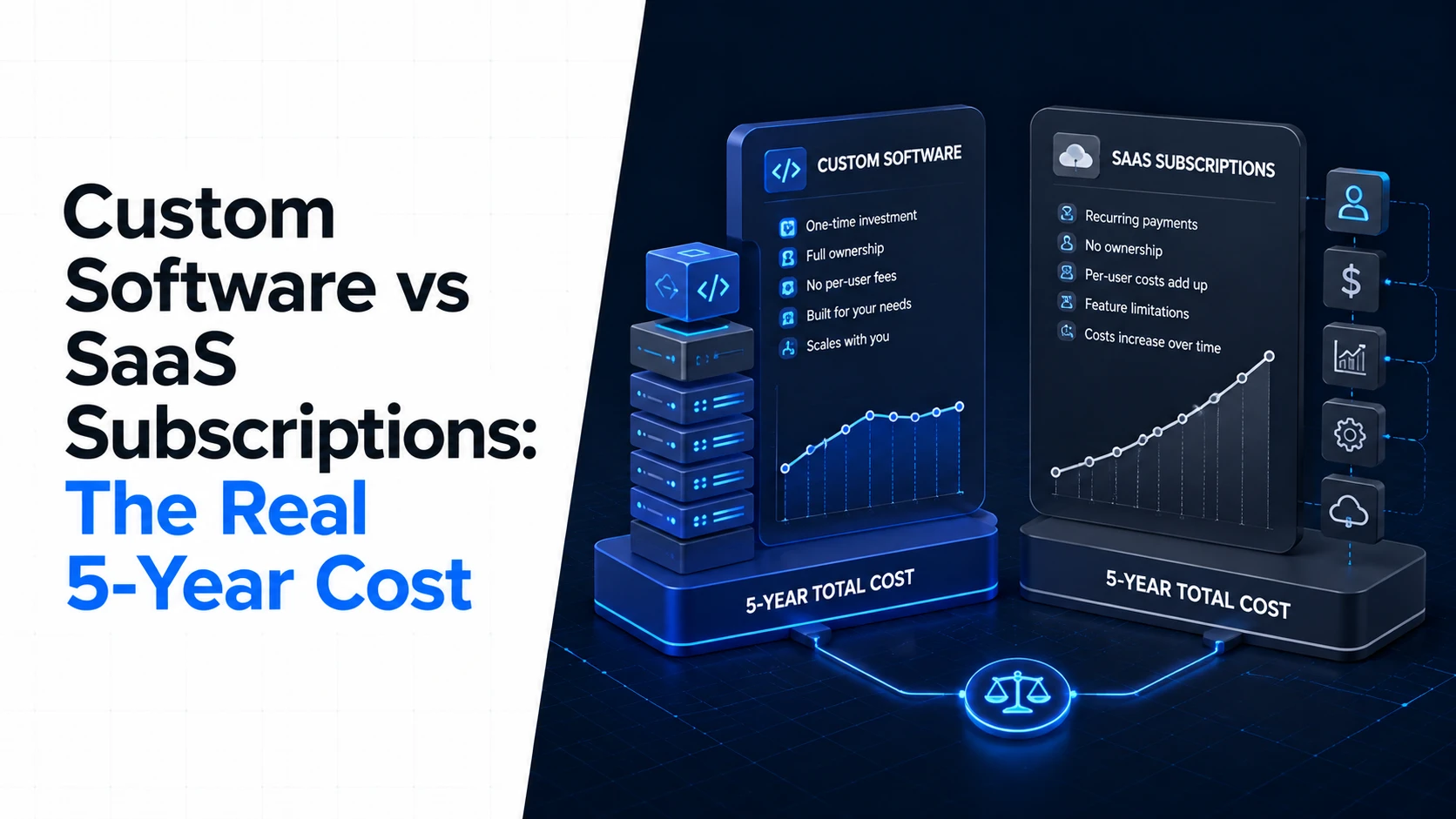
The five-year cost of software is often much higher than the subscription bill.
Sections
Five software subscriptions can look like a sensible way to run a growing business. One tool handles customer records. Another manages projects. A third handles support. Someone else owns reporting, while a separate automation tool connects everything together.
Each purchase makes sense on its own. The problem appears when the tools become the workflow.
People export data from one system and import it into another. Managers ask for updates because the dashboard is missing context. Teams maintain spreadsheets because two platforms do not share the same information. Employees remember which system contains the latest version of a record.
That is the real question behind custom software vs SaaS: what does the entire system cost over five years, not what does each subscription cost this month?
A 2026 survey of 817 enterprise builders found that 35 percent had already replaced at least one SaaS tool with a custom build, while 78 percent expected to build more custom internal tools during 2026. The same survey found that workflow automation and internal administration were among the SaaS categories facing the most replacement pressure.
The five-year view changes the build vs buy decision
SaaS is often easier to start with because the initial cost is low. You can sign up, configure the product, train the team, and start working without funding a full software project.
That does not make SaaS the cheaper option over five years.
A useful comparison includes the recurring subscription, user growth, upgrades, integrations, implementation, training, and the staff time spent working around limitations. For custom software, the calculation includes design, development, hosting, maintenance, support, training, and future improvements.
The important difference is how the cost behaves. SaaS keeps generating a bill for as long as you need the product. Custom software moves more of the spending toward the beginning and gives the business control over the system afterward.
Imagine five tools that do not share the same workflow
Consider a company with 20 employees using five core SaaS products. For a simple example, assume each product costs an average of $50 per user per month.
That creates a direct subscription cost of $60,000 per year, or $300,000 over five years, before considering price increases, extra seats, premium features, or add-ons.
Now add the work between those systems.
Customer information is copied between the CRM and another operational system.
Project status is updated manually for management reporting.
Support information is checked before an account can be approved.
Finance exports data because the reporting tool does not contain everything it needs.
Automation rules are added to move information between systems.
The subscription bill is still $300,000 in this example. The operating cost is not.
The hidden SaaS tool sprawl cost
Recent SaaS-sprawl research shows why the problem is becoming harder to ignore. One 2026 review reports that the average company runs about 275 SaaS applications, with estimates ranging from roughly 152 at smaller companies to 660 at large enterprises. It also reports that 53 percent of SaaS licenses sit idle.
The exact figures vary by research method, but the broader point is consistent: companies are paying for large software estates, and not all of that software is being used efficiently.
There is another cost that does not appear on the software invoice: coordination.
When information lives in separate systems, employees become the integration layer. They copy, check, reconcile, explain, and chase information. That work may be small for one transaction. Across thousands of transactions, it becomes a meaningful operating cost.
Five costs to include in a real comparison
1. Subscription and user costs
Start with the obvious numbers. Record the current annual subscription for every tool and then model how the business is likely to grow.
A company that adds employees will usually add seats. Some products also charge more as usage, storage, reporting needs, or feature requirements increase.
2. Integration costs
Five tools often need five different ways to exchange information.
You may need APIs, automation services, middleware, custom connectors, or ongoing integration maintenance. These costs are easy to overlook because they are spread across different budgets.
More importantly, every integration creates another dependency. When one vendor changes its API or data model, someone has to deal with the change.
3. Manual work and workarounds
This is where the SaaS tool sprawl cost becomes more difficult to measure.
If employees spend ten minutes moving information between systems, that may not look serious. If 20 employees do it several times each week, the business is paying for that work in salaries rather than software invoices.
The same applies to spreadsheets, manual approvals, duplicate data entry, exports, and reconciliation.
4. Business constraints
A SaaS product is designed for a broad market. Your business is not.
Sometimes the difference is harmless. Sometimes a limitation forces the team to change a process that should have been simple.
Custom software becomes more attractive when the workflow itself is important to how the business operates and when adapting the business to the software creates repeated friction.
5. Future changes
A five-year comparison should include what happens when the business changes.
Will you need another integration? More users? A new approval flow? Different reporting? A new customer portal? More automation?
With SaaS, each requirement may mean another product, another tier, or another integration. With a custom platform, the same requirement can become part of the product you already own.
When custom software starts to make financial sense
Custom software does not automatically become cheaper just because a company has several subscriptions. Building software requires a meaningful upfront investment, and ownership brings ongoing maintenance responsibilities.
The business case becomes stronger when several conditions appear together.
The same information moves between multiple systems every day.
Your team maintains spreadsheets because the existing tools do not support the workflow.
Subscription costs increase as the team grows.
Several tools perform parts of one larger business process.
Integrations require regular maintenance.
The workflow is specific enough that generic SaaS products create repeated compromises.
The software will remain central to the business for several years.
In these situations, the question is no longer simply whether custom software costs more to build. It is whether continuing to rent and connect several systems costs more than owning one system designed around the work.
A simple five-year example
Suppose the five SaaS tools in our example cost $300,000 over five years. Now assume the company spends another $20,000 per year on integrations, automation, and other recurring software-related work. That brings the five-year total to $400,000 before counting internal time spent on manual work.
Now imagine a custom platform costs $220,000 to design and build, followed by $25,000 per year for hosting, maintenance, and ongoing improvements.
Over five years, that would be $345,000.
The example does not prove that custom software will always be cheaper. The numbers will change from one business to another. It shows why the comparison needs to include the full operating model rather than comparing a monthly subscription with a development quote.
Do not build everything just because you can
The 2026 build vs buy discussion is not an argument for replacing every SaaS product.
Some software is a good fit precisely because you do not need to own it. If a product solves a common problem well, has a reasonable cost, and does not create significant workflow friction, replacing it may add unnecessary complexity.
The strongest candidates for consolidation are usually the systems sitting in the middle of a business-critical workflow.
For example, a company might keep a general accounting platform while replacing three smaller operational tools that sit between sales, fulfillment, and customer support. The goal is not to build a replacement for every application. The goal is to remove unnecessary handoffs where ownership creates a better long-term result.
One platform can remove more than subscription fees
The biggest benefit of consolidation may not appear in the software budget.
When the right processes live in one platform, employees can work from the same data. Approvals can follow the actual business rules. Reporting can use the same source as operations. New features can be added to the system instead of creating another layer around it.
This is especially relevant for businesses with complex operational workflows. In logistics, for example, customer, supplier, driver, dispatch, and delivery information can become difficult to manage when each part of the process depends on a different system. A purpose-built platform can bring those workflows together around the way the business actually operates.
That does not mean every logistics company needs custom software. It means the decision should be based on the cost and friction created by the current workflow.
How to decide if you should replace your SaaS stack
Start with the workflow, not the software.
List the five to ten tools that employees use most often.
Map where information moves from one tool to another.
Record the annual subscription and integration costs.
Estimate the staff time spent on exports, data entry, reconciliation, and workarounds.
Identify which tools are essential to the business process and which simply support a common task.
Model the likely five-year cost as the team and workflow grow.
Compare that number with the estimated cost of building and maintaining a focused custom platform.
This exercise often gives you a clearer answer than a simple SaaS versus custom software feature comparison.
The real build vs buy question in 2026
Software buying has become easier. That is useful, but it also makes it easier to accumulate tools without deciding how they fit together.
The latest enterprise research suggests that custom internal software is becoming a more serious part of the build vs buy decision. SaaS-sprawl research shows why: companies are managing hundreds of applications, unused licenses remain common, and consolidation is not happening automatically.
For a business with a stable workflow, growing software spend, and too many systems that need to talk to each other, five years can reveal a very different cost picture.
The right question is not, “Which option is cheaper this year?”
It is, “Which system will cost less to operate, change, and depend on over the next five years?”
For companies that have reached that point, custom software development can be a practical way to replace disconnected tools with a system built around the business. For companies that need to create a product for external customers, SaaS development may be the better direction.
Keep reading
How Much Does It Cost to Build a Mobile App in 2026?
How much does a mobile app cost in 2026? Explore realistic development price ranges, MVP costs, major pricing factors, hidden expenses, and ways to budget smarter.
Khubaib Rasheed · · 17 min read

Old Is Gold: Why Custom Mobile Apps Still Matter in the AI Era
AI can add real value, but it can also add data, vendor, security, and compliance complexity. Here is why some custom mobile apps are better without it.
Khubaib Rasheed · · 17 min read
How to Turn an AI-Generated App Into Secure, Scalable, Production-Ready Software
AI can generate a working app fast. Learn what architecture, security, scalability, testing, and operations are needed before that prototype becomes production software.
Abdullah · · 18 min read