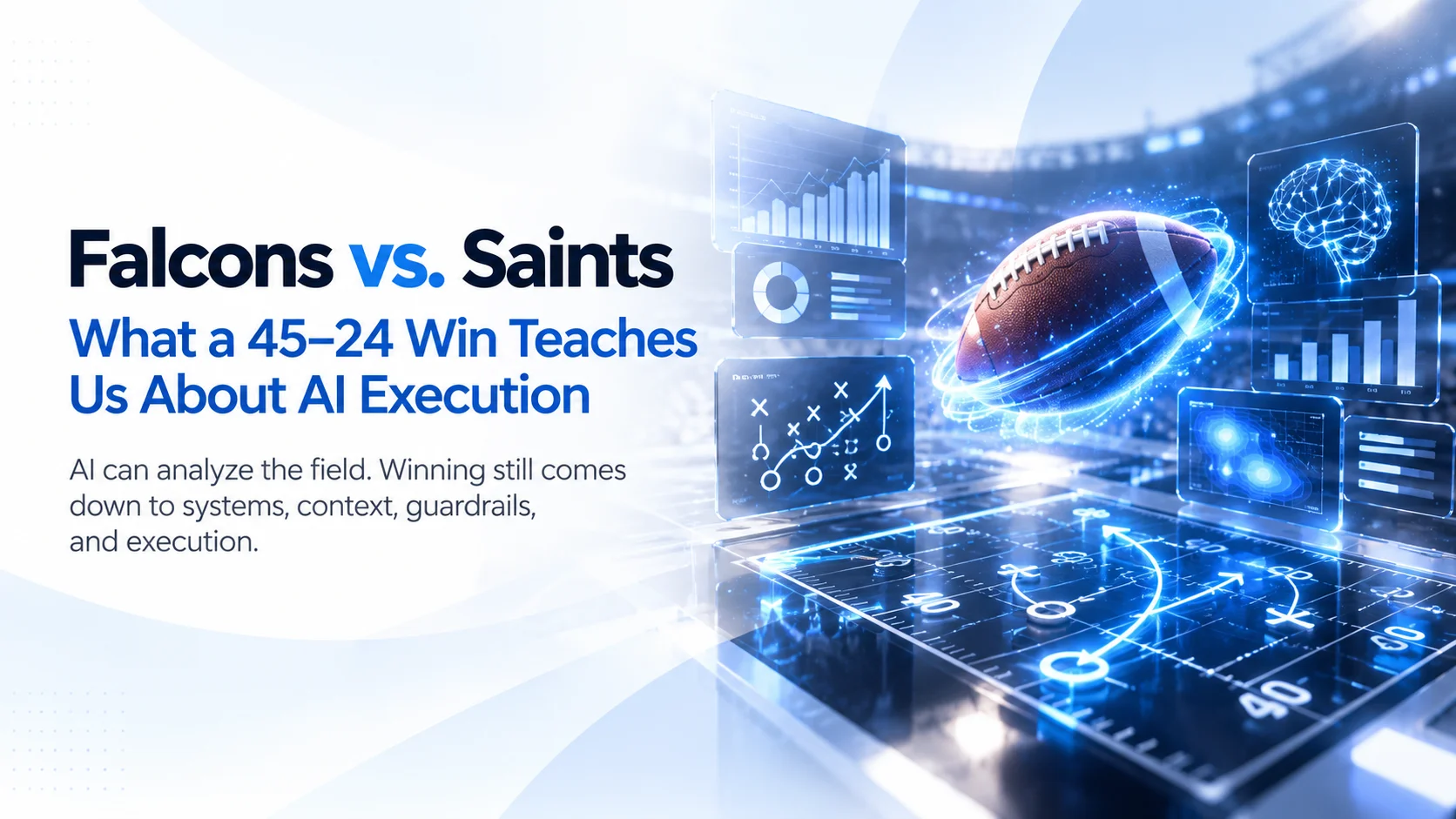
Falcons vs. Saints: What a 45–24 NFL Win Teaches Us About Building Better AI Products
Atlanta’s 45–24 win over New Orleans was a reminder that insight only creates value when a system can execute. The same is true for AI products.
Sections
On October 5, 2026, the Atlanta Falcons walked into the Caesars Superdome and beat the New Orleans Saints 45–24 on Monday Night Football. The final score was decisive, but the numbers underneath it tell an even more interesting story. Atlanta finished with 420 total yards, including 205 on the ground, averaged 7.5 yards per play and completed the game without a turnover.
Bijan Robinson rushed for 145 yards and two touchdowns, while Brian Robinson Jr. added another 62 yards and three rushing touchdowns. Atlanta was already ahead 24–7 at halftime and remained in control as the game developed. New Orleans actually ran more offensive plays, but Atlanta turned its opportunities into considerably more yards and more points.
Football and artificial intelligence are obviously very different things, but there is a useful product lesson hidden inside those numbers. Having information, identifying opportunities and understanding what might happen are not the same as executing effectively. That distinction is becoming increasingly important as AI gets more capable and access to strong models becomes easier.
AI Is Becoming Very Good at Seeing the Field
Modern AI can process enormous amounts of information, summarize documents, identify patterns, classify data, reason through alternatives, generate software, recommend actions and increasingly interact with external tools. For many businesses, capabilities that would have required a specialized technical project only a few years ago can now be accessed through an API.
That creates an interesting change in the competitive landscape. A growing number of companies can access leading model families from OpenAI, Anthropic, Google and other providers. Open-weight models provide even more options. Model choice still matters, and different models can perform very differently on particular tasks, but simply having access to AI is becoming less distinctive.
The more important question is what the business builds around that intelligence. A model can produce an excellent answer and still be part of a poor product. It can receive incomplete information, retrieve the wrong customer record, violate a business rule, call the wrong tool, spend too much money completing a task or produce an output that nobody verifies before it affects a real user.
In other words, AI may help a product see more of the field. The system around the AI still has to execute the play.
The Falcons Turned Opportunities Into Results
One of the most interesting statistics from the Falcons-Saints game is that New Orleans ran 69 offensive plays while Atlanta ran only 56. Yet Atlanta generated 420 yards compared with New Orleans' 320 and averaged 7.5 yards per play compared with 4.6. More activity did not produce the better result. Atlanta was simply far more effective with the opportunities it had.
The Falcons also protected possession. They finished with zero turnovers while New Orleans lost one. Their running game repeatedly converted drives into points, with Bijan Robinson and Brian Robinson Jr. combining for five rushing touchdowns. The advantage was not one isolated highlight. It came from several parts of the team's execution working together.
That is a useful way to think about AI products. A team can generate thousands of AI responses, use the largest model available and add an AI feature to every screen without creating much business value. Another team can use AI in one carefully selected workflow, connect it to the right information, define clear boundaries and make that workflow considerably more useful for customers.
Access to AI Is Becoming Common. Reliable AI Products Are Not.
The first wave of AI adoption was largely about access. Businesses wanted to know whether generative AI could answer questions, write content, generate code or summarize information. The next phase is increasingly about integration and execution. The question is no longer simply whether the model can perform a task during a demonstration. It is whether the complete product can perform that task repeatedly under real conditions.
This is where the surrounding software becomes important. A production AI feature may need customer data, permissions, retrieval, business rules, external APIs, validation, logging, cost controls, fallback behavior and human approval. The model is an important component, but it operates inside a much larger product system.
This is also why we approach AI-assisted application development as a product and engineering problem rather than simply connecting an application to a model API. The useful question is not “Where can we add AI?” It is “Which customer or business problem becomes meaningfully better if AI is part of the workflow?”
What Actually Sits Around a Production AI Model?
If the model itself is only one component, what determines whether the complete system works? The exact architecture depends on the product, but several layers consistently become important when an AI feature moves from experimentation into production.
1. A Clear Workflow
Before choosing a model, the team should understand the job. What information enters the workflow? What should the AI produce? Which tools can it use? What represents success? What happens when information is missing? Which situations should stop the workflow and involve a person instead?
This sounds simple, but many AI implementations start in the opposite direction. A team chooses a model first and then looks for places to use it. That can produce impressive demonstrations without creating a reliable product. A defined workflow gives the AI a specific role inside a system rather than allowing the model to become the system.
2. Reliable Context and Data
A capable model working with poor information can still make poor decisions. An AI support assistant needs current customer and product information. An AI recommendation engine needs relevant user context. An operations agent may need access to orders, schedules, inventory or internal policies.
Giving the model more information is not automatically better either. The system has to retrieve the right information at the right moment and make sure the user or AI has permission to access it. Context quality often matters as much as raw model intelligence because the model can only reason from the information it receives.
3. Business Rules and Guardrails
Some decisions should not depend entirely on what a language model decides to generate. Permissions, financial limits, eligibility rules, safety constraints and other important business requirements should often be enforced by application logic outside the model.
Our AL IFF case study provides a practical example. The product includes AI outfit generation, but the production system also includes a dedicated modesty-rule layer, user feedback through accept, swap and reject actions, quota management, caching and streaming. The AI generates useful intelligence, while the surrounding product controls how that intelligence is delivered and constrained.
This separation makes an AI product easier to understand and maintain. The model can change without requiring every important business rule to be rediscovered inside a new prompt.
4. Evaluations and Testing
Traditional software usually produces predictable outputs from defined inputs. Generative AI is more variable. The same request can sometimes produce different answers, and changing a prompt or model can improve one type of request while unexpectedly making another worse.
AI teams therefore need their own version of a scoreboard. That can include task-success rate, retrieval accuracy, user corrections, failed tool calls, rule violations, escalation rate and other metrics that describe whether the complete workflow is actually succeeding.
Evaluation should also include realistic and difficult cases rather than only examples that make the system look good. If an AI feature cannot be measured, teams can easily confuse an impressive demonstration with a reliable product.
5. Human Judgment and Escalation
AI does not have to make every decision simply because it technically can. A well-designed system should understand where human judgment remains useful or necessary. High-impact actions, unusual situations and low-confidence outputs may need review rather than another attempt by the model.
This is especially important in workflows involving customer relationships, payments, sensitive information, operational commitments or decisions that are difficult to reverse. Human involvement should not necessarily be treated as evidence that the AI failed. In many products, designing the right human-AI handoff is part of the solution.
6. Cost, Latency and Observability
An AI feature can work technically and still be unsustainable as a product. Model calls cost money. Long contexts increase usage. Agentic workflows can require multiple calls and tool interactions. Slow responses affect user experience, while repeated failures can multiply costs without producing useful results.
Production systems therefore need visibility into what the AI is doing. Teams should be able to inspect failures, understand which tools were called, measure latency, track usage and identify where requests are becoming expensive. These operational details may receive less attention than model intelligence, but they often determine whether the feature remains useful at scale.
We discuss many of these production concerns in more detail in our guide to turning an AI-generated app into production-ready software.
The Best Model Is Not Automatically the Best Product
Model comparisons are useful, but businesses can easily ask the wrong question. “Which AI model is best?” sounds straightforward, yet the answer changes depending on the work being performed. A customer support workflow, coding agent, document extraction system and recommendation engine may value very different characteristics.
A better process is to define the workflow first and create a realistic evaluation set from the situations the product will actually encounter. Candidate models can then be compared on task success, reliability, latency, tool usage, cost and the amount of human correction required.
This changes model selection from a popularity contest into a product decision. The strongest benchmark result is not necessarily the model that creates the best economics or experience for a particular application.
It also reduces dependency on individual providers. When core business rules, product data, permissions and evaluations live in the application rather than being buried inside one prompt, teams have more flexibility to test different models as the market changes.
Founders Should Build an AI System, Not Just an AI Feature
Before adding AI to a product, founders and product teams should be able to answer a small set of practical questions:
What specific user or business outcome should improve?
What information does the AI need to perform the task?
Which actions should the AI be allowed to take?
Which rules must remain deterministic outside the model?
What happens when the model is uncertain or wrong?
When should a human take over?
How will task success, cost and latency be measured?
How will the team detect when a model or prompt change makes performance worse?
These questions are not as exciting as announcing that a product now uses the latest AI model, but they are closer to what determines whether customers can actually depend on the feature. The same principle applies to more autonomous systems. As we explain in our guide to AI agents for service businesses, the value of an agent comes from giving it a useful workflow, appropriate information and clear boundaries around what it should do.
Execution Is Becoming the Real AI Advantage
The Falcons-Saints game produced plenty of individual highlights, but the larger result came from execution across the full game. Atlanta generated yards efficiently, controlled the ground game, protected the football and repeatedly turned drives into points. The scoreboard reflected the system working together.
Something similar is happening in AI. Model capability is improving quickly, but access to capable models is also spreading quickly. That means the distance between companies may increasingly come from everything built around those models: proprietary context, workflow design, integrations, product experience, business rules, evaluations, monitoring and the judgment required to decide where AI should and should not operate.
AI can analyze the field, identify patterns and suggest the next move. That is valuable. But an intelligent recommendation does not create a business outcome by itself.
The product still has to execute.
Build the System Around the Intelligence
If you are planning an AI feature, assistant, recommendation engine or agent, start with the workflow rather than the model announcement. Define what the system needs to accomplish, what information it can trust, what rules must remain outside the model and how you will know whether the final experience actually works.
Next Level Software helps businesses design and build AI-assisted web and mobile products where the model is connected to the workflows, data, controls and production engineering required to create a dependable product. Explore our AI-Assisted Applications service if you are moving from an AI idea or prototype toward a system that needs to work reliably for real users.
Keep reading

Gemini 4 Argon: Everything You Need to Know About Google’s Most Powerful AI Model Yet
Google has launched Gemini 4 Argon, its new frontier AI model for coding, cybersecurity, AI agents, and long-horizon reasoning. Here is what we know about pricing, benchmarks, access, and how it compares with GPT and Claude.
Khubaib Rasheed · · 12 min read
How to Write Better AI Prompts in 2026: Context Engineering Over Prompt Tricks
Better AI results come from relevant context, clear expectations, and useful constraints. Learn a practical 2026 framework for prompting any capable AI model.
Khubaib Rasheed · · 10 min read

OpenAI Dots vs Meta Muse: The AI Agent War Has Officially Started
OpenAI Dots and Meta Muse signal a new phase in AI: always-on agents that keep working, use connected apps, and take action after the chat ends.
Khubaib Rasheed · · 12 min read