Gemini 4 Carbon vs Argon: Why Google Released Two Powerful AI Models in One Month
Why Google's newest frontier AI model focuses on cybersecurity, long-running coding agents, and more reliable software engineering.
Sections
Google has released two frontier AI models within one month, and the second announcement may be more important than the first.
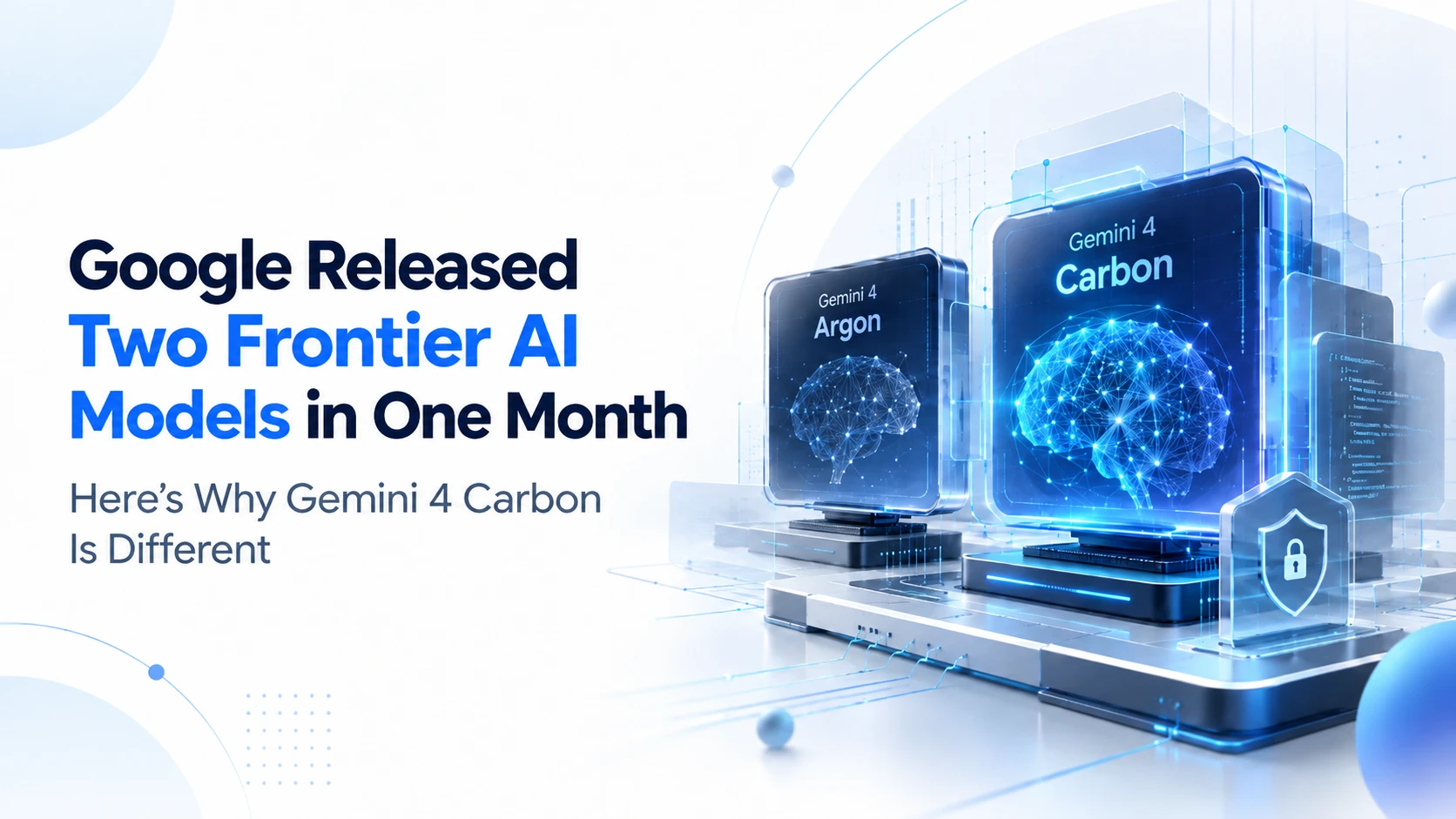
On September 30, 2026, Google DeepMind announced Gemini 4 Argon, a powerful reasoning model designed for complex software engineering, research, enterprise workflows, and cybersecurity. It became broadly available on October 13. Just 15 days later, on October 28, Google introduced Gemini 4 Carbon, a new frontier model with significant improvements in autonomous coding, cybersecurity, long-context reasoning, and reliable AI agent execution.
Two major model announcements within four weeks would attract attention on their own. But what makes Gemini 4 Carbon different is not simply that Google has improved its benchmark scores. Carbon appears to represent a stronger push toward AI systems that can investigate complicated problems, work across large codebases, identify security weaknesses, and carry out multi-step engineering tasks over extended periods.
Google reports that Carbon leads the Artificial Analysis Intelligence Index v5.0 with a score of 59, compared with 50 for Argon. It also achieved 88.2% on SEC-bench Pro for vulnerability discovery and 71.0% on CWE-bench for vulnerability patching. These results provide a useful picture of the model's strengths, although benchmarks alone cannot guarantee reliability in production software.
So why did Google introduce Gemini 4 Carbon so quickly after Argon? What has actually changed, and should developers or businesses building AI-powered applications pay attention? Let's examine the announcements, published benchmark results, pricing, and practical implications.
Google's Gemini 4 Timeline: Two Frontier Models Within One Month
Before comparing the models, it is important to understand the release timeline. Google's first Gemini 4 announcement took place at the end of September, followed by broader availability in October and then the Carbon announcement. For a deeper look at the first model, read our complete guide to Gemini 4 Argon.
September 30, 2026: Google officially announces Gemini 4 Argon, initially emphasizing advanced reasoning, long-horizon engineering, and access for selected cybersecurity defenders.
October 13, 2026: Gemini 4 Argon becomes available globally to developers and enterprises through supported Google platforms and to eligible Gemini subscribers.
October 28, 2026: Google announces Gemini 4 Carbon, highlighting improved coding performance, cybersecurity capabilities, reliability, and long-running autonomous workflows.
Late October 2026: Carbon begins a limited rollout to selected cybersecurity defenders, with broader access planned for a later stage.
Strictly speaking, the two models were announced within 28 days, rather than both first being announced in October. However, the broader Argon launch and Carbon announcement both occurred in October, which explains why this period represents such a significant month for Google's frontier AI development.
The timeline also reveals something important. Google did not wait for a traditional long release cycle before presenting another major model. Instead, it introduced a new model with measurable improvements in several difficult tasks, particularly security-focused engineering.
What Is Google Gemini 4 Carbon?
Gemini 4 Carbon is a frontier artificial intelligence model developed by Google DeepMind and announced on October 28, 2026. It builds on the Gemini 4 generation, with a particular emphasis on long-horizon AI agents, complex software engineering, cybersecurity defense, and more dependable execution of multi-step tasks.
A frontier AI model is a highly capable general-purpose model operating near the leading edge of available AI performance. Such models can process complex information, reason through challenging problems, generate code, work with tools, and support applications requiring more than simple text generation.
Gemini 4 Carbon is designed for more demanding workflows. Instead of merely generating a function or answering a technical question, a sufficiently capable AI coding agent may investigate an unfamiliar repository, locate a defect, examine dependencies, propose a fix, execute tests, and revise its implementation based on the results.
Google says Carbon has supported internal engineering workflows lasting days, including attempts to find and patch subtle defects across large codebases and low-level systems. These are Google-reported internal observations, not evidence that the model can independently deliver production-ready software without human supervision.
That distinction matters because the value of an AI engineering model increasingly depends on whether it can sustain progress through uncertainty, verification, and correction, not just produce plausible code quickly.
Gemini 4 Carbon vs Gemini 4 Argon: What Is Actually Different?
Both Gemini 4 models target complex workflows, including coding, reasoning, and cybersecurity. Carbon is therefore not a completely different category of AI product. Its main distinction is stronger reported performance, especially in security-sensitive and long-running engineering tasks.
CategoryGemini 4 ArgonGemini 4 CarbonOriginal announcementSeptember 30, 2026October 28, 2026Main positioningDeep reasoning, enterprise work, coding, and researchAdvanced coding, cybersecurity, and sustained agentic workflowsArtificial Analysis Intelligence Index v5.05059Terminal-Bench 4.0 (AA)57.1%65.2%FrontierSWE 255.0%61.2%SEC-bench Pro83.4%88.2%ExploitGym42.0%54.8%CWE-bench68.0%71.0%Availability on October 29Available through supported developer and consumer productsInitially limited to selected cyber defendersAnnounced introductory API pricing$2 input / $10 output per million tokens$2 input / $10 output per million tokens
The benchmark comparisons above use Google's published Gemini model performance table and the accompanying Artificial Analysis comparisons. A benchmark score describes performance under a particular evaluation method. It should not be interpreted as a universal success rate for everyday development projects.
Carbon's improvement is especially notable in technical evaluations where the AI must perform multiple operations rather than generate a single response. These include terminal-based tasks, codebase investigation, vulnerability validation, and software repair.
1. Gemini 4 Carbon Makes a Stronger Push Into AI-Powered Cybersecurity
One of the most significant aspects of the Gemini 4 Carbon announcement is its cybersecurity performance. Google presents Carbon as an improvement across three important stages of defensive security work: finding vulnerabilities, determining whether a vulnerability is exploitable, and developing a patch that addresses the underlying cause.
Finding vulnerabilities in real software
Carbon achieved 88.2% on SEC-bench Pro, compared with 83.4% for Argon in Google's published comparison. This benchmark measures the ability to identify security weaknesses in realistic software environments.
For engineering teams, vulnerability discovery matters because security problems are not always obvious or isolated. They can emerge from interactions between dependencies, permissions, validation logic, and application architecture. An AI model capable of investigating these relationships could become a valuable assistant during security reviews.
Validating whether weaknesses can be exploited
Carbon scored 54.8% on ExploitGym, compared with 42.0% for Argon. This evaluates capabilities related to testing exploitability, which can help authorized defenders distinguish potentially serious weaknesses from findings that are not practically exploitable in a given environment.
The result also explains why cybersecurity AI models require careful release controls. Capabilities useful for legitimate defensive assessment may also create misuse risks. Google's decision to provide Carbon initially to selected cyber defenders reflects this concern.
Fixing security issues at the root cause
Carbon also reached 71.0% on CWE-bench, compared with Argon's 68.0%. This benchmark focuses on addressing software vulnerabilities through code changes.
Finding a problem is only the beginning. Engineering teams must understand why the vulnerability exists, determine which parts of the system are affected, produce a safe correction, and confirm that the fix does not introduce new problems.
Google additionally reports that Carbon delivered more than twice Argon's success rate for secure-code generation on internal evaluations. This is an encouraging result, but security engineers should still independently review generated patches, run regression tests, and verify the security properties of the final implementation.
2. Carbon Is Designed for Long-Horizon AI Coding Agents
Another major difference between Gemini 4 Carbon and Argon is the emphasis on long-horizon software engineering. Long-horizon tasks require an AI system to maintain context, follow a plan, work through obstacles, and complete several dependent steps without losing track of its objective.
Consider a SaaS application where users report that payment records sometimes appear twice. A basic coding assistant might suggest adding a condition to stop duplicate records. A more capable agentic coding system could inspect the payment workflow, examine webhook processing, investigate database constraints, reproduce the issue, propose an idempotency strategy, and test the implementation against concurrent requests.
This example illustrates the kind of workflow advanced AI coding agents are intended to support. It is not a claim that Carbon has successfully performed this specific task in an independent production evaluation.
Google's benchmark table shows Carbon reaching 65.2% on Terminal-Bench 4.0 (AA), compared with 57.1% for Argon. On FrontierSWE 2, Carbon scored 61.2%, compared with Argon's 55.0%. The improvements suggest stronger capabilities for technical work involving tools, repositories, and iterative execution.
However, long-running AI agents introduce operational challenges. A small mistake early in a task can affect later decisions. Reliable systems therefore need permission boundaries, checkpoints, logs, tests, and human approval before consequential changes are applied.
3. Better Reasoning Over Large and Complex Contexts
Modern software engineering rarely involves a single isolated file. Developers work across source code, technical documentation, database schemas, dependency graphs, infrastructure configurations, and historical changes. AI systems must understand how these pieces fit together before they can safely modify an application.
Gemini 4 Argon already supports a unified context window of approximately one million tokens, according to Google's developer documentation. Carbon's published evaluations indicate improvements in handling difficult long-context tasks, rather than simply making the context window larger.
In Google's published results, Carbon scored 96.2% on the GraphWalks evaluation covering 256,000 to one million tokens, compared with 84.2% for Argon. This benchmark tests structured reasoning over information distributed across large contexts.
For developers, the potential benefit is more reliable reasoning across larger collections of related material. A model could, for example, examine API contracts, service implementations, and technical specifications while evaluating an architectural change.
A large context window is not the same as accurate understanding. Developers should still provide relevant documentation, retrieve authoritative sources, verify references, and measure whether the model follows system-level constraints.
4. Google's Focus Is Shifting Toward More Reliable AI Agent Behavior
Generating technically impressive output is not enough for an AI agent working inside a business application. The system also needs to recognize incomplete information, avoid inventing evidence, stay within its assigned permissions, and report what it could not complete.
Google highlighted several changes to Gemini 4 Carbon that address these problems. In internal evaluations, Carbon reportedly produced approximately half as many unsupported claims as Argon. Google also reported a 26% reduction in agent overreach and a 29% reduction in under-service.
Overreach occurs when an AI agent takes action beyond its authorized scope. Under-service occurs when it fails to perform legitimate parts of an assigned task. Reducing both is important for AI agents operating within enterprise workflows, where execution must remain aligned with the user's actual instructions.
Google further reported that high-severity misalignment alerts in its internal live coding environments fell by almost 80%. On the evaluated Gray Swan indirect prompt-injection benchmark, Carbon recorded a 0.0% attack success rate, compared with 0.7% for Argon.
These results should be read with appropriate caution. A zero-percent success rate on a finite evaluation does not mean a system is immune to every prompt-injection attack. Security, transparency, and correct scope handling must still be tested independently in the environment where an AI application will operate.
5. Gemini 4 Carbon Also Improves Web Development Capabilities
Although cybersecurity receives much of the attention, Gemini 4 Carbon also shows gains in web development and the generation of usable software artifacts. Google reports an improvement of 89 Elo points on WebDev Arena, where Carbon reached a score of 1,769 and ranked fourth at the time of the announcement.
For developers building web applications, higher-quality generated interfaces can potentially shorten the time required to explore layouts, implement components, or prototype product features. This could be useful for startups developing SaaS dashboards, internal portals, and customer-facing web platforms.
However, a visually polished application is not necessarily a production-ready one. Business software must also handle authentication, permissions, database consistency, API failures, billing, monitoring, deployment, accessibility, and ongoing maintenance.
The most practical opportunity is to combine AI-generated implementation work with professional software architecture and quality assurance, rather than assuming that a strong model can replace the entire engineering process.
Gemini 4 Carbon Benchmarks: How Much Better Is It?
Benchmarks provide a structured way to compare frontier AI models, but they become most useful when evaluated according to the work a team actually needs to perform. The following results highlight where Carbon improved over Argon in Google's October 2026 published comparison.
BenchmarkGemini 4 ArgonGemini 4 CarbonImprovementAA Intelligence Index v5.05059+9 index pointsTerminal-Bench 4.0 (AA)57.1%65.2%+8.1 percentage pointsFrontierSWE 255.0%61.2%+6.2 percentage pointsSEC-bench Pro83.4%88.2%+4.8 percentage pointsExploitGym42.0%54.8%+12.8 percentage pointsCWE-bench68.0%71.0%+3.0 percentage pointsGraphWalks (256K–1M)84.2%96.2%+12.0 percentage points
The numbers show that Carbon improves across multiple dimensions rather than on a single narrowly selected test. They also show that progress is uneven. A model can make a substantial gain on one benchmark while achieving only a modest improvement on another.
Independent Artificial Analysis results similarly place Carbon ahead of Argon on its Intelligence Index. However, evaluations also include efficiency and latency considerations. According to Artificial Analysis's comparison, Carbon's tested configuration consumed more output tokens on some tasks and had a longer time to first token than Argon. Better intelligence scores therefore do not automatically translate into lower latency or lower total operating costs.
For businesses evaluating AI model performance, the central question should be whether the improvement is meaningful for their own workflows. A cybersecurity team, an AI research platform, and a customer-support application may reach very different conclusions about the same model.
Gemini 4 Carbon Pricing: How Much Will It Cost?
Google announced that Gemini 4 Carbon would launch with the same introductory token pricing as Gemini 4 Argon:
Input tokens: $2 per one million tokens during the introductory period.
Output tokens: $10 per one million tokens during the introductory period.
Cached input: Google announced a 95% discount on the applicable input-token price.
Post-introductory pricing: $4 per one million input tokens and $20 per one million output tokens.
These are announced prices rather than a confirmation that Carbon is already publicly accessible through the API. As of October 29, 2026, the model's initial rollout remains restricted, and developers should confirm pricing, availability, and billing conditions when broader access opens.
For illustration, processing two million input tokens and 500,000 output tokens at the introductory rates would create a token charge of approximately $9, excluding other services and possible billing considerations. At the announced standard rates, the same token quantities would cost approximately $18.
Actual costs depend on the number of model calls, reasoning and output token usage, caching behavior, retries, and the design of the agentic workflow. A long-running coding agent may require many rounds of generation and tool execution, making cost per completed task more useful than comparing price per token alone.
When Will Gemini 4 Carbon Be Available?
On October 28, Google announced that Gemini 4 Carbon would initially become available to a subset of cybersecurity defenders. The company plans to expand access to additional trusted partners through its Fairwind Program while continuing safety evaluation and guardrail improvements.
Google has not provided a firm general-availability date for Carbon's release to all developers, enterprises, or consumers. Therefore, announcements about the model should not be confused with full availability in the Gemini app, Google AI Studio, or public API products.
Gemini 4 Argon is different in this respect. It became broadly available on October 13 through supported developer and enterprise services and to eligible Gemini subscribers. For companies that need to integrate a Gemini 4 model immediately, Argon is currently the more accessible option.
Google's cautious rollout of Carbon also reflects its potential security implications. Advanced vulnerability discovery and exploitation capabilities can support legitimate defensive work, but their deployment requires additional safeguards and responsible access controls.
What Gemini 4 Carbon Means for Software Developers and SaaS Businesses
For founders and CTOs, the real value of a new frontier model is not the announcement itself. It is whether that model improves the reliability, economics, and usefulness of the software they are building.
AI-assisted software maintenance could become more capable
Large applications accumulate technical debt, changing dependencies, configuration problems, and difficult-to-reproduce defects. More capable agentic coding models could help teams investigate these issues across multiple files and services rather than treating each source file independently.
This may reduce time spent on initial diagnosis and routine investigation. However, teams still need test environments, code review, security controls, and approval processes before model-generated fixes reach production.
Security testing may become more accessible
Carbon's cybersecurity results suggest a growing role for AI within authorized security assessments and secure development workflows. Organizations may eventually use similar capabilities to prioritize vulnerability reports, propose remediations, and assist with regression testing.
The important principle is that defensive AI should complement established security engineering processes. A vulnerability is not resolved simply because an AI model produces a convincing patch.
AI agents could handle longer business workflows
Long-horizon reasoning may also benefit business applications. An enterprise AI agent could analyze documents, reconcile structured records, prepare reports, or coordinate several authorized actions while maintaining context across the workflow.
These scenarios require application-level orchestration, dependable tool integrations, access controls, and verifiable outputs. The underlying model supplies reasoning capabilities, but the software system must define how that reasoning is used safely.
Choosing the strongest model for everything may increase costs
Not every task requires the newest frontier AI model. Simple classification, short summaries, routine product assistance, and predictable structured workflows may be more economical with smaller or faster models.
Companies developing AI-powered SaaS products should evaluate accuracy, latency, token usage, reliability, and total cost per successful task before deciding which model to deploy. A mixed-model architecture, where demanding tasks use a frontier model and simpler tasks use a less expensive alternative, may offer a better balance.
Should Businesses Upgrade From Gemini 4 Argon to Carbon?
For businesses already using Gemini 4 Argon, the Carbon announcement is a reason to prepare an evaluation, not an immediate reason to migrate. Carbon's broader availability remains limited, and the improvements that matter will vary by product.
A practical evaluation should begin with the existing workload. Teams can identify difficult tasks where Argon struggles, including large-codebase investigations, security-related reasoning, long document analysis, and multi-step agent execution. These cases should form a repeatable test set before Carbon is introduced.
Next, engineering teams should compare successful completion rates, response latency, output quality, human correction effort, and total inference cost. They should also check whether the new model reliably follows existing business rules and tool permissions.
For customer-facing applications, stability is often more valuable than a slightly higher benchmark result. Teams should therefore deploy new model versions gradually, monitor results, and maintain a fallback until the new model has been validated in their own environment.
What Our Experience Building AI Applications Suggests
At Next Level Software, one recurring lesson from developing AI-powered applications is that model intelligence and product reliability are different engineering concerns.
Our ALIFF AI stylist application demonstrates this distinction. The application uses generative AI to recommend outfits from a user's wardrobe, but the final recommendations must also respect specific modest-fashion requirements. Instead of relying entirely on prompt instructions, the product uses a structured rule layer to filter generated combinations before presenting them to users.
The application also includes caching, streaming, and usage quotas to manage the experience and operational costs of AI generation. These architectural decisions matter regardless of which frontier model provides the underlying intelligence.
Gemini 4 Carbon's reported improvements in reasoning, coding, and alignment are promising. However, reliable AI applications still require clear business rules, permission boundaries, testing, monitoring, and well-designed user experiences.
That is why our approach to AI application development focuses on combining useful model capabilities with the software engineering required to make them dependable in real products.
Why Google's Rapid Gemini 4 Releases Matter for the Future of AI
The speed of Google's Gemini 4 announcements suggests that competition among frontier AI developers is becoming increasingly focused on sustained execution rather than isolated responses. AI models are being evaluated on whether they can investigate complex problems, interact with tools, work across large amounts of information, and complete difficult tasks over time.
Carbon also highlights a growing overlap between artificial intelligence and cybersecurity. The same technical capabilities that make AI useful for detecting vulnerabilities can introduce risks when models are deployed without appropriate restrictions. This creates pressure for developers to improve model safety alongside capability.
Another important implication is the potential for faster iteration. Google's release schedule demonstrates that meaningful changes in frontier-model performance can arrive within weeks. For software companies, this reinforces the value of designing AI integrations that can be evaluated and updated without rebuilding the application around every new model.
It would be premature to conclude that Carbon eliminates the need for professional software engineers or guarantees autonomous development. The available evidence shows meaningful benchmark progress, but production software involves business decisions, security responsibilities, user expectations, and long-term maintenance that are not fully measured by model leaderboards.
Final Thoughts: Gemini 4 Carbon Is More Than Another Model Upgrade
Google's introduction of Gemini 4 Carbon shortly after Argon is one of the clearest examples of how quickly frontier AI capabilities are advancing in 2026. Carbon's published gains in cybersecurity, agentic coding, long-context reasoning, and model alignment suggest that AI is moving toward longer and more demanding forms of technical work.
For developers, this could mean more capable assistants for investigating codebases, reviewing security issues, and supporting multi-step engineering tasks. For founders and SaaS businesses, it creates opportunities to design AI features that solve more complex problems within existing software products.
But the most important decision remains unchanged: selecting a powerful AI model is only one part of building a successful application. The system around that model must remain secure, affordable, testable, and aligned with the needs of its users.
Businesses that combine emerging AI capabilities with disciplined software engineering will be better positioned to turn these advances into useful products rather than temporary demonstrations.
If you are exploring an AI-powered application or considering new agentic features for an existing product, discuss your project with Next Level Software to evaluate the requirements, architecture, and practical implementation options.
Frequently Asked Questions About Gemini 4 Carbon
What is Gemini 4 Carbon?
Gemini 4 Carbon is a frontier AI model announced by Google DeepMind on October 28, 2026. It focuses on advanced software engineering, cybersecurity defense, long-horizon agentic tasks, and improved reliability when completing complex workflows.
When was Gemini 4 Carbon released?
Google announced Gemini 4 Carbon on October 28, 2026. Its initial rollout is limited to selected cybersecurity defenders, with broader access planned but no confirmed general-release date as of October 29.
Is Gemini 4 Carbon better than Gemini 4 Argon?
Carbon performs better than Argon on several published evaluations, including the Artificial Analysis Intelligence Index, Terminal-Bench 4.0, SEC-bench Pro, ExploitGym, and long-context reasoning tests. However, model selection should also consider latency, price, availability, and workload-specific performance.
How much does Gemini 4 Carbon cost?
Google announced introductory pricing of $2 per million input tokens and $10 per million output tokens, with a 95% cached-input discount. Announced standard pricing after the introductory period is $4 per million input tokens and $20 per million output tokens.
Is Gemini 4 Carbon available in Google AI Studio?
As of October 29, 2026, Google has not announced general developer availability for Carbon in Google AI Studio. Gemini 4 Argon is available through supported Google developer platforms, while Carbon is initially restricted to selected cybersecurity defenders.
Can Gemini 4 Carbon build complete applications automatically?
Google reports that Carbon can support complex, long-running coding workflows, including investigating and patching defects. However, this does not establish that the model can autonomously deliver reliable production applications without human review, testing, deployment controls, and product-level engineering.
Why is Google restricting access to Gemini 4 Carbon?
Google is taking a phased approach because Carbon has advanced cybersecurity capabilities, including vulnerability discovery and exploit validation. The company is initially prioritizing trusted defenders while evaluating safeguards before expanding access.
Sources and Further Reading
Keep reading
OpenAI Launches GPT-6.1 Terra: Features, Pricing, Benchmarks & AI Agent Capabilities
OpenAI launched GPT-6.1 Terra on October 26, 2026, with faster computer use, improved visual reasoning, lower API pricing and stronger coding performance. Here's what developers and businesses need to know.
Khubaib Rasheed · · 18 min read

Meta's $25 Billion Fine: Why Your Privacy Promises Matter
New Mexico ordered Meta to pay $25 billion after a jury found misleading claims about privacy and content moderation. Here is what app founders can learn from the ruling.
Khubaib Rasheed · · 12 min read
BioWare Shutting Down After 31 Years: Why EA Closed the Legendary Gaming Studio
On October 21, 2026, EA confirmed it is shutting down BioWare after 31 years and canceling the next Mass Effect game. Here is what happened, why EA made the decision, and the lessons for software teams and founders.
Khubaib Rasheed · · 11 min read