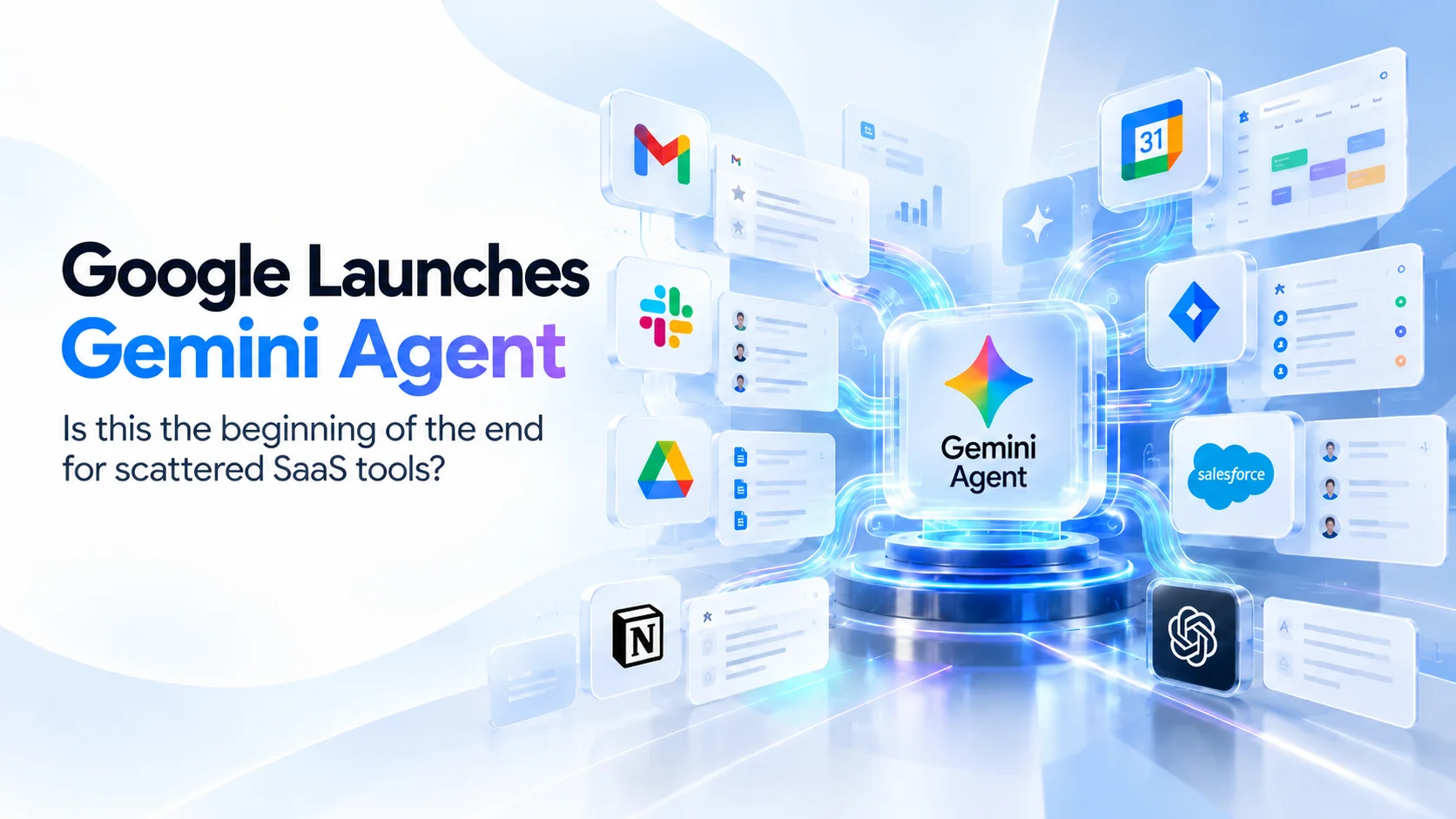
Google Launches Gemini Agent: Is This the Beginning of the End for Scattered SaaS Tools?
Google’s new universal work agent can operate across business systems from one prompt. The bigger question is whether AI agents will reduce the need to live inside a dozen separate SaaS tools.
Sections
For years, the average business software stack has moved in one direction: more tools.
A CRM for sales, another platform for project management, a help desk for customer support, separate software for documents, analytics, accounting, meetings, automation and internal communication. Each tool may solve a legitimate problem, but together they create another problem: employees spend a surprising amount of time moving information between systems, finding context and remembering where work actually lives.
Google's new Gemini Agent is a direct challenge to that way of working.
On October 8, 2026, Google Cloud announced what it calls a single, universal agent for work. Instead of opening one application, completing part of a task, moving into another application and repeating the process, Google's vision is that you give Gemini an objective and allow the agent to coordinate the work across the systems your business already uses.
That makes the launch much more interesting than another AI chatbot update. It raises a larger question for founders, SaaS companies and business owners: if an AI agent can become the interface across many applications, how many separate SaaS interfaces will businesses still need?
What Did Google Actually Launch?
The Gemini Agent was announced during Google's Gemini at Work 2026 event. Google describes it as an agent that can answer questions, handle knowledge work, create content and media, write and run code, use tools, access business context and coordinate work across connected systems.
The important difference is the interaction model. Traditional AI assistants usually wait for a specific instruction and return an answer. An AI agent is designed to work toward an outcome. You describe what needs to be accomplished, and the agent can determine which steps, tools and information are required to get there.
Google's own language captures the change well: the user provides an objective rather than a detailed sequence of instructions. Gemini can then plan the work, use skills and tools, connect with business systems and return something completed inside the environment where the team already works.
Google is also embedding Gemini directly into Workspace products including Gmail, Drive, Docs, Slides, Sheets, Chat and Calendar. Current launch reporting says the broader agent can also operate across environments such as Slack and Microsoft 365. Instead of maintaining a completely separate AI context for every application and device, Google is trying to create one persistent work layer above them.
As of October 9, 2026, the new enterprise Gemini Agent remains in private preview, so this is not yet a tool every company can deploy today. Pricing and broader general availability will also matter before its real impact can be measured.
The Bigger Idea: The Agent Could Become the Interface
Today, software is usually organized around applications. If you want customer information, you open the CRM. If you need an invoice, you open accounting software. If you want to understand a project, you check the project management platform. If you need the conversation behind a decision, you search email or Slack.
Agentic AI creates a different model. Instead of asking an employee to navigate every application manually, the employee could ask one agent to retrieve the required context, determine which systems matter, perform approved actions and return the result.
The traditional workflow might look like this:
Open the CRM and find the customer.
Search email for the latest conversation.
Check the project management tool for delivery status.
Open analytics to review usage.
Create a summary document.
Write a follow-up email.
Create a task for the account manager.
An agentic workflow could reduce that to a request such as: "Review this customer's account, summarize the current situation, identify any unresolved issues, prepare the follow-up and create the appropriate tasks."
The CRM, inbox, analytics platform and project system may still exist. The difference is that the employee no longer needs to personally operate every interface.
So Is This the Beginning of the End for Scattered SaaS Tools?
Possibly for the scattered interface layer. Probably not for SaaS itself.
This distinction is important because predictions that "AI will kill SaaS" often combine two very different things: the software employees see and the systems businesses depend on underneath.
An accounting platform is not valuable only because it has dashboards and buttons. It contains financial records, permissions, tax logic, transaction history and integrations. A CRM is not simply a contact screen. It may contain years of customer relationships, pipeline activity, automation and reporting. Vertical SaaS products can encode industry-specific workflows that would be expensive and risky to reproduce from scratch.
Those systems can remain extremely valuable even when an AI agent becomes the primary way users interact with them.
The change may therefore look less like:
AI Agent → replaces every SaaS application
and more like:
User → AI Agent → APIs, workflows and specialized SaaS systems underneath
In that world, the visible software stack gets smaller while the infrastructure behind it remains sophisticated.
Why This Matters for the SaaS Business Model
The economic impact could still be significant. Gartner estimated in July 2026 that as much as $234 billion in enterprise application software spending could be exposed to what it calls "agentic arbitrage" by 2030, representing roughly 20% of enterprise application SaaS spending.
The logic is straightforward. Traditional SaaS businesses often charge for access to their interface through per-user or per-seat subscriptions. But if one AI agent can perform actions across several systems on behalf of many employees, businesses may begin questioning how many human seats they actually need.
A company may still require the underlying CRM, but perhaps fewer employees need direct licenses. Another application may survive as a data service or workflow engine even if employees rarely open its dashboard. Some lightweight tools may be eliminated entirely if the agent can reproduce their basic workflow using data from existing systems.
This does not mean the SaaS model collapses overnight. Deloitte's 2026 outlook takes a more gradual position, arguing that AI agents will increasingly reshape SaaS products, pricing and workflows but that replacing entire enterprise applications is likely to take years rather than happen immediately.
That is probably the more useful way for founders to think about the transition: SaaS is not disappearing, but the value of simply owning another dashboard is becoming weaker.
What Types of SaaS Tools Are Most Exposed?
The most vulnerable tools may be applications whose primary value is helping humans perform relatively simple, repeatable actions across information that already exists somewhere else.
Examples could include lightweight reporting interfaces, basic workflow utilities, simple data-transfer tools, repetitive research products and narrow applications whose main purpose is helping an employee move information between systems.
If an AI agent can securely retrieve the same information, reason over it and perform the next action through an API or connector, the standalone interface becomes less important.
By contrast, software that owns critical business data, executes regulated transactions, provides specialized infrastructure or handles complex domain-specific logic may become even more important because agents need reliable systems underneath them.
The Winners May Become Systems of Record and Systems of Action
This creates an interesting shift in how SaaS companies should think about product strategy.
Historically, software companies have invested heavily in making users spend more time inside their product. More daily active users, more seats and more interface engagement generally supported stronger SaaS economics.
AI agents can reverse part of that incentive. A useful SaaS platform in an agentic world may not require a person to open the product ten times every day. Its value may come from providing reliable data, permissions, APIs and actions that an agent can use safely.
That means SaaS products may increasingly compete on questions such as:
Can an AI agent reliably discover and use our capabilities?
Do we expose clean APIs and structured data?
Can administrators control exactly what an agent can read or change?
Do important actions have approval workflows and audit trails?
Can our platform become part of a larger automated business process?
This is why the future of SaaS may involve fewer isolated applications and more connected services operating underneath an AI orchestration layer.
Why Gemini Agent Matters More for Google Than Another Model Launch
Google has already spent years building models, productivity software, cloud infrastructure and enterprise applications. Gemini Agent attempts to combine those pieces into a single interaction layer.
Google says nearly 80% of Google Cloud customers are already using its AI products and nearly 90% of the Fortune 100 use Gemini Enterprise. Those are Google-reported figures, but they demonstrate why distribution matters in the AI agent race. A capable agent becomes substantially more useful when it already sits close to the email, documents, calendar, cloud infrastructure and organizational data people use every day.
The next competitive battle may therefore be less about which company has the best individual model benchmark and more about which agent becomes the trusted coordination layer for work.
We have already seen this direction across the broader AI market. AI products are moving from answering isolated questions toward persistent agents capable of using tools, remembering context and completing multi-step workflows.
Agentic AI Is Becoming One of 2026's Biggest Software Trends
The search behavior around the category reflects that growing interest. Third-party keyword research based on U.S. Google Ads data from July 2026 estimated roughly 110,000 monthly searches for "agentic AI" and around 49,500 each for "AI agents" and "AI agent." Exact search volumes change over time, and Gemini Agent itself is too new for stable monthly-volume data, but the broader category is clearly attracting substantial attention.
The reason is practical. Businesses are no longer only asking whether AI can write better content or answer harder questions. They are asking whether AI can remove entire steps from operations.
That changes the discussion from AI assistance to AI automation, and eventually from individual automation to coordinated agentic workflows.
What This Means for Startups and SMBs
For smaller businesses, this shift could be particularly important because SaaS sprawl is not only a technical problem. It is an operational and financial problem.
A growing company can easily end up paying for separate products for CRM, support, project management, forms, reporting, email automation, documents, scheduling and workflow automation. The direct subscription cost matters, but the hidden cost is often the time employees spend keeping those systems synchronized.
An AI agent does not automatically solve that fragmentation. If customer information is inconsistent, permissions are unclear and business rules exist only in someone's head, giving an agent access can simply automate the confusion faster.
The better approach is to identify the business workflows first, determine which systems contain the authoritative data and then decide where an AI agent can safely remove manual steps.
This is also why AI application development should not begin with the question, "Where can we add an agent?" The better question is, "Which repeated workflow currently requires people to move between several systems, and what would it take to complete that workflow reliably from one place?"
The Hard Part Will Not Be the Chat Window
The impressive part of an AI agent demo is usually the conversation: someone types a goal and the software gets to work.
The difficult production work sits underneath that experience.
The system still needs identity, authentication, permissions, APIs, audit logs, reliable data, business rules, cost controls, observability, error handling and clear boundaries around what the AI is allowed to change.
We have seen the same principle while building production AI products. In our ALIFF AI stylist case study, useful AI generation was only one part of the product. The surrounding system also required a dedicated modesty-rule layer, quotas, caching, streaming and application logic so the AI operated within real product constraints.
That lesson becomes even more important with AI agents. When AI moves from generating an answer to taking actions across business systems, guardrails stop being an optional improvement and become part of the architecture.
What Founders Should Do Now
Most businesses do not need to replace their software stack because Google announced a new agent. Gemini Agent is still in private preview, the market is moving quickly and many important questions around reliability, pricing and real-world ROI will only become clear after broader deployment.
But founders should start looking at their software differently.
Map your scattered workflows. Identify processes where employees repeatedly move between three or more tools to complete one business outcome.
Identify your systems of record. Decide which application owns customer, financial, operational or product data.
Remove unnecessary duplication. If three applications contain overlapping information, an AI agent will not magically make the data trustworthy.
Improve APIs and integrations. Software that exposes reliable actions and structured information will be much easier for agents to use.
Define approval boundaries. Reading a customer record and issuing a refund should not necessarily have the same level of autonomy.
Measure the workflow, not the novelty. The useful metric is whether the agent reduces time, errors, software cost or operational friction.
Could Businesses Eventually Have One AI Interface for Most Work?
That now looks much more realistic than it did a year ago.
But "one interface" should not be confused with "one piece of software."
Behind a universal agent may sit dozens of specialized services, databases, APIs and platforms. The employee may simply stop thinking about which individual system needs to be opened.
That could be the real disruption.
The software industry spent the last two decades turning almost every business process into a SaaS application. The next phase may turn many of those applications into capabilities that agents call in the background.
For SaaS companies, that means the interface alone becomes less defensible. For startups, it creates opportunities to build agent-native products around workflows instead of dashboards. For businesses, it creates the possibility of reducing operational complexity without rebuilding every system from scratch.
Is Gemini Agent the End of SaaS? No. But It Could Change What SaaS Looks Like.
Google's Gemini Agent should not be treated as proof that the traditional SaaS market is about to disappear. The product is still in private preview, enterprise adoption takes time and specialized software remains deeply embedded in how companies operate.
But the direction is becoming difficult to ignore.
AI is moving from another feature inside software toward an intelligent layer that can operate across software. If that transition works reliably, businesses may interact with fewer applications directly even while depending on more software services underneath.
The winning SaaS products may therefore be the ones that stop thinking only about how humans click through their interface and start thinking about how both humans and AI agents securely use their data, workflows and capabilities.
Gemini Agent is not the end of SaaS.
It may be the beginning of the end for forcing humans to manually operate every SaaS tool themselves.
If your business is already struggling with disconnected systems, duplicated workflows or teams constantly moving information between applications, the opportunity is not necessarily to add another SaaS subscription. It may be to build a connected workflow layer that uses your existing systems more intelligently. Explore how AI-assisted applications can turn repetitive multi-tool processes into controlled, measurable workflows.
Keep reading
AI Is Not Killing SaaS Yet: Why Software Stocks Are Hitting New 2026 Highs
Software stocks are rebounding in 2026 as earnings improve and enterprises embed AI into SaaS instead of replacing their core systems. Here is what is changing.
Abdullah · · 14 min read
The New AI Job Boom: Why GTM Engineers Are Becoming a Real Career
Discover why GTM engineering is emerging as an AI-era career, what the job involves, the skills employers seek, and how the role differs from RevOps.
Khubaib Rasheed · · 7 min read
Major AI Models Launched in September 2026: GPT-6, Claude, Gemini, Grok, DeepSeek and More
September 2026 delivered a wave of major AI model releases from OpenAI, Anthropic, Google, xAI, DeepSeek, Meta and Alibaba. Here is what launched and why it matters.
Abdullah · · 12 min read