How to Write Better AI Prompts in 2026: Context Engineering Over Prompt Tricks
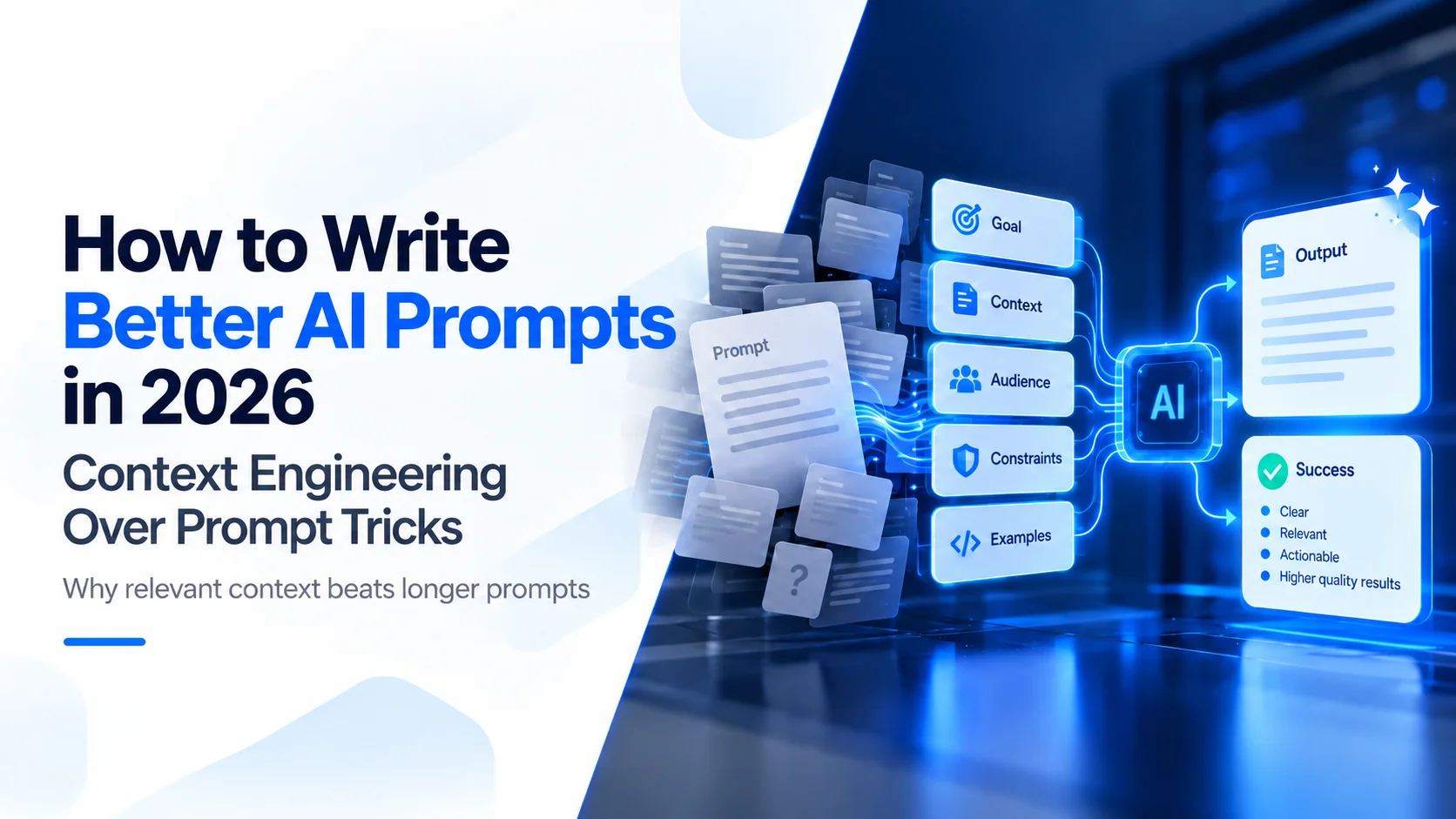
Better AI results do not come from the longest prompt. They come from giving the model the right goal, context, constraints, examples, and definition of success.
Sections
People spend a surprising amount of time asking which AI tool is best. Should they use ChatGPT, Claude, Gemini, or another specialized application? One model may be better at coding, another may feel better for writing, and another may offer a feature that looks useful. Those differences are real, but there is another variable that often has a bigger impact on everyday results: what you actually give the AI to work with.
A powerful AI model can still give you a poor answer when the request is vague. At the same time, a well-structured request with the right context can produce a much better result without requiring an enormous prompt, dozens of uploaded documents, or a collection of different AI subscriptions. The goal in 2026 is no longer simply learning clever prompt tricks. It is learning how to give AI the right information for the job.
More information does not automatically mean better context
Imagine that you want to buy a new laptop. You could give an AI assistant the complete HP website, the complete Dell website, hundreds of product specifications, several buying guides, and dozens of reviews. That is a huge amount of information, but the model still does not know what matters to you. It does not know your budget, whether you travel frequently, what software you use, whether battery life matters, or whether you need a powerful GPU.
Now compare that with a much smaller request: "I am a software developer with a budget of $1,800. I regularly use Docker, Cursor, Chrome with many tabs, and occasionally run local AI tools. I want Windows, at least 32GB of RAM, strong battery life, and a 15 to 16-inch display. Gaming performance is not important. Compare suitable HP and Dell laptops and explain the trade-offs."
The second request contains far fewer words, but almost every sentence changes the recommendation. That is the difference between having a lot of information and having useful context.
The goal is not maximum context. It is relevant context.
Modern AI models can process very large amounts of information, but that does not mean every available token should be filled. A 2025 study published in Findings of EMNLP tested five open and closed-source language models across question answering, coding, and mathematics tasks. The researchers found that performance could decline substantially as input length increased, even when the models could still retrieve the relevant information correctly.
This does not mean long context is bad. There are many situations where a model genuinely needs large documents, source code, contracts, research papers, customer records, or conversation history. The lesson is simpler: context length is a capacity, not a target. You should use the amount of information necessary to solve the problem instead of assuming that more input automatically produces a smarter answer.
Prompt engineering is becoming context engineering
Prompt engineering traditionally focused on how an instruction was written. Should you assign the AI a role? Should you use a specific phrase? Should you tell it to act as an expert? Those techniques can still be useful, but modern AI workflows are becoming broader than a single carefully written prompt.
Anthropic describes this broader idea as context engineering: deciding what combination of information is most likely to produce the behavior you want from the model. That context can include the current instruction, previous messages, examples, retrieved documents, business rules, tool results, user information, product data, and other information available at the moment the model generates its answer.
OpenAI's current prompting guidance follows a similar practical direction. It recommends clear instructions, relevant context, examples where useful, and explicit guidance about the required output. Google's Gemini prompting guidance also emphasizes being precise and direct, defining parameters, separating instructions from context, and clearly controlling the expected output.
The important change is that good prompting is becoming less about finding a secret sentence and more about designing the information environment around the model.
Seven things to give AI before asking for a better answer
You do not need a complicated prompt formula for every request. For most serious tasks, seven pieces of information provide a useful starting point.
1. Goal
Tell the AI what you are actually trying to accomplish. "Write about our software" is vague. "Write a landing page that helps non-technical gym owners understand how our booking platform replaces spreadsheets and encourages them to request a demo" gives the model a business objective.
2. Relevant context
Provide information that changes the answer. That might include your product, customer, current situation, source document, business process, or previous decision. Avoid adding information simply because you have it available.
3. Audience
A technical architecture explanation for a CTO should not look like the same explanation written for a small-business owner. Tell the model who will read or use the result and what that person is likely to understand already.
4. Constraints
Constraints reduce ambiguity. They can include budget, technologies, geography, word count, timeline, compliance requirements, brand rules, features that cannot change, or things the AI should avoid. A useful constraint often improves an answer more than another page of background material.
5. Examples
If you already know what good looks like, show it. An example can communicate tone, structure, terminology, level of detail, or formatting much more clearly than several paragraphs describing those qualities. This is particularly useful for repeated tasks such as support replies, product descriptions, reports, social posts, or structured data extraction.
6. Output format
Tell the AI how the answer will be used. You may want a comparison table, technical specification, executive summary, JSON response, implementation checklist, email, proposal section, or three recommendations with pros and cons. When the output structure is known, state it instead of making the model guess.
7. Definition of success
This is the part many prompts miss. Tell the model what a good answer must achieve. If you are comparing software vendors, success might mean recommending options that support your required integrations and stay within budget. If you are creating an MVP plan, success might mean identifying the smallest feature set capable of validating the core business assumption.
A better prompt explains the expectation, not just the task
Consider a simple marketing request: "Write a landing page for my booking software." The model can certainly produce something, but it has to make assumptions about the audience, problem, positioning, tone, features, and conversion goal.
A stronger request would explain that the software is for small service businesses currently managing appointments through spreadsheets and messages, that the primary audience is non-technical business owners, that the page should focus on operational simplicity rather than technical features, and that the desired action is booking a consultation. You could also specify that the page should contain a problem section, solution section, key benefits, proof, and a final call to action.
The difference is not that the second prompt contains more impressive language. It simply removes more uncertainty.
Does this mean ChatGPT, Claude, Gemini, and other models are all the same?
No. Model choice still matters. Models differ in reasoning ability, coding performance, tool access, speed, pricing, context limits, multimodal capabilities, and how they behave during complex tasks. We have discussed some of those differences in our ChatGPT Astra vs Claude Fable 5.1 comparison.
Better context cannot give a model a capability it simply does not have. It cannot give an offline model current market information, turn a text-only system into a video model, or make a smaller model perform every complex reasoning task at the same level as a frontier model.
But this does not mean the first response to a disappointing result should always be another subscription. For many writing, research, planning, product, analysis, and business tasks, it is worth asking whether the model actually understood the requirement before deciding that the tool itself is the problem.
Before changing AI tools, improve the brief
If a response is poor, inspect your input first. Did the model know the real goal? Did it have the information that would change its answer? Did you specify the audience? Were the important constraints clear? Did you show an example if style mattered? Did you explain what the final output should contain?
You can also refine the task interactively. Start with a clear brief, review the answer, identify what is missing, and add only the information necessary to correct it. OpenAI's current ChatGPT guidance recommends this iterative approach rather than expecting every prompt to be perfect on the first attempt.
This can also reduce unnecessary tool switching. You may still decide that another model is better for a particular workflow, but you are making that decision after improving the quality of the input rather than comparing several models using an unclear request.
For AI products, context becomes part of the architecture
The same principle becomes even more important when AI is built into a real application. A production AI assistant may need information from user profiles, business records, documents, product databases, APIs, previous actions, and company policies. Sending everything to the model on every request would be expensive, slow, and difficult to control.
Good AI systems therefore decide what information should be retrieved, when it should be included, which rules should be enforced outside the model, and what the AI is allowed to do. Our AI-assisted application development work treats the model as one part of the product rather than the entire product.
ALIFF is one example. The application uses AI for fashion recommendations, but important modesty requirements are handled through a dedicated rule layer rather than relying only on a prompt to remember every restriction. The system also uses techniques such as caching, streaming, quota management, and user feedback around the model. The lesson from our ALIFF case study is that reliable AI products usually need both good model instructions and good software around those instructions.
When should you provide more context?
More context is useful when the missing information genuinely changes the answer. If you want an AI to review a contract, it needs the contract. If you want it to understand a codebase, it needs relevant code and architecture information. If you want it to answer questions about an internal company policy, it needs access to that policy. The problem is not large context itself. The problem is treating all information as equally important.
For large knowledge bases, the better approach is often retrieval. Instead of placing every document into every request, a system can search for information related to the current question and provide the most relevant sections to the model. This is one reason retrieval-augmented generation and document search remain important parts of many AI applications.
A simple prompt template you can actually use
You can apply the following structure without turning every conversation into a complex prompt-engineering exercise:
Goal: Explain what you need to accomplish.
Context: Give the information necessary to understand the situation.
Audience: Explain who the result is for.
Constraints: State important limits, requirements, and things to avoid.
Examples: Include a reference when showing is easier than explaining.
Output: Describe how you want the answer structured.
Success: Explain what the final answer must achieve.
You will not need every section for every question. A request for a restaurant recommendation does not need the same structure as a product strategy document. The purpose of the framework is not to make prompts longer. It is to help you notice what the model is missing.
The real AI skill in 2026 is reducing ambiguity
Prompting is sometimes presented as if people need to learn a new programming language to communicate with AI. For most users, the more useful skill is much simpler: learn how to explain the problem clearly.
Give the model the information that changes the answer. Remove information that does not. Define important constraints. Show examples when they communicate your expectation faster. Tell the AI what the result will be used for and what success looks like. Then refine the request based on what comes back.
There will still be reasons to choose one AI model over another. Models will continue to compete on reasoning, speed, cost, coding, agents, multimodal capabilities, and tools. But before asking, "Which AI should I pay for next?" there is another question worth asking first: "Have I given the AI enough relevant information to understand what a good answer looks like?"
In many cases, that is where the biggest improvement starts.
Keep reading

OpenAI Dots vs Meta Muse: The AI Agent War Has Officially Started
OpenAI Dots and Meta Muse signal a new phase in AI: always-on agents that keep working, use connected apps, and take action after the chat ends.
Khubaib Rasheed · · 12 min read

OpenAI Dots: What Always-On AI Agents Mean for the Future of Software
OpenAI Dots move AI beyond one-off prompts toward persistent agents that can own ongoing work. Here is what that shift means for businesses and software teams.
Abdullah · · 14 min read

Meta Muse Privacy: What Happens When an AI Agent Can Access Your Email, Files and Payments?
Meta Muse can access connected data and take actions across apps, so privacy depends on more than a policy page. Here is how its safeguards, training controls, permissions and current risks actually work.
Khubaib Rasheed · · 16 min read