ChatGPT Astra vs Claude Fable 5.1: Which AI Model Is Better in 2026?
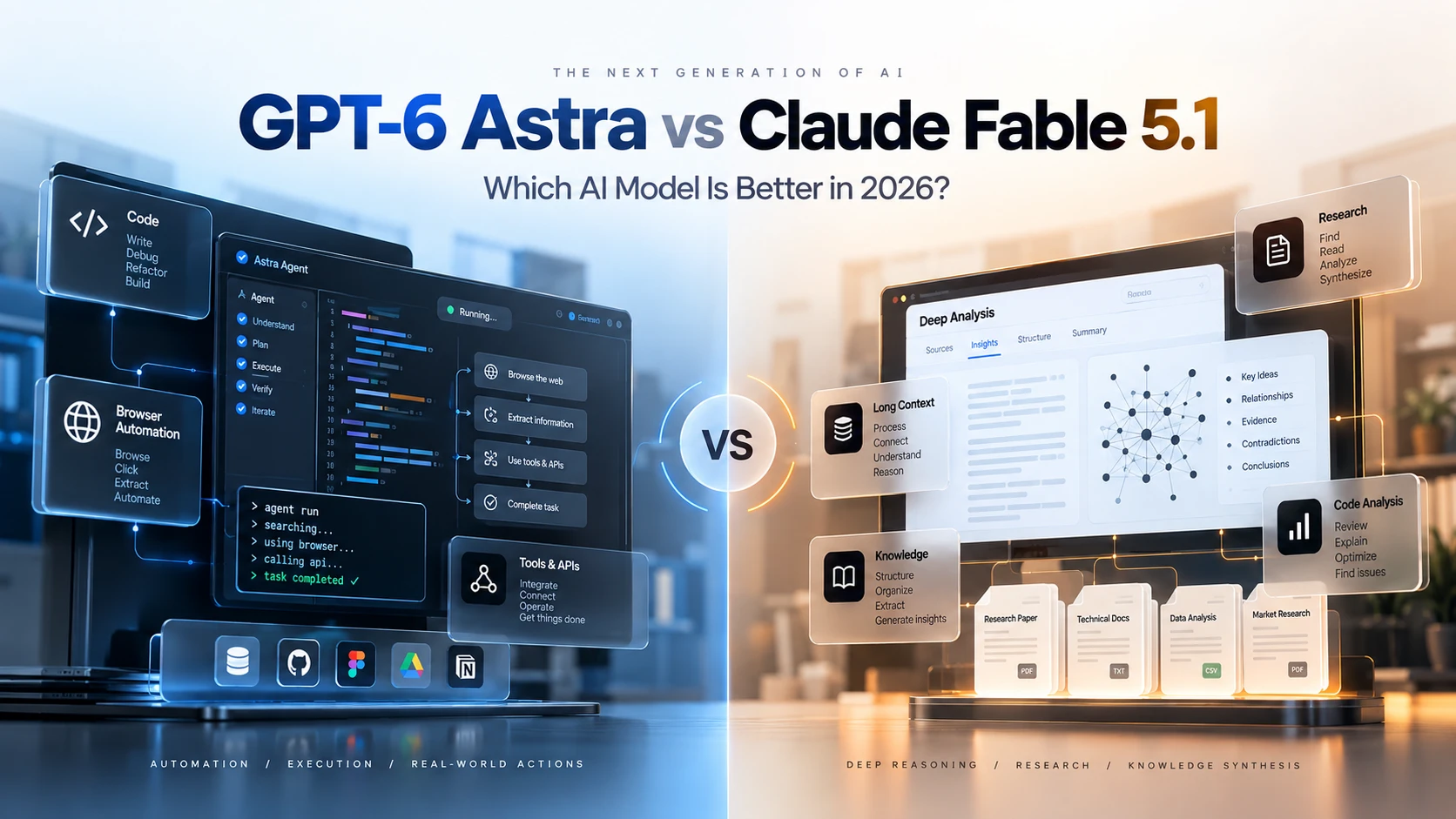
GPT-6 Astra and Claude Fable 5.1 are tied at the frontier—but they win in different workflows. Here is what benchmarks, pricing, coding tests, and real-world usage suggest.
Sections
OpenAI's GPT-6 Astra and Anthropic's Claude Fable 5.1 arrived within days of each other, and the obvious question followed almost immediately: which one is better?
The answer is more interesting than a benchmark leaderboard suggests. These are two of the strongest AI models available in 2026, they offer almost identical headline context sizes, and they even start with exactly the same API input and output prices. Independent testing currently places them at essentially the same overall intelligence frontier. What separates them is how they get there: the kinds of tasks they perform best, how many tokens they consume, how they behave during long autonomous workflows, how their context is priced, and how well each model fits the surrounding product ecosystem.
This comparison looks at GPT-6 Astra and Claude Fable 5.1 from the perspective that matters to developers, founders, and businesses: coding, AI agents, reasoning, computer use, long-context work, API economics, and real software products. If you want a broader look at why Astra itself matters, we have also covered the shift from AI answers to AI action with ChatGPT Astra.
First, what are ChatGPT Astra and Claude Fable 5.1?
"ChatGPT Astra" is the term many people use for OpenAI's GPT-6 Astra model when accessing it through ChatGPT. OpenAI released GPT-6 Astra in September 2026 as its most capable model for difficult end-to-end tasks, including software engineering, computer use, research, professional work, scientific reasoning, and complex multi-step workflows. It is also available to developers through the OpenAI API and other cloud platforms.
Claude Fable 5.1 is Anthropic's frontier model for demanding reasoning, coding, research, and long-horizon agentic work. Anthropic positions it above its lower-cost general-purpose models when a task requires sustained reasoning or autonomous work over a long period. Fable 5.1 is available through Claude and through the Claude API, as well as major cloud platforms.
Both represent the same larger change in AI development. The frontier is no longer only about generating a better paragraph or a better code snippet. These models are increasingly expected to inspect environments, use tools, modify artifacts, test their own work, recover from failures, and keep working through tasks that may involve dozens of steps.
GPT-6 Astra vs Claude Fable 5.1: quick comparison
| Area | GPT-6 Astra | Claude Fable 5.1 |
|---|---|---|
| Developer | OpenAI | Anthropic |
| Released | September 2026 | September 2026 |
| Context window | Approximately 1.05M tokens | 1M tokens |
| Maximum output | 128K tokens | 128K tokens |
| API input price | $10 / 1M tokens | $10 / 1M tokens |
| API output price | $50 / 1M tokens | $50 / 1M tokens |
| Cached input / cache read | $1 / 1M tokens | $0.25 / 1M tokens |
| Knowledge cutoff | April 30, 2026 | June 2026 |
| Input modalities | Text and images | Text and images |
| Independent Intelligence Index | 53 at max effort | 53 at max effort |
| Independent Coding Agent Index | 62 | 62 |
| Particularly strong pattern | Computer use, automation, terminal execution, token efficiency | Knowledge work, scientific reasoning, long-form analysis, sustained agentic work |
The most striking part of the table is how similar the headline specifications are. Looking only at context length, maximum output, or base API prices will not tell you which model belongs in your product. The meaningful differences appear after the model begins doing actual work.
The benchmark result that matters most: the overall race is effectively tied
Independent evaluator Artificial Analysis currently gives GPT-6 Astra at maximum effort and Claude Fable 5.1 at maximum effort the same score of 53 on its Intelligence Index. Its Coding Agent Index also places both at 62. That makes a simplistic claim that either Astra or Fable 5.1 is universally the "smartest" model difficult to defend.
The individual tests underneath that overall score tell a better story. In the independent comparison, Astra scored about 68% on AutomationBench-AA versus 59% for Fable 5.1, and roughly 59% on Terminal-Bench 4.0 versus 52% for Fable. Fable moved ahead on SciCode at roughly 63% versus Astra's 56%, and on Humanity's Last Exam at approximately 59% versus 55%. Fable also scored higher on some long-horizon professional-work measurements, while Astra held advantages in other automation and document-oriented tests.
That split is important. A combined benchmark compresses many different forms of intelligence into one number. A software company does not buy "53 points of intelligence." It buys the ability to perform a particular workflow reliably. An AI coding agent fixing infrastructure failures has different requirements from a research assistant reading technical papers, even if both models receive the same aggregate score.
Which is better for coding?
For coding, there is no longer a meaningful argument that one of these models belongs in a different performance class. Both are frontier engineering models. The independent Coding Agent Index places them level, while specific coding evaluations show advantages moving in both directions depending on the environment.
Astra's strongest case appears when coding turns into execution. Terminal-based tasks require more than predicting source code. The agent needs to inspect files, run commands, understand failures, change its approach, verify the result, and continue until the environment reaches the required state. Astra's lead on Terminal-Bench 4.0 and its broader computer-use capabilities make it particularly interesting for workflows where the model is expected to operate rather than merely advise.
Fable 5.1, however, remains exceptionally strong when the engineering task requires sustained comprehension. Anthropic specifically designed it for codebase-wide changes, code review, performance work, long-running projects, and autonomous sessions. Early professional and community testing also suggests that many developers value Fable for following complex project context, producing detailed implementations, and maintaining coherence across ambitious changes.
The practical conclusion is that developers should not choose between them using a generic "best coding model" label. If your agent spends most of its life executing commands, testing software, navigating tools, and resolving environment failures, Astra deserves serious attention. If your work places more emphasis on understanding a large existing system, reasoning across many files, maintaining a detailed specification, and producing substantial implementations, Fable 5.1 may fit better. For important repositories, testing both against your own backlog is more useful than relying on a public coding leaderboard.
Astra's biggest advantage may be computer use and action
The broader difference becomes clearer outside the code editor. OpenAI has put computer use at the center of Astra. The model is intended to navigate software interfaces, work in browsers, fill forms, interact with professional applications, perform frontend QA, manipulate documents, and execute multi-step computer workflows.
That matters because many useful business automations do not fit neatly inside an API. A real workflow may begin in a CRM, move into a browser, require information from several documents, update a spreadsheet, modify a business application, and finish by preparing a report. Traditional automation often requires an integration for every step. Computer-using AI can potentially interact with some of those interfaces more like a person would.
Fable 5.1 is also highly agentic and works across Claude Code, browser-based workflows, Claude's broader tools, and managed agent environments. The distinction is therefore not that one model can act and the other cannot. The difference is one of emphasis. Astra's strongest published results and product direction place computer operation, automation, and end-to-end digital work particularly close to the center of the model.
Fable 5.1 has a strong case for deep research and knowledge work
Fable's advantages become more visible on evaluations that reward deep reasoning, scientific problem solving, detailed professional outputs, and maintaining coherence through large amounts of information. Its higher results on SciCode and Humanity's Last Exam fit Anthropic's positioning of Fable 5.1 as a model for demanding reasoning and long-horizon work.
This distinction is useful for companies building research-heavy tools. Consider an application that needs to examine lengthy financial documents, compare competing arguments, interpret technical reports, prepare a detailed recommendation, and preserve important nuance across each step. Execution speed matters, but losing an assumption or overlooking a relationship can matter far more.
That does not mean Astra is weak at research; it is a frontier research model in its own right. It means Fable's strongest results make it particularly worth evaluating when the quality of analysis, synthesis, and sustained reasoning is more important than minimizing agent steps or token consumption.
The price looks identical until you examine how the models work
This is one of the most interesting parts of the comparison. At standard API rates, both companies charge $10 per million input tokens and $50 per million output tokens. If you stopped there, you would assume cost is a tie. It is not.
Claude Fable 5.1 has a major prompt-caching advantage. Its cache reads cost $0.25 per million tokens, compared with $1 per million cached input tokens for Astra. For an agent that repeatedly works with the same large repository, documentation set, system instructions, or background context, that difference can become meaningful. Anthropic says the reduced cache-read rate lowers Fable 5.1 costs by around 25% on typical workloads compared with Fable 5 and by substantially more on some highly agentic workloads.
Fable also includes its full one-million-token context window at the standard per-token rate. OpenAI's API pricing for Astra applies higher rates when an API request exceeds 272,000 input tokens: input and cache pricing increase and output pricing also receives a multiplier. There are product-specific exceptions, including Astra usage inside Codex, so the exact economics depend on how the model is being used.
Then the comparison flips again when we look at actual model behaviour. Artificial Analysis found that Astra used far fewer tokens on its evaluation workloads. At maximum effort, Astra achieved the same overall Intelligence Index score as Fable 5.1 while costing approximately $3.26 per benchmark task versus about $7.63 for Fable 5.1 in that evaluation. On the Coding Agent Index, Astra also matched Fable while costing roughly 40% less per task in the evaluator's setup.
This is why AI model pricing should never be evaluated using token rates alone. Cached context, reasoning effort, number of turns, amount of generated reasoning, tool calls, retries, long-context premiums, and whether the model solves the task on its first attempt can all have a larger effect on the final bill. We discuss the same principle more broadly in our guide to what actually drives AI app development cost.
Context window: almost a tie in size, not necessarily in economics
Both models can work with enormous contexts. Fable 5.1 supports one million tokens and Astra approximately 1.05 million, with both allowing up to 128,000 output tokens. In practical terms, the raw context-size difference is unlikely to determine most purchasing decisions.
The larger issue is what happens inside that context. A million-token window does not guarantee that a model will use every piece of information equally well. Teams should test retrieval accuracy, instruction retention, attention to details near the middle of large inputs, and behaviour after many agent turns. They should also calculate the cost of repeatedly sending or caching that context.
For workloads that genuinely require hundreds of thousands of input tokens in a single API request, Fable's standard pricing across its full context window is attractive. For agent workflows where the model can solve the same problem using fewer generated tokens and fewer turns, Astra's efficiency can outweigh its higher cache-read price. Once again, workload shape matters more than the size printed on the model card.
Which one is faster?
Speed is another area where one number can mislead. Independent API measurements have shown Fable 5.1 generating more output tokens per second than Astra in some comparable configurations. But Astra frequently uses fewer total output tokens and fewer turns to complete the evaluation task. A model can therefore generate tokens more slowly while still finishing the overall job efficiently.
For an interactive chat experience, time to first token and generation speed may influence how responsive the product feels. For a background coding agent running for an hour, total task completion time and number of retries can matter far more. For an API product handling thousands of requests, cost-adjusted latency may be the real metric.
This is why a team's model evaluation should measure the end-user workflow rather than simply recording tokens per second. The fastest model response is not necessarily the fastest completed business process.
What early developers are seeing in real usage
Early developer discussions since the two launches are predictably mixed, and they should be treated as anecdotal evidence rather than controlled testing. Still, several patterns are worth watching. Some developers report that Astra feels more economical in long coding sessions, plans effectively, and works quickly through execution-heavy jobs. Others prefer Fable 5.1's implementation style, instruction following, richer creative output, or ability to maintain coherence across complex projects.
There are also examples of developers deliberately using both: one model creates a plan or implementation, while the other reviews it; one handles visual or execution work, while the other checks architectural consistency. That may sound inefficient, but for valuable engineering work a second frontier model can function like an independent reviewer. Disagreement between two strong systems can reveal assumptions that a single-agent workflow would otherwise miss.
The important limitation is that community reports are highly sensitive to prompts, effort settings, subscription limits, coding harnesses, repository structure, and the kind of software being built. They are useful signals, but they should not replace a controlled evaluation against your own tasks.
Astra vs Fable 5.1 for businesses: the model should follow the workflow
For businesses, the temptation is to pick a winner and standardize immediately. A better approach is to begin with the workflow. What information does the AI receive? What decision must it make? Which tools does it need? What happens when it is wrong? How expensive is a failure? Does a human approve the action? How often is the same context reused?
If the application needs an AI agent that navigates interfaces, operates software, executes procedures, and completes digital tasks end to end, Astra's computer-use and automation strengths make it an obvious candidate. If the application is centered on extensive research, technical reasoning, large bodies of information, or sustained analytical work, Fable 5.1 should be tested seriously. If the application performs many predictable lower-value requests, neither frontier model may be economically appropriate for every request.
A production system can also route different work to different models. The hardest reasoning request might go to a frontier model while routine classification goes to a smaller model. Another system might use one provider primarily and invoke a second model only for review or fallback. Good AI-assisted application development increasingly involves designing this model layer rather than hard-coding every feature around whichever model happens to lead a leaderboard this month.
The model is only one layer of a production AI product
The Astra-versus-Fable debate can make it seem as though choosing the correct model determines whether an AI product succeeds. In production software, that is rarely true. The model needs access to the right data, product rules, permissions, context, monitoring, evaluation, fallbacks, usage controls, and user experience.
Our ALIFF case study is a useful example. The AI stylist does not simply generate arbitrary outfits from a prompt. The product combines AI generation with modesty rules, a digital wardrobe, automated clothing processing, conversational styling, accept/swap/reject feedback, quotas, caching, and streaming. Those surrounding systems make the AI useful within the actual product constraint.
The lesson applies directly to Astra and Fable 5.1. A stronger model can reduce engineering friction, but it cannot automatically understand every private business rule or decide which actions your product should permit. The software surrounding the model remains responsible for structure, access, validation, state, user feedback, and business logic.
Do you need to commit to one model?
Not necessarily. If you are building a new AI product, avoiding unnecessary provider lock-in can be valuable. That does not mean creating an abstraction so generic that you cannot use the strengths of either platform. It means separating product logic from model-specific implementation wherever it makes practical sense.
For example, your application can keep domain data retrieval, permissions, usage limits, output validation, and core business rules in your own application layer. A model adapter can then handle the differences between OpenAI and Anthropic APIs. If a future evaluation shows that another model performs better on your workload, switching becomes a contained engineering decision rather than a product rewrite.
This architecture is particularly useful now because frontier-model leadership changes quickly. The best model for a particular task in September 2026 may not remain the best six months later. We use the same workflow-first approach when adding AI to an existing application: define what the feature needs to accomplish first, then select the model and architecture that support it.
So, which should you choose?
Choose GPT-6 Astra first when your main requirement is agentic execution: computer use, browser interaction, terminal work, workflow automation, autonomous software tasks, or situations where token efficiency can materially affect operating cost. Its independent automation and terminal results are especially strong, and current evaluations suggest it can reach frontier performance with significantly less generated output than some competitors.
Choose Claude Fable 5.1 first when your workload is dominated by deep research, long-form analysis, demanding scientific or technical reasoning, extremely large reusable contexts, or complex projects where maintaining detailed coherence is more valuable than minimizing generated tokens. Its inexpensive cache reads and standard pricing across the full one-million-token context can also matter for context-heavy architectures.
Test both when the AI performs a core business function. Give the models the same representative tasks, tools, data, and acceptance criteria. Record accuracy, successful task completion, human correction time, latency, token use, failure rate, and total cost. Ten realistic tasks from your own workflow will often tell you more than another ten public benchmark charts.
Our view: Astra vs Fable is really an architecture decision
GPT-6 Astra and Claude Fable 5.1 show how mature frontier AI has become. Both can code, reason, research, use tools, process enormous contexts, and carry complex work for extended periods. The interesting differences now appear deeper in the workflow: how the agent behaves under uncertainty, how efficiently it uses context, whether it executes or analyzes better, how well it verifies its work, and what the task ultimately costs.
That changes the question businesses should ask. Instead of asking, "Which AI model is the smartest?" ask, "Which model produces the best reliable outcome for this workflow at a cost we can support?" The answer may be Astra. It may be Fable 5.1. It may even be a routing architecture that uses both alongside cheaper models.
Frontier models will continue changing. Your product architecture should not have to change every time the leaderboard does. If you are evaluating where AI belongs in a web, mobile, SaaS, or internal business product, discuss your AI product with Next Level Software. We can help turn the model capability into a controlled production workflow rather than simply attaching an API to a chat box.
Frequently asked questions
Is GPT-6 Astra better than Claude Fable 5.1?
There is no universal winner. Independent Artificial Analysis testing currently places GPT-6 Astra and Claude Fable 5.1 level on its overall Intelligence Index at maximum effort. Astra leads several automation and terminal-oriented measurements, while Fable 5.1 leads several scientific reasoning, research, and professional-work evaluations. The best choice depends on the task rather than the overall score.
Which is better for coding, Astra or Fable 5.1?
Both are frontier coding models, and independent agentic coding testing currently puts them at essentially the same overall level. Astra has shown particularly strong terminal execution and agent efficiency, while Fable 5.1 is highly competitive for complex codebase reasoning, long-running implementation, and detailed engineering work. Teams should benchmark both against their own repository and workflow.
Which is cheaper: GPT-6 Astra or Claude Fable 5.1?
Both list the same standard API input and output prices: $10 per million input tokens and $50 per million output tokens. Fable 5.1 has cheaper cache reads and standard pricing throughout its one-million-token context. Astra, however, used considerably fewer tokens per task in some independent evaluations and consequently achieved a lower effective task cost. The cheaper model therefore depends on how your application uses it.
Which has the bigger context window?
GPT-6 Astra supports approximately 1.05 million context tokens, while Claude Fable 5.1 supports one million. Both allow up to 128,000 output tokens. For most products, the practical differences in context pricing, retrieval quality, and token efficiency matter more than the roughly five-percent difference in maximum input size.
Can Astra and Fable 5.1 build complete applications?
Both can contribute substantially to application development and can operate through agentic coding environments. That does not mean generated software should automatically be treated as production-ready. Architecture, security, permissions, testing, monitoring, deployment, maintainability, and product requirements still need to be validated before real users depend on the system.
Should I build my AI product around only one provider?
Sometimes that is the simplest option, especially when one provider offers a capability your product specifically needs. For strategically important AI products, however, keeping core product rules, data access, validation, and workflow logic separate from provider-specific model calls can make future model changes easier. The goal is not abstraction for its own sake; it is avoiding unnecessary dependence on a leaderboard that changes rapidly.
Keep reading
AI Can Write the Code. Who Reviews the Software?
AI can generate code faster than teams can review it. As coding agents become part of everyday development, engineering judgment, testing, security, and accountability matter more—not less.
Abdullah · · 16 min read

Top Things to Consider When Approaching a White Label Mobile App Development Service
Choosing a white label mobile app development service affects more than your development budget. Here is what to evaluate before trusting another team with a product that will carry your brand.
Khubaib Rasheed · · 9 min read
ChatGPT Astra: A new generation of intelligence is Here
ChatGPT Astra points to a broader shift in AI, from generating answers to operating software and completing multi-step work. Here is what that change means for businesses and software teams.
Abdullah · · 9 min read