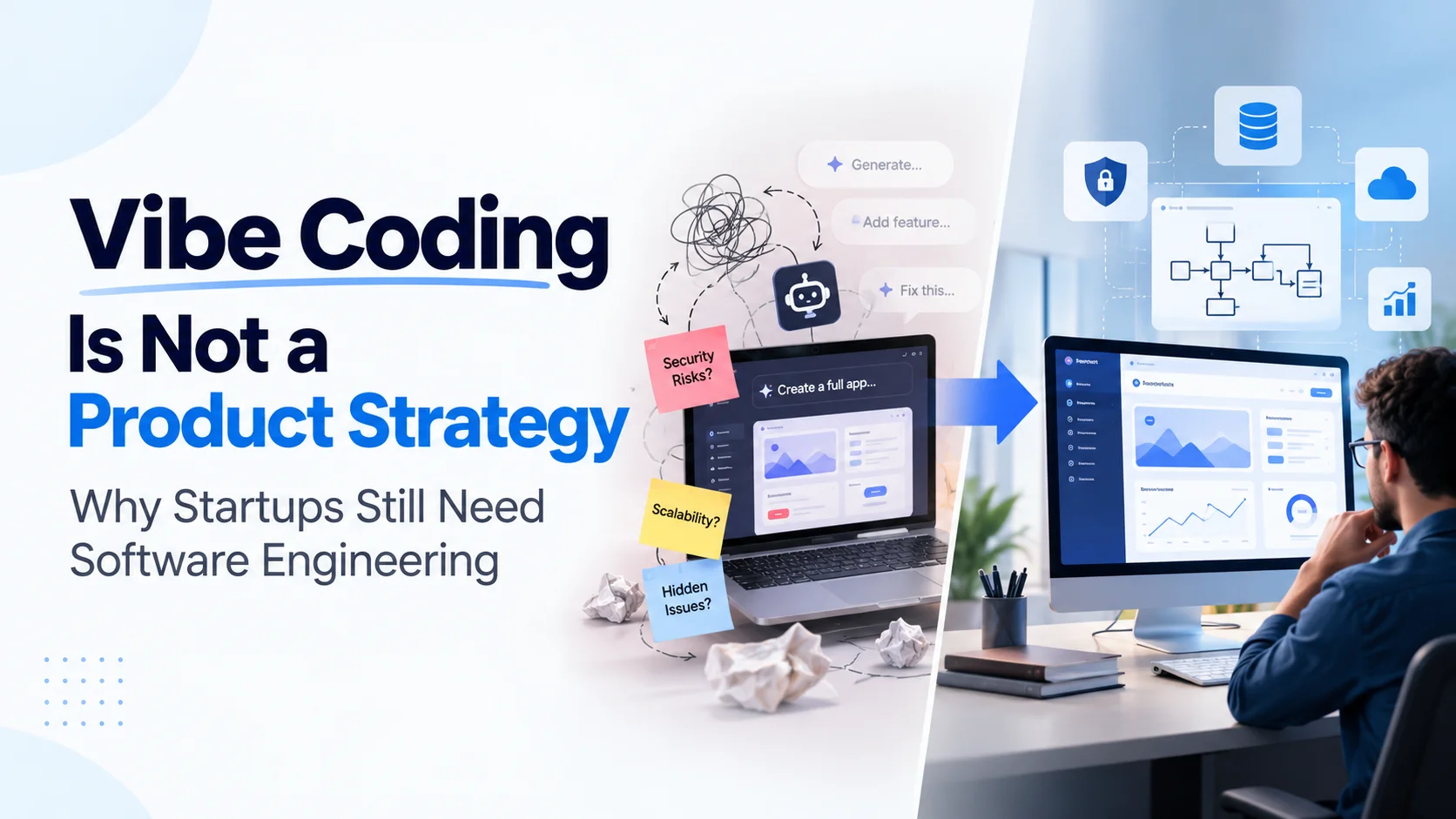
Vibe Coding Is Not a Product Strategy: Why Startups Still Need Software Engineering
AI can help founders build software faster, but a working demo is not the same as a secure, scalable product. Here's what founders need to understand before launching.
Sections
Building a software product has never been easier. A founder with an idea can open an AI coding tool, describe a few features, and have a working application within days. Tools like Bubble, Cursor, Lovable, and other AI-powered development platforms have made it possible to create prototypes without the traditional cost of assembling a development team.
For early-stage founders, this is an important opportunity. You can experiment with ideas, demonstrate product concepts, gather feedback, and even approach investors without committing substantial capital to full-scale development.
But there is a problem that deserves more attention: building something that works is not the same as engineering something that can be trusted.
A functional interface can hide serious weaknesses in authentication, API security, database design, business logic, and deployment configuration. These problems may remain invisible until real customers start using the product, sensitive information is involved, or the business needs to scale.
This is why founders need to stop treating vibe coding as a complete product development strategy. AI-assisted development is valuable, but it needs to operate within a structured engineering process.
What Vibe Coding Actually Solves
Vibe coding is an approach where people use natural-language instructions to have AI generate and modify software, often with limited manual involvement in understanding or reviewing the resulting code. Instead of writing every component, developers or founders describe what they want and let AI tools produce an implementation.
Its biggest advantage is speed. A founder can move from an idea to a visible application much faster than before. This is particularly useful when the purpose is to test a concept rather than operate a complex business system.
For example, imagine a founder planning a fitness marketplace where customers can discover gyms, purchase memberships, and book classes. Rather than spending months building everything, they could use AI tools to create a simple prototype, demonstrate the customer experience, and understand whether gym operators are interested.
At this stage, the prototype has achieved something useful. It has helped communicate and validate an idea. Problems begin when the founder assumes that because the prototype looks functional, the underlying software is ready for production.
Vibe coding is useful for accelerating experimentation. It becomes risky when speed replaces technical understanding and product ownership.
The Dangerous Assumption: If It Works, It Must Be Ready
For someone without a technical background, a successful login, working dashboard, and completed checkout can create the impression that the application is finished. However, software reliability depends on much more than whether the expected action works during a demonstration.
Consider a subscription-based SaaS product. During testing, a user signs up, selects a plan, and successfully completes payment. Everything appears to work. But important questions may remain unanswered. What happens if the payment gateway sends the same confirmation twice? Can one customer access another customer's data? What happens when a subscription expires? Can the system recover from a failed transaction without charging the customer twice?
These are not additional features intended to make the product more sophisticated. They are fundamental requirements for operating a reliable business.
A non-technical founder may not know which questions to ask, and an AI coding tool will not necessarily identify every requirement that was never included in the instructions.
Security Problems Can Stay Hidden Behind a Beautiful Interface
One of the most serious risks of launching software without proper technical oversight is that security weaknesses are rarely visible in the user interface.
A product can look polished while exposing API credentials, applying incorrect database permissions, or allowing users to access information that belongs to other accounts.
These are real software security concerns, not problems limited to AI-generated applications. However, they become particularly concerning when the person deploying the application does not understand how its code, infrastructure, and integrations work.
API Key Exposure and Credential Leakage
Many applications depend on external services for payments, messaging, maps, analytics, artificial intelligence, and cloud storage. These integrations commonly require API keys or other credentials.
If sensitive credentials are placed in client-side code, published in a repository, or included in an exposed configuration file, unauthorized parties may be able to misuse the connected services. Depending on the credential's permissions, the consequences can include unexpected charges, service disruption, or unauthorized data access.
This is not a hypothetical category of security risk. In an April 2025 report, GitHub stated that more than 39 million secrets were leaked across its platform during 2024. That figure represents the wider software ecosystem and should not be interpreted as a count of leaks caused by vibe coding.
Source: GitHub: 39 Million Secret Leaks in 2024.
Reliable applications need appropriate secret management, restricted permissions, credential rotation procedures, and automated checks to reduce accidental exposure. Using AI does not eliminate the need for these controls.
Broken Permissions and Insecure Data Access
Imagine a SaaS application where customers can view their invoices and subscription details. The interface may show only the correct account, but the backend could still allow someone to retrieve another customer's records by changing an identifier in an API request.
This type of weakness falls under broken access control, which remains the highest-ranked category in the OWASP Top 10:2025 web application security risks. Security misconfiguration and software supply chain failures are also included among the leading categories.
Source: OWASP Top 10:2025.
These vulnerabilities demonstrate why visual testing alone cannot establish whether an application is secure. Authentication, authorization, database access policies, dependencies, and infrastructure configuration all require appropriate review.
Why System Architecture Still Matters, Even for an MVP
There is a common misunderstanding that startups should build quickly without worrying about architecture and address technical issues only after gaining traction.
There is some truth behind this idea. An early-stage product does not need an elaborate enterprise architecture, multiple microservices, or infrastructure designed for millions of users. Premature engineering can be as wasteful as poor engineering.
However, avoiding unnecessary complexity is different from ignoring the software's foundation.
A well-planned MVP should have a clear data model, predictable business logic, defined user permissions, manageable integrations, and enough separation between components to allow future changes without rewriting the entire application.
For example, a booking application should prevent two customers from successfully reserving the same unavailable time slot. This is not an advanced scaling feature. It is a basic business rule that belongs in the system from the beginning.
Similarly, a subscription platform should have a reliable way to track payment status, subscription access, and account ownership. Leaving these decisions undefined during development can lead to expensive rework when the product starts handling real transactions.
The objective should not be to build a massive system on day one. It should be to make the important architectural decisions early enough that the product can evolve without repeatedly breaking its foundation.
Think of Software Development Like Building Construction
Consider how a building is constructed. A property owner may understand the layout they want, the number of rooms, and the appearance of the finished building. But that does not mean they understand structural loads, foundation requirements, drainage, electrical design, or building safety.
A construction expert evaluates these requirements before major work begins. Some of the most important components of the building are not visible once construction is complete, yet they determine whether the structure is safe and suitable for its intended use.
Software development follows a similar principle.
A founder understands their business idea, target customers, and desired features. An experienced product architect or engineering team understands how these requirements interact with data security, performance, integrations, infrastructure, and future development.
If software is built by continuously adding features without evaluating these underlying requirements, the product may become increasingly difficult to maintain. Changes that should take hours can start requiring days because different parts of the system were never designed to work together.
The value of engineering is not simply writing code. It is knowing which decisions will prevent expensive failures later.
AI Cannot Replace the Context of an Experienced Engineer
AI models can generate code, explain frameworks, identify potential bugs, and suggest implementation approaches. Their usefulness in software engineering is substantial, and dismissing them would ignore genuine progress in development productivity.
However, these tools have limitations. Their responses can reflect incomplete information, outdated examples, insecure patterns, or assumptions that do not match a particular product's requirements. A generated implementation may be technically plausible without being appropriate for the business.
Consider a founder requesting an online marketplace. AI may generate product listings, checkout screens, and vendor dashboards. But it cannot reliably determine the correct business rules from that description alone.
Should vendors receive payments immediately or after order completion? Who is responsible for refunds? Can administrators reverse a transaction? How should commissions be calculated? What happens if a customer cancels after payment but before fulfillment?
Different businesses need different answers. An implementation can be perfectly functional from a coding perspective while following the wrong business model.
This is where experienced engineers and domain specialists create value. They challenge assumptions, identify missing decisions, and evaluate approaches against the product's actual requirements.
AI Should Assist Engineering, Not Operate Without Oversight
Think of an automated machine capable of performing construction tasks. It may execute instructions quickly and consistently, but someone must still understand the design, provide correct specifications, verify the results, and intervene when conditions change.
AI-assisted software development works similarly. AI can accelerate implementation, testing, documentation, and code analysis. But accountable engineers still need to own the architecture, assess generated code, validate integrations, and make decisions when requirements conflict.
Replacing repetitive engineering work with automation is progress. Removing responsibility for the engineering outcome is not.
Why a Focused MVP Is Better Than a Feature-Heavy AI-Built Product
Many founders assume that adding more features increases a product's value. AI coding tools can reinforce this behavior because new screens and features are relatively inexpensive to generate.
A founder might begin with a simple booking application, then add a marketplace, community feed, AI assistant, referral system, loyalty points, and analytics dashboard before the first customer has meaningfully tested the core experience.
The result can be an application with impressive feature coverage but no clear product focus. Every new feature introduces additional user journeys, business rules, integrations, and maintenance requirements. Without careful planning, the complexity grows faster than the product's demonstrated value.
A more effective approach is to identify the central problem customers are willing to solve and build the smallest reliable product that tests it.
For a fitness booking startup, that may mean launching with account creation, gym discovery, available time slots, booking confirmation, and a straightforward operator dashboard. The first release can establish whether customers actually want the service before investing in secondary capabilities.
This approach is central to structured MVP development. The goal is not simply to produce fewer screens. It is to reduce unnecessary development while ensuring the core workflow is trustworthy and useful.
What a Structured Product Looks Like in Practice
At Next Level Software, we have worked on products where different user roles, payment flows, and operational workflows need to function through a shared system. These projects illustrate why the relationships between features are often more important than the number of features themselves.
One example is FitFinds, a bilingual fitness marketplace developed for Kuwait. The platform brought together a customer application, merchant system, and administration system through one backend. Customers could manage memberships, discover classes, and purchase fitness products, while merchants managed their operations through a dedicated interface.
The important architectural principle is that these are not three disconnected applications. They depend on shared information and consistent business workflows. Planning these relationships helps prevent inconsistent data, duplicated logic, and unnecessary operational complexity.
Another example is ALIFF, an AI-powered styling application. Rather than relying only on AI-generated recommendations, the application includes a rule layer for modest-fashion requirements, alongside caching, streaming, and usage quota controls.
This demonstrates a wider principle: production AI features need constraints and operational controls that reflect the business problem. A model's ability to produce a response does not automatically mean that the response meets the product's requirements.
Can Investors Trust a Vibe-Coded MVP?
AI-built prototypes can be useful when approaching investors. A visible demonstration can communicate a product concept more effectively than a description alone, and founders may be able to test investor interest before investing in full development.
However, it is important to distinguish a convincing product demonstration from evidence that a startup is ready to operate and grow.
A polished interface does not prove that the software is secure, that customers want the product, that its economics work, or that the team can maintain it. Depending on the stage of investment, investors may also examine customer traction, retention, technical ownership, operational risks, and the team's ability to execute.
A founder who clearly explains which parts are prototypes, what has been validated, and which technical risks remain can present a more credible picture than one who describes an unreviewed application as fully production-ready.
There is nothing inherently wrong with using vibe coding for an investor demonstration. The mistake is confusing the purpose of the demonstration with the requirements of a live software business.
A Better Approach: Build With AI, but Follow an Engineering Process
Founders do not have to choose between slow traditional development and completely uncontrolled AI coding. A more practical approach combines AI-assisted productivity with structured product planning and technical accountability.
1. Validate the Problem Before Building the Solution
Before selecting a framework or AI tool, define the target customer, the problem being solved, and the assumption the first release needs to test. Customer conversations, workflow analysis, and prototype testing can reveal incorrect assumptions before they become expensive software features.
2. Consult a Product or Technical Expert Early
Even a limited technical consultation can help identify missing business rules, integration constraints, security considerations, and unrealistic feature expectations. The purpose is not necessarily to hire a complete development team immediately. It is to avoid making major decisions without understanding their consequences.
3. Define a Focused MVP Scope
Separate essential workflows from features that can wait. Describe the user roles, the main actions each user needs to perform, and the conditions under which those actions should succeed or fail. A clear requirements document gives both engineers and AI tools better context for implementation.
4. Establish a Practical Architecture
Choose an appropriate application structure, database design, authentication approach, and integration strategy. Keep the architecture proportional to the product's current requirements while avoiding avoidable dependencies that would make future development unnecessarily difficult.
5. Use AI to Accelerate Implementation
AI-assisted coding can help engineers implement components, generate tests, review repetitive patterns, and document functionality. The essential difference is that generated output is evaluated against documented requirements and engineering standards instead of being accepted simply because it runs.
6. Review Security and Core Business Logic Before Launch
Check access permissions, credential handling, input validation, payment workflows, database rules, dependency risks, and deployment settings. Test important failure scenarios, not just successful user journeys. The depth of review should reflect the sensitivity of the data and the consequences of a failure.
7. Launch, Measure, and Improve
Once the core workflow is reliable enough for its intended users, launch within an appropriate scope and collect meaningful feedback. Product analytics, error monitoring, customer behavior, and support requests should guide future iterations. Additional features should be justified by user needs rather than by how quickly AI can generate them.
What If You Have Already Built an Application With AI?
If you have an existing vibe-coded application, discovering technical risks does not automatically mean you need to throw everything away. Depending on the implementation, some parts may be suitable for production, while others may need restructuring or replacement.
A practical starting point is an independent review of the source code, database, authentication, integrations, deployment configuration, and important business workflows.
The review should answer several questions. Can the application safely handle real users and data? Which components are reliable enough to retain? What are the highest-risk weaknesses? Can the architecture support planned features without extensive rework? What should be fixed before launch, and what can be improved later?
For founders facing this situation, a technical audit and app recovery assessment can help distinguish problems that require immediate correction from improvements that can be planned over time.
The Future Is AI-Enabled Software Engineering, Not Engineering Without Engineers
AI is changing how software is developed, and that change is likely to continue. Tasks that previously required substantial manual effort can increasingly be completed with the support of coding assistants and automated workflows.
But the fundamental responsibilities of software engineering remain. Applications still need correct business logic, secure access controls, maintainable architecture, testing, monitoring, and people who understand how the complete system behaves.
The most valuable engineering skills may shift toward product understanding, architecture, validation, integration, and oversight. Faster code generation makes these responsibilities more important because teams can now produce software complexity at a much higher speed.
For startup founders, the question should no longer be limited to how cheaply or quickly a product can be generated. A more useful question is whether the product can solve a real customer problem while remaining reliable enough to support the business.
Final Thoughts: Build Less, but Build With Intention
Vibe coding is not inherently a bad idea. It offers a practical way to explore concepts, test assumptions, and create early demonstrations with limited resources. When used within appropriate boundaries, it can save founders considerable time and money.
What is not sustainable is treating generated code as proof that a complete product has been engineered.
A startup does not need every feature on day one, and it does not need infrastructure designed for millions of users before it has its first customers. But it does need a clear product direction, reliable core workflows, appropriate security, and an architectural foundation that supports sensible growth.
A focused, well-engineered MVP with five essential features can create more business value than a visually impressive application with fifty poorly connected ones.
AI can help you build faster. Experienced product and engineering judgment helps ensure that you are building the right thing, in the right way.
If you are planning a new software product or want an experienced perspective on an existing AI-built application, discuss your product with Next Level Software before making your next major development decision.
Keep reading
AI Agents for Business Automation: Why Startups Are Moving Beyond Chatbots
AI agents are changing how startups automate business operations. Explore the difference between chatbots and AI agents, practical use cases, benefits, costs, and implementation risks.
Abdullah · · 20 min read
Microsoft's AI Software Factory: Will Businesses Soon Build Apps Without Developers?
Microsoft's AI Software Factory could change app development. Explore what Microsoft has demonstrated, what businesses can build with AI, and why developers still matter.
Khubaib Rasheed · · 18 min read
AI Agents for Small Businesses: Can They Replace Multiple Software Tools?
Can AI agents replace your CRM, scheduling, reporting, and automation tools? Discover what small businesses can consolidate, what still needs software, and how to start.
Abdullah · · 18 min read