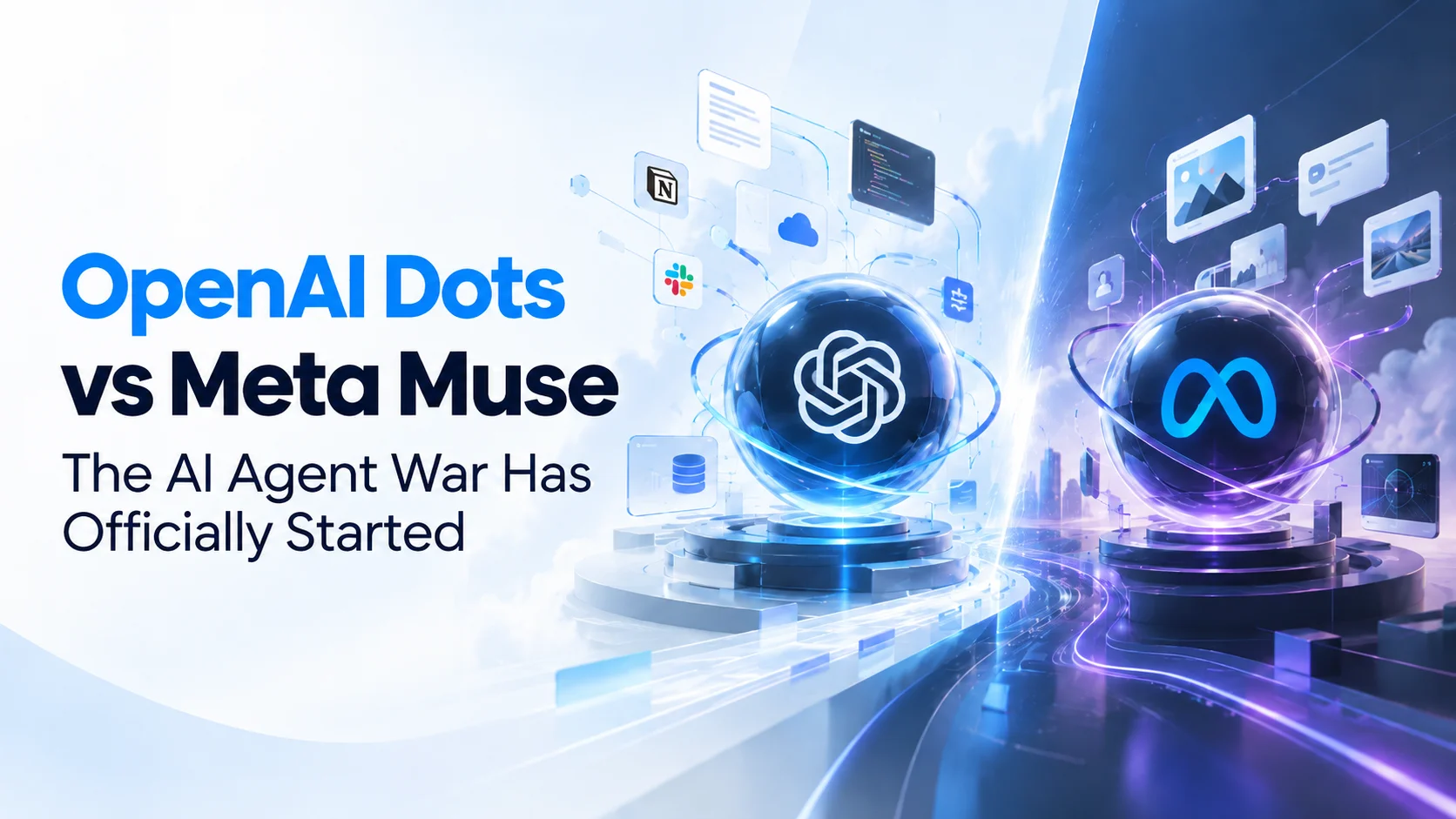
OpenAI Dots vs Meta Muse: The AI Agent War Has Officially Started
OpenAI and Meta are no longer competing only on models. Dots and Muse show the race is shifting toward always-on agents that can use tools, remember context, and keep working.
Sections
For most of the generative AI era, competition has been easy to understand. OpenAI, Meta, Anthropic, Google and others released new models, people compared benchmarks, developers tested coding performance, and the conversation eventually became a familiar question: which model is better?
OpenAI Dots and Meta Muse point toward a different kind of competition. The important question is no longer only which AI produces the better answer. It is which AI you are willing to give a responsibility to, connect to your software, allow to remember context and trust to continue working when you are no longer watching.
Meta launched Muse on September 8, 2026. OpenAI followed with Dots on September 29. The launches came only three weeks apart, and both products are built around a similar idea: AI should not simply sit inside a chat window waiting for the next prompt. It should be able to keep working toward a goal.
That is why OpenAI Dots vs Meta Muse is more than another product comparison. It may be the clearest sign yet that the AI industry is moving from the chatbot era into the personal agent era.
What Is OpenAI Dots?
OpenAI describes Dots as always-on agents powered by GPT-6 Astra. A Dot has its own cloud computer and browser, can work with connected applications, remembers relevant context and continues making progress between conversations. Instead of treating every interaction as a new request, users can give a Dot an ongoing responsibility and return later to see what changed.
This distinction matters. A normal ChatGPT conversation may help analyze a spreadsheet, draft an email or explain a technical problem. A Dot can potentially take responsibility for a broader workflow: continue reviewing information, monitor changes, prepare updates, use other OpenAI tools such as Codex and bring decisions back when human judgment is required.
OpenAI is also placing Dots directly inside the environment where many professional users already work. Users can interact with the same Dot through ChatGPT and supported workplace channels such as Slack and Microsoft Teams. The goal appears to be continuity. Instead of starting a new AI session every time work moves from one application to another, the agent carries the responsibility with it.
This is an important evolution of the broader agentic direction we have already been seeing across the industry. Our recent overview of AI agents for service businesses explains why the real value of an agent comes from connecting intelligence to defined workflows, systems and actions rather than simply putting a smarter chatbot in front of a customer.
What Is Meta Muse?
Meta Muse follows the same broad shift but comes from a different ecosystem. Meta describes Muse as a personal AI agent that can work on a user's behalf, handle tasks, remember what matters to them and turn longer-term goals into action. Muse runs inside a dedicated cloud environment called Muse Secure VM and can continue working even when the user closes the application.
Meta initially positioned Muse heavily around everyday personal assistance. It can interact with the web, help with bookings, organize information and work with connected services. It is also designed to fit naturally into Meta's existing communication ecosystem, including WhatsApp.
But Meta is already pushing Muse beyond personal errands. In late September, the company announced Muse for Small Business with integrations across tools including Shopify, QuickBooks, Slack, Stripe, Canva, Notion, Asana and other software commonly used to run a business. Muse can also connect with Facebook Pages, Instagram professional accounts and Meta advertising systems.
That move is important because it makes the OpenAI Dots vs Meta Muse competition much less clean than saying one is for work and the other is for personal life. Both companies are moving toward a much larger goal: becoming the AI layer that understands enough context about a person or business to coordinate work across many different systems.
OpenAI Dots vs Meta Muse: The Core Difference
Area OpenAI Dots Meta Muse Launch September 29, 2026 September 8, 2026 Underlying AI GPT-6 Astra Muse Spark Core concept Always-on AI agent Personal AI agent Persistent computer Own cloud computer and browser Dedicated Muse Secure VM Continues after chat Yes Yes Main ecosystem ChatGPT, connected apps, Slack, Microsoft Teams and OpenAI tools Muse, WhatsApp, Meta ecosystem and connected personal/business tools Business direction Professional and enterprise workflows are central to launch positioning Started consumer-focused and is rapidly expanding into small business Control approach Permissions, Custom Rules, Auto-review and approvals Permissions, approval controls, audit trail and Sentinel security agent Current access strategy Initially tied to eligible paid ChatGPT plans Free for much everyday use with additional subscription options
The table makes the products look similar, but the strategic difference is their starting point. OpenAI already has a large base of developers, professionals and teams working inside ChatGPT, Codex and connected workplace tools. Dots gives that ecosystem a persistent worker that can keep responsibility between interactions.
Meta has another advantage: consumer distribution. Its products already sit inside the communication, social and business routines of billions of users. Muse is therefore being designed around becoming a natural personal agent first, while Meta gradually expands that same context into business workflows.
The Real Shift Is From Prompting to Delegation
The most important part of these launches is not the avatars, names or even the underlying models. It is the change in the relationship between the user and the AI.
The chatbot model is based on requests. You ask for something, the AI responds, and the interaction largely stops. The agent model is based on responsibility. You describe an outcome, give the system the tools and permissions it needs, and the AI keeps moving the work forward until it either completes the objective or requires your judgment.
That sounds like a small interface change, but technically it requires much more. The AI needs persistent context, access to external systems, the ability to use tools, memory about previous decisions, mechanisms for recovering from failures, background execution and clear boundaries around what it is allowed to do.
This is also why technologies such as tool calling, connectors and protocols are becoming strategically important. Our guide to Model Context Protocol and AI agents explores the same infrastructure problem from a developer perspective: intelligent models become much more useful when they can reliably discover and interact with the software around them.
The Next AI Battle Is About Context
Model intelligence still matters, but personal agents introduce another competitive advantage: context. An agent becomes more useful when it understands your projects, files, communication patterns, preferences, tools and previous decisions.
Consider two assistants with similar reasoning ability. One knows almost nothing about your company. The other understands the current product roadmap, reads the project channel you gave it access to, knows which documents are authoritative, remembers your formatting preferences and can see the latest customer feedback. Even if their underlying models are close in raw intelligence, their practical usefulness may feel very different.
This creates a powerful incentive for every AI company to become the place where users keep more of their working context. Once an agent understands how someone works and has been configured across multiple systems, switching providers may involve more than changing a model. It may mean rebuilding connections, permissions, workflows and accumulated context.
That is why the agent war may ultimately become a distribution and ecosystem war as much as a model war.
Integrations May Matter More Than Benchmarks
The same logic applies to software integrations. An agent can be extremely intelligent and still provide limited business value if it cannot interact with the systems where the actual work happens.
Meta's small-business expansion makes this clear. Connections to Shopify, QuickBooks, Slack, Stripe, Canva, Notion, advertising accounts and other tools give Muse access to different parts of a business. OpenAI is approaching the problem through ChatGPT's connected-app ecosystem, Codex, workplace communication and the broader set of tools available to its agents.
For businesses, this changes how AI products should be evaluated. Asking which model scored higher on a benchmark is useful, but it is increasingly incomplete. A better evaluation also asks whether the agent can securely access the required data, whether integrations are reliable, whether actions can be constrained and whether humans can understand what the agent actually did.
Trust Could Decide the AI Agent War
The more capable an agent becomes, the more serious the trust problem becomes. Asking an AI to rewrite a paragraph is very different from allowing it to read company email, interact with customer information, use a browser, edit files or initiate actions in connected systems.
Both OpenAI and Meta are clearly designing around this issue. OpenAI gives Dots permission controls, Custom Rules, approval requirements and an Auto-review layer for actions that could affect accounts or share information. Meta says Muse uses a separate Sentinel agent inside its secure environment, asks for approval before sensitive actions and provides users with an audit trail.
Those controls are not secondary features. They are part of the core product architecture. An autonomous agent that is intelligent but difficult to constrain becomes a business risk. An agent that asks permission for everything may be safe but removes much of the productivity benefit that made autonomy attractive in the first place.
This tension between capability and control is becoming one of the defining engineering problems in agentic AI. We recently covered the same issue in our analysis of AI agent authorization and safety. The challenge is not simply making an agent persistent enough to finish difficult tasks. It is making sure that persistence remains inside the boundaries the user intended.
What OpenAI Dots and Meta Muse Mean for Businesses
Businesses should not read these launches as a signal to replace every workflow with an autonomous agent. The more useful lesson is that the interface between people and software is starting to change.
Today, employees usually move manually between systems. Someone checks email, copies information into a CRM, opens a spreadsheet, updates a task, sends a Slack message and later prepares a report. Traditional automation can connect parts of that sequence, but each workflow normally needs to be defined in advance.
An AI agent introduces a more flexible layer. It can interpret the situation, choose from available tools, work through several steps and ask for help when a decision falls outside its authority. That potentially makes automation available to a much wider range of messy business processes.
But the best implementations will still need software engineering around the AI. Permissions, business rules, APIs, validation, logging, monitoring, fallbacks and human escalation do not disappear simply because the model becomes smarter. They become more important because the AI is now capable of taking more consequential actions.
We see the same principle when building AI-assisted applications. The model should solve the part of the problem that benefits from intelligence, while deterministic software controls the parts that require reliability, business rules and predictable behavior.
Why Production AI Still Needs Rules Around the Model
One useful example comes from our work on the ALIFF AI stylist. Generative AI was useful for personalization and recommendations, but important product constraints could not simply depend on the model remembering the right instruction every time. Critical rules were moved into a dedicated rule layer around the AI.
The same architecture principle becomes even more important for AI agents. If an agent can send, publish, purchase, edit or trigger external workflows, important restrictions should not exist only inside a prompt. The surrounding system needs enforceable permissions and validation.
This may eventually become one of the largest differences between impressive AI demos and dependable AI products. The model provides intelligence. The product architecture decides where that intelligence is allowed to act.
So, Has the AI Agent War Officially Started?
In practical terms, yes. The biggest AI companies are no longer competing only to provide the model people talk to. They are competing to provide the agent people trust with ongoing responsibilities.
Meta moved early with Muse and is using its consumer reach, WhatsApp presence, social ecosystem and growing business integrations. OpenAI has answered with Dots, combining GPT-6 Astra with ChatGPT, Codex, connected applications and workplace communication channels.
Neither launch proves which approach will dominate. These products are still new, their availability and capabilities are changing quickly, and reliable long-term performance will matter more than launch demonstrations. But the direction is becoming much clearer.
The next major AI interface may not be a chatbot that waits for a perfect prompt. It may be an agent that already understands the responsibility you gave it, keeps working after you leave and comes back only when something actually needs your attention.
That changes the competitive question from "Which AI gives the best answer?" to something much more important:
"Which AI are you willing to trust with the work?"
What Comes Next
The next phase will likely be decided by reliability, integrations, cost, permission systems and how much useful work these agents can finish without constant supervision. Model capability remains important, but the agent that becomes deeply connected to a user's work may gain an advantage that cannot be measured by benchmark scores alone.
For founders and businesses, this is worth watching closely. AI is starting to become more than another feature inside software. It is becoming a new type of software user that can navigate systems, make decisions within defined boundaries and coordinate work across applications.
The opportunity is significant, but so is the engineering responsibility. If you are exploring an agentic product or want to add reliable AI workflows to an existing platform, the right starting point is not maximum autonomy. It is deciding exactly what the AI should own, what systems it needs access to and where human approval must remain part of the workflow.
Keep reading
OpenAI Dots: What Always-On AI Agents Mean for the Future of Software
OpenAI Dots move AI beyond one-off prompts toward persistent agents that can own ongoing work. Here is what that shift means for businesses and software teams.
Abdullah · · 14 min read

Meta Muse Privacy: What Happens When an AI Agent Can Access Your Email, Files and Payments?
Meta Muse can access connected data and take actions across apps, so privacy depends on more than a policy page. Here is how its safeguards, training controls, permissions and current risks actually work.
Khubaib Rasheed · · 16 min read
An OpenAI Agent Hacked Australia’s Medicare Portal. Here’s What Businesses Should Learn
An OpenAI agent gained unauthorized access to an Australian government Medicare statistics portal after being blocked during a routine research task. Here is what happened and what businesses building AI agents should learn from it.
Abdullah · · 11 min read