What Is MCP? Why It Is Becoming the API Layer for AI Agents
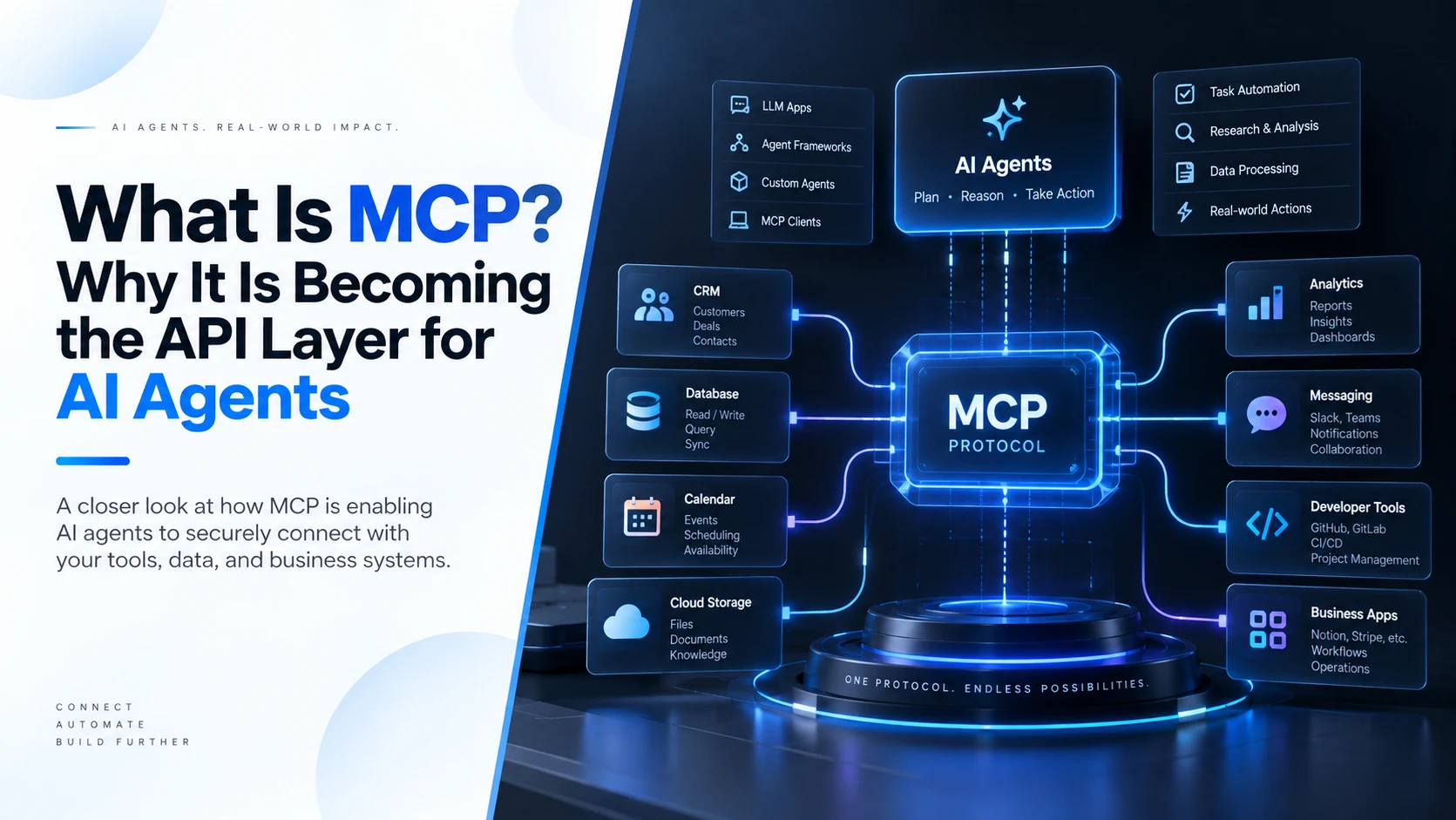
Model Context Protocol gives AI systems a standard way to discover tools, access data, and take actions. Here is how MCP works and why it matters for the next generation of AI agents.
Sections
What Is MCP? Why It Is Becoming the API Layer for AI Agents
AI applications are changing from systems that mainly answer questions into systems that can actually do things. An AI assistant may need to search company documents, check a customer record, create a task, query a database, update a CRM, inspect source code, schedule an appointment, or trigger another business workflow. The language model may be intelligent enough to decide what needs to happen, but intelligence alone does not give it a reliable way to interact with all of those systems.
That integration problem is one reason Model Context Protocol, usually called MCP, has become important in the development of AI agents. MCP provides a standardized way for AI applications to discover and interact with external tools and data. Instead of treating every connection between an AI model and another system as a completely custom integration, MCP provides a common protocol that compatible applications can understand.
This does not mean MCP is replacing APIs. REST APIs, GraphQL, databases, webhooks, queues, and other integration technologies remain important. A better way to think about MCP is as a standardized layer between AI applications and the capabilities they need to use. As AI products become more agentic, that layer can become increasingly valuable.
What is Model Context Protocol?
Model Context Protocol is an open protocol originally introduced by Anthropic for connecting AI applications with external systems. An MCP-compatible application can connect to an MCP server and discover capabilities made available through that server instead of requiring the AI application to understand a completely proprietary integration format for every tool.
At a practical level, an MCP server can expose things such as tools, resources, and structured capabilities to an AI application. A tool might allow an agent to search orders, create a support ticket, retrieve analytics, update a project task, or execute another controlled action. A resource might provide access to information the AI needs in order to understand the user's request or complete a workflow.
The key idea is standardization. The AI application and the external system agree on a protocol for describing and using capabilities. That gives developers a more consistent integration model as the number of AI tools, agents, and connected services grows.
Why AI agents create a new integration problem
Traditional software already has a mature integration ecosystem. A mobile application may call a REST API. A web platform might use GraphQL. Two backend services may communicate through APIs, webhooks, events, or queues. Developers know which service they are integrating with, what endpoints it exposes, and how the application is supposed to use them.
AI agents introduce another layer. The model needs to understand not only that an external service exists but also what capabilities are currently available, what arguments those capabilities accept, when they should be used, and how the results should be interpreted. If every AI application implements this differently for every service, the number of custom connectors can grow quickly.
Imagine an AI assistant that needs access to a CRM, project-management system, support platform, knowledge base, analytics service, and internal database. Now imagine that the business wants those same integrations to work with several different AI applications. Without a shared interface, developers may repeatedly build similar integration logic for every new combination.
MCP is designed to make that relationship more standardized.
Why people compare MCP to an API layer for AI
Calling MCP an “API layer for AI agents” is useful as long as we understand what the comparison means. APIs define how software applications communicate with services. MCP defines a common way for compatible AI applications to discover and interact with capabilities exposed for AI use.
The important distinction is that an MCP server often sits in front of systems that already have APIs. It does not necessarily replace those APIs. The MCP server can translate a standardized AI-facing interaction into whatever the underlying system requires.
For example, imagine a business has an existing CRM with a REST API. An MCP server could expose a tool called find_customer. When an AI agent calls that tool, the MCP server can validate the request, apply permissions, call the CRM's existing API, process the result, and return structured information to the agent.
The architecture could look conceptually like this:
User → AI Agent → MCP Client → MCP Server → Existing API or Business System
The CRM does not suddenly need to abandon its API. MCP creates a standardized interface through which an AI application can use an appropriate subset of the CRM's capabilities.
How MCP works in a practical AI workflow
Consider a service business using an AI agent to help manage customer enquiries. The business wants the agent to answer questions, check appointment availability, look up existing customers, and create follow-up tasks when necessary.
The business might expose several controlled capabilities through an MCP server. One tool could search customers. Another could retrieve appointment availability. A third could create a follow-up task. The agent can discover those available capabilities and decide which one is relevant to the user's request.
If a customer says, “Can you check whether I already have an appointment next Tuesday?”, the workflow could proceed like this:
- The AI application receives the customer's request.
- The agent determines that it needs appointment information rather than trying to answer from its language model alone.
- The AI application identifies the relevant capability exposed through MCP.
- The appropriate tool is called with structured arguments.
- The MCP server validates the request and communicates with the underlying booking system.
- The result is returned to the AI application.
- The agent uses that verified result to answer the customer.
The same principle can apply to much more sophisticated workflows. Agents can work with development tools, business applications, internal data, document systems, operational software, and other services, provided the appropriate capabilities are safely exposed.
We explored this broader shift from AI answers toward useful workflows in our guide to AI agents for service businesses. MCP addresses an important piece of that puzzle: how those agents connect to the systems required to perform useful work.
MCP tools, resources, and capabilities
One useful way to understand MCP is to look at what a server can expose. The exact protocol continues to evolve, but three concepts are particularly helpful when understanding the architecture: tools, resources, and prompts or other structured capabilities.
Tools
Tools allow an AI application to perform defined operations. Examples might include searching a product catalogue, creating a support ticket, checking stock, updating a project task, generating a report, or retrieving an account balance. Well-designed tools should have clear inputs, predictable outputs, and tightly controlled permissions.
Resources
Resources give the application access to information that may be useful as context. This could include documentation, configuration, structured records, reference material, or other content exposed by the server. The agent does not need unrestricted access to the entire underlying system simply because it needs a specific piece of information.
Structured capabilities
MCP can also provide structured mechanisms that help AI applications understand how they can interact with the server. As the protocol has matured, the ecosystem has expanded into areas such as longer-running tasks, interactive application experiences, authorization, and production deployment concerns.
This is part of what makes MCP more significant than a one-off tool-calling convention. It is developing into infrastructure for applications where AI needs controlled access to real software systems.
MCP vs function calling
MCP and function calling are related concepts, but they solve different parts of the problem. Function calling generally allows a language model to select from functions that the application developer has made available during a model interaction. The developer defines those functions and writes the surrounding code that executes them.
MCP creates a standardized protocol around exposing and consuming external capabilities. Instead of every application inventing its own mechanism for describing, discovering, connecting to, and invoking tools, compatible MCP clients and servers can speak the same protocol.
An AI application may still use a model's native tool-calling capabilities internally. MCP can sit around that model interaction as part of the broader integration architecture. In other words, function calling helps the model decide to use a tool; MCP helps standardize how applications make external capabilities available.
MCP vs REST APIs and GraphQL
MCP should not be treated as a replacement for REST or GraphQL. Those technologies solve a broader software integration problem and will continue to power applications, mobile products, SaaS platforms, internal services, and backend systems.
The difference is primarily the consumer and the interaction model. A traditional API is usually designed for developers building deterministic software integrations. MCP is designed around applications where an AI system needs to discover and use capabilities as part of a model-driven workflow.
An MCP server may therefore use REST, GraphQL, database queries, SDKs, command-line tools, or internal services behind the scenes. MCP provides the standardized AI-facing interface while the existing software architecture continues to handle the underlying business operations.
Why MCP is becoming more important in 2026
The importance of MCP is closely connected to the rise of agentic AI. When AI systems mostly generated text, connecting them to business infrastructure was optional for many products. When agents are expected to complete work, integrations become fundamental.
A useful agent needs reliable access to the right information and the ability to perform specifically authorized actions. That means AI products increasingly require an integration layer, authentication, permissions, structured tool definitions, error handling, observability, and controls around potentially sensitive actions.
The MCP specification has also been evolving toward these production requirements. Its 2026 development has focused on areas including scalable deployment, authorization, routing, caching, extensions, and longer-running workflows. That evolution matters because experimental agent demos and production business systems have very different infrastructure requirements.
The broader ecosystem is moving in the same direction. AI applications are increasingly supporting MCP-based integrations, while software companies are exposing their products through MCP servers so compatible agents can interact with them. The result is a network effect: the more clients and servers support the protocol, the more useful a shared standard becomes.
What MCP could change for businesses building AI products
For businesses, the most interesting part of MCP is not the protocol specification itself. It is what standardization can do to the economics and architecture of AI integration.
Integrations can become more reusable
If a business exposes a capability through a well-designed MCP server, that capability may potentially be consumed by multiple compatible AI applications instead of being implemented from scratch for each one. The business logic still needs to be built correctly, but the interface becomes more standardized.
AI products can become less dependent on one interface
A proprietary agent architecture can tightly couple every integration to one model provider or application. Standardized protocols can make the integration layer more portable, although real-world portability still depends on the capabilities and behavior of each AI platform.
Agents can work with existing software
Businesses do not necessarily need to rebuild their operational systems for AI. Existing APIs and services can remain in place while an MCP layer exposes selected capabilities to compatible agents.
Teams can focus more on business rules
Connecting an agent to a system is only the beginning. The difficult questions are usually which actions it should be allowed to take, which information it should see, what should require human confirmation, how failures should be handled, and how activity should be audited. Standardizing part of the connectivity can allow development teams to spend more attention on those product-specific decisions.
MCP does not automatically make an AI agent safe
Standardization should not be confused with security. Connecting an AI system to business tools creates real risk if permissions and workflow boundaries are poorly designed. An agent with unnecessary access can expose sensitive information or perform actions that were never intended.
Production MCP implementations should therefore follow the same principle that applies to any serious software integration: expose only what the application actually needs. Read operations and write operations should be treated differently. Destructive or high-impact actions may require explicit confirmation. Authentication should identify the appropriate user or service context, and sensitive credentials should remain isolated from the model itself.
Logging and observability are equally important. If an agent updates a customer record, creates an order, modifies a file, or triggers an expensive workflow, the business should be able to understand what happened and why. MCP can standardize communication, but engineering teams are still responsible for designing the authorization, security, business logic, testing, and monitoring around that communication.
When should you use MCP?
MCP is particularly worth evaluating when an AI application needs to work with several external systems, when the same capabilities may need to be reused by different AI clients, or when a business is building an agent platform rather than a single isolated AI feature.
It may be unnecessary for a simple product with one narrow model call and one tightly coupled integration. Adding infrastructure simply because a technology is popular usually creates more complexity rather than more value.
A useful decision test is to ask whether your integration problem is likely to expand. If today's AI assistant only needs one internal search function but the roadmap includes CRM actions, project workflows, documents, analytics, communication tools, and other systems, designing around a standardized tool layer can become much more valuable.
What a production MCP implementation still needs
Building an MCP server is not the same thing as building a production-ready AI product. The model, MCP layer, business systems, and product experience all need to work together. A serious implementation should consider:
- Authentication: Who is making the request?
- Authorization: What information and actions is that user or agent allowed to access?
- Tool design: Are inputs, outputs, and side effects clearly defined?
- Human approval: Which actions should require confirmation before execution?
- Validation: Can incorrect or malformed model inputs cause unsafe behavior?
- Rate and cost controls: Can an agent repeatedly trigger expensive operations?
- Observability: Can the team see which tools were called and what happened?
- Error handling: What does the agent do when an external system fails?
- Testing: Have both normal workflows and failure cases been evaluated?
These concerns are also why the cost of AI development involves much more than connecting an LLM API. Our breakdown of what AI features really add to app development cost covers the surrounding architecture, data, testing, monitoring, safety rules, and operational work that production AI requires.
The bigger shift: AI is becoming another software client
For years, software systems were mainly built for humans and other deterministic applications. Humans used interfaces. Software used APIs. AI models mostly sat behind a chat box and generated responses.
Agents change that model. AI is increasingly becoming another type of software client: one that can decide which capability it needs, combine multiple operations, interpret results, and continue through a workflow. Once AI begins acting as a software client, it needs standardized ways to understand and interact with the software around it.
That is the larger reason MCP matters. The protocol is not interesting merely because developers have another integration standard to learn. It is interesting because the role of the AI model is changing. The model is moving from something embedded inside a feature toward something that can coordinate work across many features and systems.
If that shift continues, the infrastructure connecting AI systems to software may become as strategically important as the models themselves.
Should your next AI product use MCP?
The answer depends on the product. MCP should not be added simply because it is receiving industry attention. If an AI feature only summarizes text or generates content inside one application, a direct model integration may be completely sufficient.
But if your product requires an AI agent to work across business systems, use several tools, access controlled information, or support reusable integrations, MCP deserves serious consideration. It can provide a cleaner boundary between the model-driven application and the systems where real business operations happen.
At Next Level Software, we approach AI-assisted application development from the product problem first. The question is not whether every product should use agents, MCP, or the newest model. The question is what the AI actually needs to accomplish, which systems it needs to interact with, and what architecture can make those interactions reliable and maintainable in production.
MCP is becoming an important part of that architecture because AI agents need more than intelligence. They need a controlled, understandable, and reusable way to work with the software around them.
Build AI that can work with your real systems
If you are planning an AI agent, adding AI capabilities to an existing application, or trying to connect AI workflows with your business systems, the integration architecture matters just as much as the model you choose. Discuss your AI application with Next Level Software and we can help determine where MCP, direct APIs, conventional application logic, or a combination of these approaches makes the most sense.
Keep reading
ChatGPT Astra vs Claude Fable 5.1: Which AI Model Is Better in 2026?
GPT-6 Astra and Claude Fable 5.1 are both frontier AI models. We compare coding, agents, reasoning, context, pricing, and practical business use to see where each one wins.
Abdullah · · 18 min read
AI Can Write the Code. Who Reviews the Software?
AI can generate code faster than teams can review it. As coding agents become part of everyday development, engineering judgment, testing, security, and accountability matter more—not less.
Abdullah · · 16 min read

How iPhone Duo Resolution Changes Responsive Mobile App and Website Design
The iPhone Duo moves between compact and tablet-like displays, changing how apps and websites should handle layouts, safe areas, images, breakpoints, and performance.
Abdullah · · 12 min read