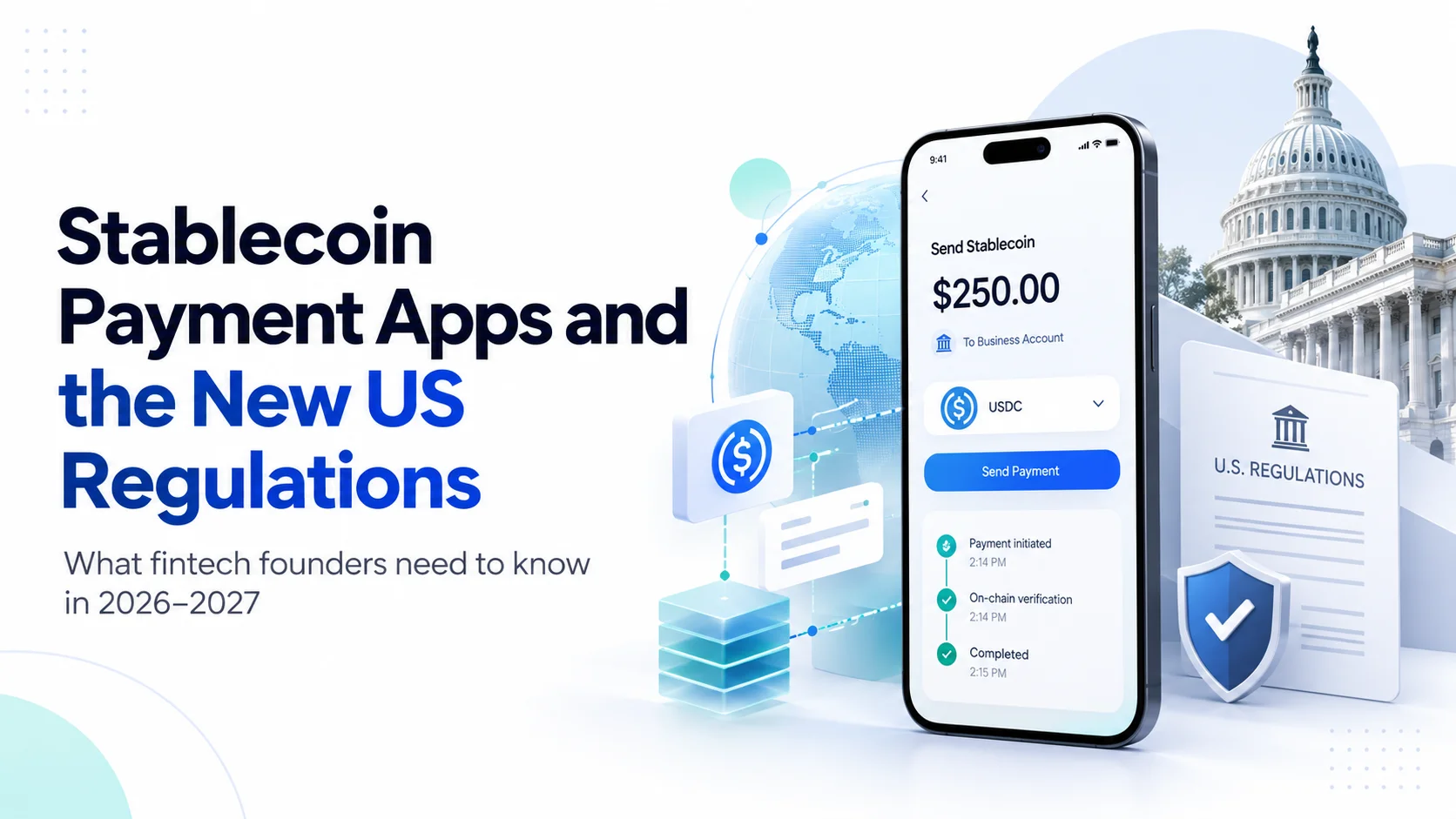
Stablecoin Payment Apps and New US Regulations: What Changes in 2027
The GENIUS Act is reshaping stablecoin payments in America. Explore the latest regulations, compliance requirements, payment app features, and opportunities for fintech founders.
Sections
Stablecoin payment apps are entering a new phase in the United States. What began as a way to move digital dollars between cryptocurrency wallets is increasingly becoming part of business payments, international transfers, merchant settlements, and financial technology platforms.
The timing matters. The United States has moved from debating stablecoin legislation to implementing a federal regulatory framework. The GENIUS Act became law in July 2025, and on October 21, 2026, the Office of the Comptroller of the Currency (OCC) issued its final implementing rule for stablecoin issuers under its jurisdiction. The law and the OCC rule are scheduled to take effect on January 18, 2027.
For fintech founders, payment companies, and businesses considering stablecoin integration, the question is no longer simply whether blockchain can move money. It is how to build a payment product that offers real business value while accounting for licensing, security, transaction monitoring, reserves, redemption, and customer protection.
This guide explains the new US stablecoin regulations, how stablecoin payment apps work, the business opportunities emerging in 2026, and the technical decisions founders should make before developing a stablecoin-powered financial product.
What Are Stablecoin Payment Apps?
A stablecoin payment app is a financial application that allows individuals or businesses to send, receive, hold, or use digital assets designed to maintain a stable value, typically relative to the US dollar. Unlike cryptocurrencies such as Bitcoin, which can experience significant price fluctuations, dollar-pegged stablecoins are designed to track the value of one US dollar.
Two well-known examples are USD Coin (USDC) and Tether (USDT). Both are widely used in digital asset markets, but their issuers, reserves, redemption arrangements, regulatory status, and supported networks must be evaluated separately. A stablecoin's dollar peg does not eliminate depegging, operational, counterparty, or regulatory risk.
A typical stablecoin payment app connects a customer-facing web or mobile interface with wallets, payment APIs, blockchain networks, transaction monitoring, and financial records. Depending on the product, customers may never need to interact directly with complex cryptocurrency interfaces.
For example, a US business paying an international contractor could initiate a dollar-denominated payout inside a familiar payment dashboard. Behind the scenes, a suitable payment provider could convert the funded amount into a supported stablecoin, transfer it through a blockchain network, and arrange delivery to the recipient's wallet or local bank account through an approved payout partner.
The customer sees a payment amount, recipient details, fees, status, and receipt. The underlying system handles settlement, conversion, blockchain interactions, and applicable compliance checks.
Why Stablecoin Payments Are Becoming Important in 2026
The business interest in stablecoins is moving beyond crypto trading. Companies are exploring stablecoins as infrastructure for cross-border payments, corporate treasury operations, merchant payments, and international payouts. These applications are attractive because certain blockchain networks can operate around the clock and support programmable transfers without depending on every intermediary in a traditional correspondent-banking chain.
Recent industry data provides evidence that stablecoin-linked payment products are expanding. On October 1, 2026, Visa reported that approximately 17% of its stablecoin-linked card volume during fiscal 2026 year-to-date came from business and commercial card programs. Visa also reported supporting more than 160 stablecoin-linked card programs covering consumer, business, and commercial activity.
These figures do not mean that 17% of all Visa transactions use stablecoins. They specifically describe activity within Visa's stablecoin-linked card programs. However, they indicate that stablecoin infrastructure is increasingly relevant to commercial payment products rather than only consumer cryptocurrency activity.
For fintech startups, this creates several potential advantages. Stablecoin-based systems may support faster international settlement, extended payment availability, improved transaction visibility, and new payout models. Actual savings and settlement performance depend on transaction volume, blockchain fees, liquidity providers, foreign exchange spreads, banking partners, compliance costs, and the recipient's ability to access funds.
The opportunity is not to replace every existing payment method. It is to identify payment flows where stablecoin infrastructure can remove specific operational difficulties or improve the customer experience.
What Is the GENIUS Act?
The Guiding and Establishing National Innovation for U.S. Stablecoins Act, commonly called the GENIUS Act, is a federal law establishing a regulatory framework for payment stablecoin issuance in the United States. It was signed into law on July 18, 2025.
The legislation addresses an important question: who is permitted to issue payment stablecoins, and what safeguards must support those stablecoins?
Under the law, permitted payment stablecoin issuers must satisfy requirements concerning eligible reserve assets, redemption, disclosures, risk management, and other obligations. The law also establishes federal and state supervisory pathways and restrictions affecting certain foreign-issued payment stablecoins.
These requirements matter because stablecoin payment systems depend on more than blockchain functionality. They also depend on the issuer's ability to maintain adequate reserves, redeem tokens, and operate under an appropriate legal and supervisory framework.
For fintech entrepreneurs, an important distinction is that issuing a stablecoin is different from building an application that integrates a stablecoin issued by another company. The applicable regulatory obligations depend on the product's actual activities, custody model, partners, transaction flows, and jurisdictions.
Latest US Stablecoin Regulation: What Changed in October 2026?
On October 21, 2026, the OCC announced a final rule implementing major portions of the GENIUS Act for entities under its jurisdiction. The rule was published in the Federal Register on October 23, 2026, and is scheduled to become effective on January 18, 2027.
The rule establishes more detailed requirements for activities involving payment stablecoin issuance, reserves, redemption, risk management, examinations, custody, applications, and capital and operational safeguards. It also addresses certain foreign payment stablecoin issuers and state-qualified issuers subject to OCC authority.
This is particularly important for businesses planning to issue their own dollar-backed stablecoin. The regulatory framework is moving from broad statutory requirements toward more specific supervisory standards and application procedures.
However, the October OCC final rule does not resolve every regulatory question for the stablecoin industry. Separate anti-money-laundering and sanctions rulemaking remains part of the implementation process. Other federal and state requirements may also affect payment apps, exchanges, custodians, and money transmission businesses.
Important US Stablecoin Regulation Dates
DateRegulatory DevelopmentWhat It MeansJuly 18, 2025GENIUS Act enactedFederal payment stablecoin framework established.February 25, 2026OCC proposed implementing ruleDetailed issuer requirements opened for public comment.April 8, 2026FinCEN and OFAC announced proposed rulesAnti-money-laundering and sanctions requirements moved through a separate rulemaking process.August 17, 2026Treasury announced another proposed ruleClarifications proposed for issuing, offering, and selling stablecoins in US markets.October 21, 2026OCC final implementing rule announcedMajor issuer and custody regulations finalized for OCC-supervised entities.January 18, 2027Scheduled effective dateGENIUS Act and OCC final rule obligations take effect, subject to applicable provisions and relief.July 18, 2028Additional statutory distribution restrictionsBroader restrictions concerning offering or selling payment stablecoins in the US become applicable, subject to statutory exceptions.
Fintech businesses planning a launch should treat these dates as product planning milestones. A platform designed before final regulatory implementation may need changes to its supported assets, providers, account structure, disclosures, or compliance processes.
Key GENIUS Act Requirements for Stablecoin Issuers
1. Permitted Stablecoin Issuers
The GENIUS Act establishes restrictions on who may issue payment stablecoins in the United States. The framework includes authorized federal and state pathways, with additional requirements for qualifying foreign issuers.
A fintech company planning to create its own stablecoin needs a regulatory strategy before developing the token or its supporting infrastructure. Issuing a token without addressing the required approvals can create major legal and operational risks.
By contrast, a software company integrating stablecoins issued by third parties must assess its role as a potential digital asset service provider, custodian, money transmitter, or other regulated participant. Integrating another issuer's token does not automatically remove all licensing or compliance obligations.
2. Reserve Backing
The law requires permitted payment stablecoin issuers to maintain identifiable reserves backing outstanding stablecoins on at least a one-to-one basis. Eligible reserve categories include specified cash, deposit, Treasury, and other permitted high-quality liquid assets, subject to applicable conditions.
This requirement is designed to support redemption and reduce risks associated with insufficient or inappropriate backing. For payment apps, it makes issuer selection and reserve transparency important parts of vendor due diligence.
3. Redemption and Customer Protection
Stablecoin holders need reliable information about how and under what conditions stablecoins may be redeemed. The regulatory framework includes requirements governing redemption policies and related procedures.
Payment apps should communicate redemption eligibility, processing arrangements, applicable fees, and possible delays clearly. The exact experience will vary depending on whether the customer has a direct relationship with the issuer or accesses the stablecoin through an intermediary.
4. Interest and Yield Restrictions
The GENIUS Act prohibits permitted and foreign payment stablecoin issuers from paying holders interest or yield solely in connection with holding, using, or retaining payment stablecoins. This affects how issuer-supported stablecoin products may be designed and marketed.
It should not be interpreted as a blanket prohibition on every possible third-party incentive arrangement. The legal treatment of rewards, distribution agreements, and related products depends on their structure and applicable law. Fintech founders should seek legal review before adding yield or reward functionality.
5. Transparency, Reporting, and Risk Management
Stablecoin issuers face requirements relating to financial disclosures, reserve information, audits, supervision, and operational controls. The OCC has also published revised weekly and quarterly reporting forms for entities under its jurisdiction, subject to the applicable approval process.
For an issuer, reporting capability should be designed into its accounting and operational systems rather than added as an afterthought. Reliable financial records, reconciliation, permission controls, and audit trails are essential elements of a sustainable payment infrastructure.
6. Anti-Money-Laundering and Sanctions Controls
Stablecoin businesses must also consider applicable Bank Secrecy Act, anti-money-laundering, counter-terrorist-financing, and sanctions obligations. FinCEN and OFAC have pursued a separate GENIUS Act implementation process covering these areas.
The correct technical controls depend on the business model. A product may require customer identity verification, sanctions screening, transaction monitoring, suspicious activity procedures, records retention, and mechanisms to respond to lawful orders.
These are not features that should be copied blindly from another fintech application. The obligations should be defined with qualified compliance and legal advisers before implementation.
How the New Regulations Affect Stablecoin Payment Apps
The GENIUS Act primarily establishes rules for payment stablecoin issuance, but its effects reach the broader fintech ecosystem. Wallet companies, payout platforms, merchants, payment service providers, and financial institutions must understand the role they play when offering customers access to stablecoin payments.
For a founder, the first architectural decision is whether the business intends to issue a stablecoin, hold assets for customers, facilitate transfers, or integrate with an existing regulated provider. These are different operating models with different risk profiles.
Business ModelTypical ProductPrimary ConsiderationStablecoin issuerCompany-issued dollar stablecoinIssuer authorization, reserves, redemption, and supervision.Custodial walletCustomer balances and transfersCustody controls, safeguarding, and applicable licensing.Noncustodial walletUser-controlled crypto walletSecurity, transaction functionality, and activity-specific obligations.Merchant payment appStablecoin checkout and settlementsPayment processing partners, conversions, refunds, and reconciliation.Cross-border payout appInternational business paymentsOn/off ramps, local payout rules, screening, and liquidity.Stablecoin-enabled SaaSBusiness platform with payment featuresProvider integration, account permissions, reporting, and payment records.
The most appropriate operating model is the one that solves the intended business problem without unnecessarily creating regulated activities the startup is not prepared to manage.
Top Business Opportunities for Stablecoin Payment Apps in the US
1. Cross-Border B2B Payments
International supplier payments and contractor payouts are among the strongest potential use cases. Traditional cross-border transfers can involve multiple intermediaries, processing windows, currency conversions, and limited settlement visibility.
A stablecoin-based payment platform could help businesses initiate payments, track transfer statuses, and manage recipient information through a single dashboard. However, the final outcome still depends on access to regulated banking, conversion, and payout infrastructure.
2. Stablecoin Payment Gateways for Merchants
Online merchants may want to accept stablecoin payments without building an entire blockchain system internally. A payment gateway can provide checkout sessions, invoice generation, transaction monitoring, payment confirmations, and settlement reporting.
The important product decision is whether merchants receive stablecoins or a traditional currency settlement. Many businesses may prefer the customer-facing benefits of stablecoin acceptance without holding digital assets themselves.
3. Digital Wallet Apps
Stablecoin wallet applications can support balances, transfers, transaction histories, notifications, account security, and payment requests. For consumer or business users, the experience should be as understandable as an ordinary financial application.
Wallet architecture requires particular attention to the custody model. A custodial wallet relies on the provider or its partner to control private keys, while a noncustodial wallet places key control with the user. Each model creates different security, recovery, operational, and regulatory considerations.
4. Freelancer and Contractor Payment Platforms
Businesses employing international freelancers and contractors frequently deal with payment tracking, settlement delays, banking access, and foreign exchange costs. Stablecoin-enabled payout systems may create a more streamlined payment experience where suitable partners and jurisdictions are available.
A practical platform could provide verified recipient profiles, scheduled payments, bulk transfers, approval workflows, transaction receipts, and downloadable financial reports. These operational features often matter more to businesses than the specific blockchain used for settlement.
5. Embedded Stablecoin Payments for SaaS Platforms
Software-as-a-service businesses and marketplaces can integrate payment capabilities directly into their existing products. Potential use cases include vendor payouts, marketplace settlements, international invoices, and automated treasury workflows.
This creates an opportunity for fintech products that combine payment infrastructure with useful business software. Instead of selling a generic cryptocurrency wallet, a startup can solve a specific payment problem for a defined industry.
Stablecoin Payments vs Traditional Payment Methods
Stablecoin payment infrastructure is not automatically faster, cheaper, or safer than every traditional alternative. The comparison depends on the route, provider, amount, supported currency, and settlement requirements.
FactorTraditional Payment SystemsStablecoin-Based SystemsOperating availabilitySome bank and payment processes follow business hours.Supported blockchain networks may process transfers continuously.International transfersMay involve correspondent banks and intermediary fees.May use blockchain settlement plus conversion and local payout providers.Transaction visibilityDepends on bank and payment provider reporting.On-chain transfers can provide public transaction references.Final customer accessDepends on receiving institution and payment rail.Depends on wallet access, confirmations, off-ramps, and compliance checks.Refunds and disputesSome payment methods include established dispute mechanisms.Blockchain transfers often require separate refund and dispute workflows.CostsProvider, transfer, FX, and processing fees may apply.Network, provider, liquidity, compliance, and conversion costs may apply.Regulatory requirementsEstablished rules vary by payment activity.Digital asset, money transmission, sanctions, and other rules may apply.
For example, an ACH payment between US bank accounts may already be inexpensive and convenient. Adding stablecoin infrastructure would not necessarily improve that transaction. A cross-border business payment involving multiple banking intermediaries may present a more compelling opportunity, but only after comparing the full end-to-end costs and risks.
How to Build a Stablecoin Payment App in 2026 and 2027
Building a stablecoin payment app requires more than connecting a wallet interface to a blockchain API. Founders need to define the payment business, determine applicable obligations, select appropriate providers, and design systems that can manage financial transactions reliably.
Step 1: Define the Payment Use Case
Start with the customer problem. Are users paying merchants, receiving international salaries, settling marketplace transactions, or managing business treasury transfers? Define the source of funds, destination of funds, supported countries, transaction limits, conversion requirements, and expected payment volumes.
This exercise determines the application's essential features and helps prevent unnecessary development. For a first product, focused MVP development can help validate the business need before investing in a broad financial platform.
Step 2: Determine the Regulatory and Custody Model
Before implementation, identify whether the business will issue stablecoins, custody customer assets, facilitate money transmission, or operate through regulated third-party providers. Legal and compliance specialists should assess the applicable federal, state, and international requirements.
The product architecture should follow this operating model. Regulatory assumptions made late in development can require substantial changes to wallet ownership, transaction approval flows, reporting, and customer onboarding.
Step 3: Choose the Stablecoin and Infrastructure Providers
Selecting a stablecoin involves evaluating issuer status, reserves, redemption options, supported blockchain networks, liquidity, technical documentation, security, fees, and geographic availability. USDC may be relevant for some payment applications, but founders should verify current issuer and distribution conditions rather than assuming any token is approved for every use case.
The startup must also evaluate its wallet provider, blockchain infrastructure, custody solution, banking connections, fiat conversion partners, and payment service providers. Dependence on a single vendor can introduce operational risks that should be reflected in system design.
Step 4: Build the Transaction and Accounting Architecture
A reliable payment application should maintain its own structured transaction records even when blockchain events are publicly available. The internal financial ledger, customer balances, payment instructions, fees, refunds, and settlement information need consistent reconciliation.
Important technical safeguards include idempotency keys to prevent duplicate payment processing, secure API authentication, role-based access, webhook signature verification, transaction state management, and monitoring for failed or delayed transfers.
Blockchain transaction confirmation is not the same as completed customer settlement. Applications should distinguish between payment initiation, on-chain confirmation, provider processing, conversion, and final delivery to the recipient.
Step 5: Develop the Customer Experience
Customers should not need extensive blockchain knowledge to make a payment. A good stablecoin payment app presents the amount, currency, recipient, fees, payment status, and any expected conversion details clearly.
Useful features include account onboarding, identity verification where required, recipient management, payment requests, transaction search, downloadable receipts, support workflows, and accessible error messages.
Businesses exploring fintech app development should treat financial accuracy, operational transparency, and secure payment flows as core product requirements rather than secondary technical improvements.
Step 6: Integrate Security and Compliance Controls
Security architecture should cover encrypted sensitive information, secure credential and key management, access controls, transaction approval policies, rate limits, fraud detection, infrastructure monitoring, and recovery procedures. For custodial products, private-key management and authorization controls require special care.
Depending on the business model, the platform may also need customer due diligence, screening, transaction monitoring, configurable compliance rules, audit logs, and support for lawful restrictions or asset-freezing processes.
These capabilities must be matched to the applicable legal requirements. Software features alone do not establish regulatory compliance.
Step 7: Test With Realistic Payment Scenarios
Before launching, test normal payments, rejected transfers, duplicate requests, network congestion, failed webhooks, insufficient balances, incorrect recipient details, interrupted provider connections, and delayed settlement events.
Financial applications also need systematic reconciliation tests. The amounts shown to customers must remain consistent with the application's authoritative records and the actual payment provider or blockchain settlement state.
A controlled pilot with defined transaction limits and operational monitoring can reveal issues that ordinary interface testing may miss.
What Features Should a Stablecoin Payment App MVP Include?
The first version should be designed around a specific payment journey, not an extensive list of cryptocurrency features. For example, a B2B payout product may only need business onboarding, recipient management, payment initiation, status tracking, and financial reporting.
FeatureMVP PriorityPurposeSecure user accountsEssentialProtect account access and customer information.Verification workflowsAs requiredSupport the applicable onboarding and compliance model.Wallet or provider integrationEssentialEnable the selected payment and custody workflow.Send and receive paymentsEssentialDeliver the main customer value proposition.Transaction historyEssentialShow payment amounts, statuses, and references.Internal ledger and reconciliationEssentialMaintain accurate financial records.Security and risk controlsEssentialReduce unauthorized access and payment errors.Administrative dashboardHighSupport operations, reviews, and investigations.Multi-currency payoutsUse-case dependentSupport international payment requirements.Recurring and bulk paymentsLater phaseAutomate more advanced business workflows.
The objective is to prove that the intended users can complete their most important payment task reliably. More advanced functionality can be introduced when real usage and business requirements justify it.
How Much Does Stablecoin Payment App Development Cost?
Stablecoin payment app development costs depend heavily on the product's regulatory role, custody model, supported countries, integrations, transaction volume, and security requirements. There is no reliable universal price for every stablecoin wallet or payment platform.
A payment interface built on an established third-party provider is substantially different from an independent stablecoin issuer or a platform that directly controls customer assets. The latter can require significant additional investment in regulatory preparation, infrastructure, operations, audits, and risk management.
When budgeting a stablecoin application, businesses should consider the following cost categories:
Product discovery, user journeys, and technical architecture.
Regulatory and legal analysis, licensing, and compliance operations.
Web or mobile application development.
Wallet, custody, blockchain, and banking integrations.
Transaction ledger, reconciliation, and administrative systems.
Security testing, operational monitoring, and infrastructure.
Ongoing provider charges, network fees, maintenance, and support.
Founders should also model the unit economics of individual transactions. A payment product may appear technically inexpensive but become commercially unattractive when fiat conversion, banking fees, compliance operations, customer support, and liquidity costs are included.
Starting with a defined transaction flow and an appropriate infrastructure partner can help businesses evaluate demand without immediately undertaking the complexity of building a full payment ecosystem.
Common Mistakes Fintech Founders Should Avoid
One common mistake is assuming that stablecoin payments are automatically cheaper than bank transfers. Blockchain fees represent only part of the total cost, and the final customer experience may require multiple intermediaries.
Another mistake is assuming that integrating an existing stablecoin removes the need for regulatory review. A business's obligations depend on what it actually does, including whether it holds customer funds, controls wallets, converts currencies, or transmits value on behalf of others.
Founders should also avoid using blockchain transaction records as a substitute for a properly designed financial ledger. Applications need consistent internal records, provider reconciliation, accounting controls, and an auditable history of state changes.
Finally, security and customer recovery processes should be designed before launch. Sending funds to the wrong blockchain network or address can create losses that may not be recoverable through an ordinary bank-style reversal process.
How Next Level Software Approaches Fintech Product Development
Developing a successful fintech product requires coordinated work across product planning, user experience, payment integrations, backend architecture, security, and operational systems. The goal is to make complex financial workflows understandable to users and reliable for the businesses operating them.
At Next Level Software, our fintech development services focus on building web and mobile financial applications with secure transaction workflows, payment integrations, financial dashboards, internal ledgers, verification processes, and audit-friendly records.
Our experience also includes multi-role business platforms. For example, our BBX Connect case study demonstrates work on a B2B cashless trading and networking platform used across multiple countries. That project is an example of financial workflow and platform engineering experience, not a claim that it is a GENIUS Act-regulated stablecoin product.
For founders exploring stablecoin-based products, an appropriate starting point is to define the payment experience, identify qualified financial and infrastructure partners, establish the relevant compliance responsibilities, and then build the application around those requirements.
Next Level Software provides software development and integration services. Issuer licensing, banking services, regulated payment processing, and legal compliance determinations must be handled by the appropriately authorized organizations and qualified advisers.
The Future of Stablecoin Payment Apps in the United States
US stablecoin regulation is creating a more defined framework for digital dollar payment infrastructure, but the transition is still underway. The OCC's October 2026 final rule represents an important development, while other implementation processes and jurisdiction-specific requirements continue to matter.
As financial institutions and payment providers evaluate the technology, stablecoin functionality may increasingly appear inside ordinary financial products rather than as a separate cryptocurrency experience. A business user may simply send an international invoice, pay a contractor, or receive a marketplace settlement without needing to understand the underlying blockchain.
The strongest commercial opportunities are likely to come from products that solve a measurable payment problem. Faster settlement may be useful, but businesses also need clear fees, predictable access to funds, dependable reporting, effective fraud controls, and responsive customer support.
For fintech founders, 2026 is an important planning period. The January 2027 effective date creates a reason to review product architecture, issuer dependencies, custody arrangements, and compliance assumptions before launching or expanding in the US market.
Final Thoughts
Stablecoin payment apps have the potential to become an important part of modern financial infrastructure, particularly for cross-border business payments, digital wallets, merchant settlements, and embedded financial services. The GENIUS Act and the October 2026 OCC final rule are making regulatory structure a central part of the industry's development.
However, legislation does not automatically make every stablecoin or payment application safe, licensed, or suitable for a particular business. Success still depends on choosing the right operating model, infrastructure partners, security controls, and customer experience.
Businesses considering stablecoin payments should begin with a clear use case, validate the commercial benefits, obtain the necessary regulatory advice, and build a product architecture that can adapt as the rules and market develop.
Planning a stablecoin-enabled payment platform? Discuss your fintech app idea with Next Level Software and explore the technical requirements for building a reliable financial product.
Sources and Further Reading
Regulatory information is current to October 28, 2026, and is provided for general educational purposes. This article is not legal, financial, or regulatory compliance advice. Businesses should verify subsequent regulatory developments and obtain advice specific to their products and operating jurisdictions.
Keep reading

Gemini 4 Carbon vs Argon: Why Google Released Two Powerful AI Models in One Month
Google released Gemini 4 Carbon weeks after Argon. Explore their key differences in cybersecurity, agentic coding, safety, benchmarks, pricing, and availability.
Khubaib Rasheed · · 20 min read
OpenAI Launches GPT-6.1 Terra: Features, Pricing, Benchmarks & AI Agent Capabilities
OpenAI launched GPT-6.1 Terra on October 26, 2026, with faster computer use, improved visual reasoning, lower API pricing and stronger coding performance. Here's what developers and businesses need to know.
Khubaib Rasheed · · 18 min read
Meta's $25 Billion Fine: Why Your Privacy Promises Matter
New Mexico ordered Meta to pay $25 billion after a jury found misleading claims about privacy and content moderation. Here is what app founders can learn from the ruling.
Khubaib Rasheed · · 12 min read