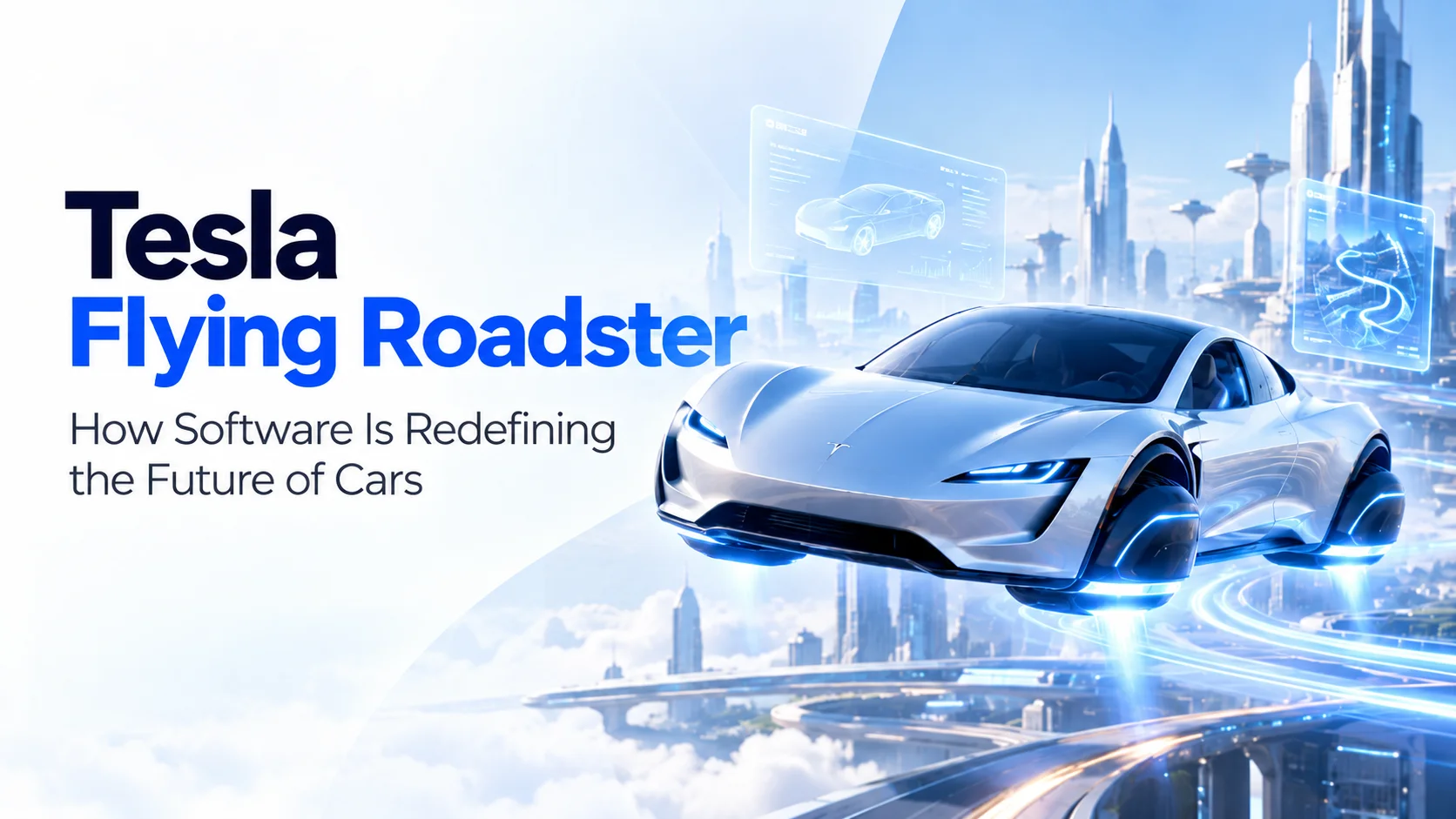
Tesla Flying Roadster 2026: How Software Is Redefining the Future of Cars
Tesla's new Roadster can briefly take flight using SpaceX-inspired thrusters. Here's what the demonstration reveals about intelligent vehicles, real-time software, and the future of automotive technology.
Sections
Tesla has finally shown the world something that sounds like science fiction: an electric sports car that can briefly lift off the ground, maneuver in midair, and land using rocket-inspired technology.
On October 15, 2026, Tesla unveiled its redesigned next-generation Roadster at a demonstration in Texas. The prototype used technologies developed in collaboration with SpaceX, including thrusters and a powerful suction system. It drove upside down on a curved ramp and performed controlled airborne maneuvers, bringing renewed attention to one of Tesla's most ambitious and long-delayed projects.
But beyond the impressive demonstration, there is a bigger technology story. Modern vehicles are becoming increasingly dependent on software to coordinate complex hardware, process information, support intelligent features, and connect users with digital services. Tesla's Roadster demonstration offers an opportunity to examine how engineering innovation is changing the relationship between vehicles and software.
What Is the Tesla Flying Roadster?
The Tesla Roadster is an all-electric sports car originally introduced in its second-generation concept form in 2017. Tesla initially projected deliveries beginning in 2020, but the project faced repeated delays. The redesigned version unveiled in October 2026 introduces experimental capabilities that go beyond traditional electric vehicle performance.
Instead of relying exclusively on electric motors and conventional aerodynamic components, the demonstrated Roadster incorporates additional systems designed to generate powerful forces and control the car's movement. Tesla worked with SpaceX on the thruster technology, bringing aerospace-inspired engineering concepts into an automotive prototype.
The result is not a conventional flying car designed to transport passengers through the sky. It is an experimental high-performance vehicle that demonstrated short airborne movements and unusual driving capabilities under controlled conditions.
What Tesla Demonstrated in October 2026
The latest Roadster unveiling included several unusual engineering demonstrations. They attracted attention not simply because of the vehicle's speed, but because they challenged expectations about what a road-oriented electric car could physically do.
1. Brief Airborne Movement Using Thrusters
The most remarkable demonstration involved the Roadster leaving the ground with assistance from integrated thrusters. The vehicle performed short aerial maneuvers and returned to the surface. These thrusters use compressed-gas technology inspired by aerospace applications, giving the prototype capabilities not normally found in passenger vehicles.
However, this should not be confused with sustained aircraft-style flight. The public demonstration does not establish that the Roadster can operate as a practical flying transportation system or that such maneuvers will be permitted on public roads.
2. Driving Upside Down
Another demonstration showed the Roadster traveling along an inverted section of a curved ramp. Tesla used a powerful fan-based suction system to create additional downforce, helping keep the vehicle attached to the driving surface even while upside down.
Tesla described the suction system as capable of producing exceptional downforce. The approach illustrates how alternative mechanical systems can extend vehicle performance beyond the limitations of conventional aerodynamics, although the demonstrated results remain manufacturer-controlled.
3. Acceleration Below One Second
The redesigned Roadster was also demonstrated accelerating from 0 to 60 mph in under one second with thruster assistance. This is a substantial departure from the performance figures Tesla originally published for its earlier Roadster concept.
These results are impressive, but it is important to distinguish a staged prototype demonstration from independently verified production-car performance. Actual specifications, availability, and conditions of use may change before commercial release.
4. A Proposed 2028 Production Timeline
Tesla is targeting 2028 for production of the redesigned Roadster. That would place its arrival more than a decade after the original second-generation prototype announcement.
The company has not established that every experimental capability shown during the demonstration will become an ordinary consumer feature. Pricing, final specifications, road legality, and production availability remain important questions.
How Does the Tesla Flying Roadster Technology Work?
The Roadster combines electric vehicle engineering with experimental aerodynamic and propulsion systems. Its demonstration highlights several technologies that must work together to produce coordinated movements.
Compressed-Gas Thrusters
Thrusters generate force by expelling pressurized gas in a particular direction. In principle, that force can help accelerate a vehicle, alter its orientation, or influence its movement during a short airborne maneuver.
Tesla's implementation is associated with SpaceX-inspired cold-gas technology. Unlike conventional rocket engines that rely on combustion, cold-gas systems release stored pressurized gas to generate thrust. Their effectiveness depends on pressure, nozzle configuration, available stored gas, vehicle mass, and control requirements.
Such hardware creates engineering challenges involving pressure management, thermal behavior, component reliability, and safe operation. A commercial implementation would also need to address maintenance, serviceability, and the consequences of component failure.
Active Suction and Downforce
Conventional performance cars generate aerodynamic downforce using airflow over wings, body panels, and other structures. Fan-based suction systems can create additional forces independently of some of those conventional aerodynamic effects.
In Tesla's demonstration, this technology enabled the Roadster to remain attached to an inverted ramp. The broader engineering concept is not simply about performing stunts. Controlling the interaction between a vehicle and the driving surface can influence grip, stability, and handling characteristics.
Electronic Control and System Coordination
The other important consideration is coordination. A vehicle combining electric propulsion, specialized actuators, pressure systems, and dynamic stability mechanisms requires precisely designed control behavior.
In systems of this kind, embedded controllers may need to interpret sensor readings, evaluate operating conditions, and command hardware within strict timing constraints. Engineers also need to define how the system should behave when a sensor becomes unreliable, an actuator responds unexpectedly, or an operating condition moves outside its approved range.
Tesla has not publicly disclosed the complete control architecture behind every Roadster demonstration maneuver. Nevertheless, the project illustrates why advanced mechanical systems increasingly depend on reliable embedded software and carefully coordinated electronics.
Why Software Matters More Than Ever in Modern Vehicles
Automotive innovation is no longer determined exclusively by engines, batteries, motors, and mechanical components. Software now influences many parts of the vehicle experience, from performance management and diagnostics to navigation, connectivity, and user interfaces.
This broader transition is often described as the rise of the software-defined vehicle. In a software-defined approach, selected vehicle capabilities can be managed, configured, monitored, or improved through software rather than being determined only by fixed hardware.
That does not mean software can overcome every physical limitation. Hardware capabilities, mechanical design, and safety requirements remain essential. Instead, software allows increasingly complex hardware systems to behave in coordinated and adaptable ways.
Real-Time Software and Sensor Processing
Many vehicle functions depend on information that changes continuously. Speed, wheel movement, steering input, position, temperature, and other conditions can affect how a system should respond.
Real-time software processes relevant measurements and supports timely decisions. In safety-critical applications, a response that arrives too late may be as problematic as an incorrect response. This creates requirements for predictable execution, fault handling, redundancy where appropriate, and extensive validation.
These principles matter well beyond experimental sports cars. They also apply, at different levels of complexity, to industrial automation, robotics, connected equipment, and other products that combine software with physical operations.
Software Updates and Long-Term Improvement
Traditional vehicles often required physical changes or replacement components to introduce substantial new capabilities. Connected vehicles can receive certain software improvements through update systems, subject to hardware compatibility and safety requirements.
This changes how manufacturers think about product development. Software maintenance, security updates, version control, diagnostics, and backward compatibility become important considerations throughout a vehicle's operational life.
For technology businesses, the lesson is that a product launch should not be treated as the end of engineering. Long-term maintenance and reliable update mechanisms are part of the product itself.
Does the Flying Roadster Use Artificial Intelligence?
It is tempting to assume that every advanced vehicle maneuver is powered by artificial intelligence. However, Tesla has not established that generative AI, machine learning, or a particular AI model was responsible for the Roadster's airborne demonstration.
Precise vehicle control can be implemented using traditional control engineering, embedded software, sensor fusion, and deterministic algorithms. AI is not automatically necessary for every intelligent-looking behavior.
At the wider automotive-industry level, artificial intelligence can support capabilities such as perception, driver assistance, predictive maintenance, and analysis of operational data. The suitability of AI depends on the specific problem, acceptable risk, and validation requirements.
For example, a connected mobility business might apply AI to understand customer demand, improve support operations, or identify patterns in vehicle maintenance records. These business applications are different from using software to operate a safety-critical physical control system.
The important principle is to select technology based on the job it needs to perform. An AI model may be useful for prediction or classification, while a deterministic control system may be more appropriate for a tightly constrained operation requiring predictable timing.
What Tesla's Roadster Means for Mobility Startups and Software Companies
Most entrepreneurs will never need to build a rocket-assisted sports car. However, the technology direction represented by modern connected vehicles can create opportunities for businesses developing transportation and mobility services.
As vehicles become more digitally connected, the platforms surrounding them can also become more sophisticated. Transportation businesses may increasingly need software that connects customers, drivers, vehicles, payments, operational teams, and administrative systems.
1. Connected Mobility Platforms
A transportation platform can combine several applications around a common backend. Passengers may use a mobile application to request services, while drivers interact with a separate application designed around navigation, trip status, and earnings.
Administrators can use a dashboard to oversee users, service operations, transactions, and performance. The technical challenge is ensuring these connected products share reliable information while maintaining appropriate permissions and workflows.
This is where ride-hailing app development becomes relevant for startups and transportation companies building digital services around mobility.
2. Real-Time Location and Operational Data
Location-aware applications need to handle constantly changing information. Driver availability, trip requests, vehicle positions, estimated arrival times, and trip completion events can change within seconds.
Reliable systems must consider network interruptions, location accuracy, data synchronization, duplicate requests, and backend performance. These challenges are very different from aerospace propulsion, but they demonstrate why transportation applications require stronger engineering than simply displaying a map on a mobile screen.
3. Intelligent Transportation Operations
Transportation operators can use software analytics to examine demand patterns, service availability, driver activity, and operational bottlenecks. Depending on the product, predictive models may help teams forecast busy periods or identify opportunities for improving resource allocation.
However, adding AI should follow a clearly identified operational need. Businesses gain more value from accurate data, dependable workflows, and measurable improvements than from adding AI features without a specific purpose.
4. Customer-Facing Mobile Experiences
The software experience surrounding mobility is also important. Customers expect understandable booking flows, transparent status updates, reliable payments, useful notifications, and accessible support.
A technically sophisticated backend cannot compensate for a confusing customer experience. Successful transportation platforms need both robust software architecture and interfaces designed around real customer behavior.
Building Transportation Software: A Practical Example From Next Level Software
At Next Level Software, our work in transportation technology focuses on the digital platforms that support mobility businesses, rather than experimental vehicle hardware.
One relevant example is iTaxi MX, a ride-hailing platform developed for the Mexican market. The product connects three operational areas through a shared backend: the passenger application, driver application, and administrative system.
This type of platform requires more than an attractive mobile interface. Different participants need access to different information, and their actions must remain synchronized across the system. A passenger booking a ride, a driver responding to a request, and an administrator reviewing operations are participating in different parts of the same connected workflow.
Shared architecture helps these applications work as one product rather than disconnected tools. It also creates a foundation for maintaining and extending the platform as business requirements change.
The connection to Tesla's Roadster is not that ride-hailing software and vehicle flight-control software are technically interchangeable. They are not. The broader lesson is that modern mobility increasingly depends on carefully designed digital systems, whether those systems operate inside a vehicle or support the services surrounding it.
From Experimental Prototype to Real Product: The Hardest Part of Innovation
Tesla's Roadster story also highlights an important distinction that startup founders should understand: demonstrating a capability is not the same as delivering a reliable commercial product.
The second-generation Roadster was first introduced in 2017, with an initial delivery target of 2020. The redesigned prototype demonstrated in October 2026 is now associated with a planned 2028 production start. Its long development history illustrates how difficult it can be to turn an ambitious engineering concept into a product ready for customers.
A demonstration can prove that a particular result is possible under specific conditions. A commercial product must operate consistently across a much wider range of situations, including conditions that may not appear in a controlled presentation.
Prototype Validation
Early prototypes help teams test whether core ideas are technically achievable and valuable to users. They allow founders to discover design problems, examine assumptions, and decide which capabilities deserve further investment.
Production Architecture
Once a concept moves toward commercial use, architecture becomes increasingly important. Teams need to consider system boundaries, scalability, authentication, data management, third-party integrations, and the long-term consequences of technical decisions.
Quality Assurance and Reliability
Production software must be tested beyond ideal operating conditions. Depending on the product, this includes handling interruptions, unexpected inputs, security threats, incomplete transactions, and changing loads. Safety-critical systems require additional specialized engineering, assurance, and regulatory processes.
Maintenance and Product Evolution
Commercial products continue changing after launch. New operating systems, customer requirements, security threats, and market expectations can all require software updates. A maintainable architecture and clear engineering ownership help businesses respond without repeatedly rebuilding their products.
For founders, a focused minimum viable product can be a practical way to test important business assumptions before committing to the complete long-term platform. Unlike a technology demonstration designed primarily to showcase engineering capability, a business MVP should establish whether the proposed solution creates meaningful value for its intended users.
Will Tesla's Flying Roadster Change Transportation?
The Roadster's immediate commercial impact may be limited. Tesla has positioned it as a showcase for advanced engineering, and its experimental thruster-assisted capabilities raise questions about safety, legality, maintenance, and practical consumer use.
Even if the Roadster reaches production in 2028, that does not mean everyday flying cars will become common. Short controlled airborne maneuvers are different from sustained flight, and widespread aerial transportation would introduce substantial infrastructure, regulatory, and operational challenges.
Its broader influence may come from how it encourages engineers and manufacturers to rethink performance systems, controls, vehicle architecture, and the boundaries between automotive and aerospace technology.
The Roadster also demonstrates how an ambitious product can generate attention long before its business value is fully established. For entrepreneurs, this is a reminder to separate technical excitement from market demand. A feature can be extraordinary without being necessary for most customers.
The Future of Automotive Software Development
The future of mobility is likely to involve a combination of improved electric vehicle technology, connected digital platforms, vehicle software, and increasingly sophisticated operational systems.
Some innovations will remain specialized demonstrations or premium features. Others may become practical capabilities used in ordinary transportation services. Software will continue to play an important role in how those capabilities are managed, connected, secured, and improved.
For mobility startups and established transportation companies, the commercial opportunity is not necessarily to reproduce the most dramatic vehicle technology. It may be to solve familiar problems more effectively: making transportation easier to access, improving fleet coordination, reducing administrative work, supporting reliable payments, or giving customers better visibility into their services.
These improvements depend on choosing the right product architecture, understanding real user needs, and building software capable of supporting the business beyond its initial launch.
Final Thoughts
Tesla's flying Roadster is one of the more unusual automotive demonstrations of 2026. By combining electric vehicle technology with SpaceX-inspired thrusters and active suction, Tesla has shown a prototype capable of maneuvers that would once have seemed impossible for a sports car.
However, the most important questions are still ahead. Can the demonstrated technology become a reliable production feature? Will regulators permit any of its airborne capabilities on public roads? And will customers find enough practical value to justify its complexity?
For software companies and founders, the Roadster provides a useful lesson about innovation. A successful product requires more than an impressive demonstration. It needs a clear purpose, dependable engineering, thoughtful user experience, and the ability to operate consistently under real-world conditions.
At Next Level Software, we apply that product-focused approach to building connected platforms and mobile applications. If you are exploring a transportation or mobility platform, discuss your product idea with our team to understand how its requirements can be translated into a practical development plan.
Frequently Asked Questions
Is the Tesla Flying Roadster real?
Yes. Tesla demonstrated a redesigned Roadster prototype on October 15, 2026, featuring upside-down driving and brief airborne maneuvers. However, the demonstration does not mean a fully road-legal flying production car is currently available.
Can the Tesla Roadster actually fly?
The prototype demonstrated short airborne movements using thruster technology. It has not been shown operating as a conventional aircraft capable of sustained passenger flight. Its demonstrated movements should not be confused with everyday flying transportation.
How fast is the new Tesla Roadster?
During the October 2026 demonstration, Tesla showed the Roadster accelerating from 0 to 60 mph in less than one second with thruster assistance. Final production performance figures have not been independently established.
When will the Tesla Flying Roadster be released?
Tesla is targeting 2028 for production of the redesigned Roadster. This is a projected timeline rather than a guaranteed delivery date, and the program has experienced significant delays in the past.
Does the Tesla Roadster use SpaceX rocket technology?
Tesla collaborated with SpaceX on thruster technology for the Roadster. The demonstrated system uses compressed-gas propulsion concepts inspired by aerospace engineering, rather than a conventional combustion rocket engine.
Does artificial intelligence control the Flying Roadster?
Tesla has not publicly established that an AI model controls the demonstrated flight maneuvers. Advanced vehicle behavior can be achieved through embedded controllers, sensors, traditional control algorithms, and other software systems without necessarily using machine learning.
What does the Tesla Roadster mean for automotive software development?
It highlights the increasing importance of coordinating hardware and software in advanced vehicles. Real-time processing, embedded controls, reliable system integration, and long-term software maintenance are central considerations in modern automotive engineering.
Can software development companies build mobility platforms without manufacturing vehicles?
Yes. Software companies can develop passenger and driver applications, booking platforms, GPS-enabled services, operational dashboards, payment integrations, and other digital products that support transportation businesses. These services are distinct from manufacturing vehicles or developing safety-critical propulsion systems.
Sources and Further Reading
Keep reading
Bend Oregon School Shooting: What Happened and Lessons for Emergency Communication Technology
The Bend, Oregon school shooting on October 15, 2026, left four victims dead and two others critically injured. Here's what authorities confirmed and what the tragedy highlights about emergency communication technology.
Khubaib Rasheed · · 13 min read
AI Shopping Is Changing E-commerce: What Business Owners Need to Know in 2026
AI shopping is transforming e-commerce in 2026. Discover how ChatGPT shopping, AI agents, and personalized recommendations work and how online retailers can prepare their businesses.
Abdullah · · 17 min read
Dubai's Agentic AI Push in 2026: What UAE Startups Need to Know
Dubai is accelerating Agentic AI adoption, with 11 major companies joining its transformation programme. Discover what this means for UAE startups and SMEs.
Abdullah · · 9 min read