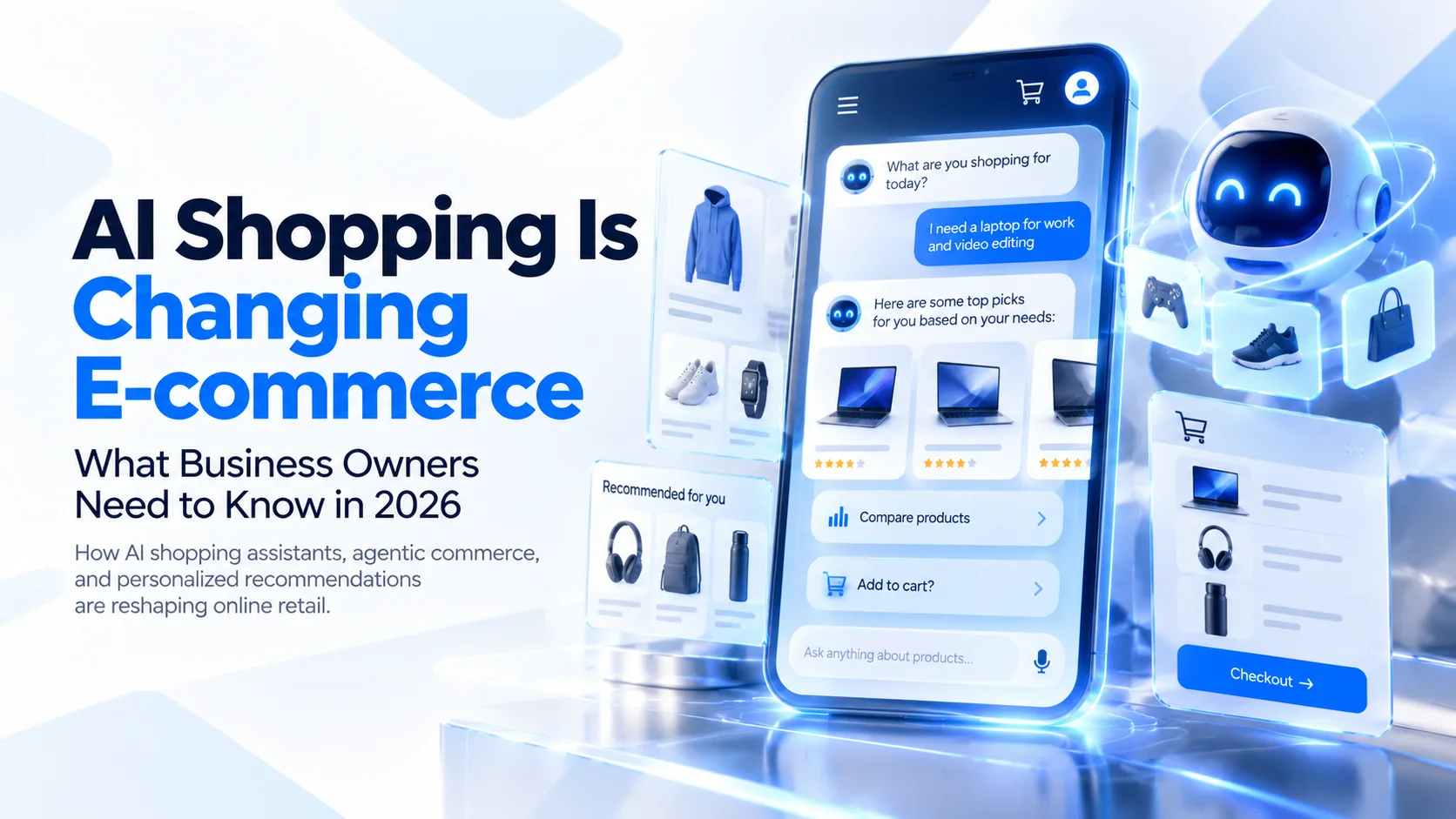
AI Shopping Is Changing E-commerce: What Business Owners Need to Know in 2026
Discover how AI shopping assistants, ChatGPT commerce, agentic AI, and personalized recommendations are changing online retail and what business owners should do next.
Sections
Online shopping is entering a new phase in 2026. Instead of opening multiple websites, comparing products manually, and reading dozens of reviews, customers can now ask an AI assistant to help them find what they need. In some supported shopping experiences, AI can even help prepare or complete a purchase with the customer's approval.
Every e-commerce business has different requirements depending on its products, customers, and daily operations. From personalized shopping experiences and inventory management to payment integrations and multi-vendor marketplaces, the right technology should support the way a business actually works. Explore our e-commerce and retail software development solutions to understand how custom web, mobile, and AI-powered applications can support modern retail businesses.
Imagine a customer asking, "Find me the best running shoes under $150 for someone with flat feet, available in my size, with delivery before Friday." An AI shopping assistant can understand those requirements, compare relevant products, explain the differences, and help the customer decide what to buy. This is a very different experience from typing "running shoes" into a search bar and scrolling through hundreds of listings.
For e-commerce business owners, this shift creates both opportunities and challenges. AI shopping can improve product discovery, deliver more relevant recommendations, and help businesses reach customers who already know what they want. However, it also raises new questions about how online stores should structure their product information, integrate AI systems, and maintain customer trust.
According to Adobe Digital Insights, AI-referred traffic to U.S. retail websites grew 393% year over year during the first quarter of 2026. In March, AI-referred visitors converted 42% better than visitors from non-AI sources. These figures do not mean traditional online shopping is disappearing, but they demonstrate why businesses should take AI-powered commerce seriously.
What Is AI Shopping?
AI shopping refers to the use of artificial intelligence to help consumers discover, compare, select, and purchase products. It can include conversational shopping assistants, personalized recommendations, intelligent product search, and AI agents capable of interacting with connected commerce systems.
In traditional e-commerce, customers usually navigate categories, apply filters, and compare individual products. AI shopping changes this process by allowing people to explain their requirements in natural language. A shopper can describe their budget, preferences, intended use, and delivery requirements in one conversation rather than manually selecting several search filters.
AI shopping is not one specific application or platform. Some systems help customers research products, while others connect to inventory, pricing, or checkout services. The level of automation depends on the technologies involved, available merchant integrations, and the permissions granted by the customer.
AI Shopping Assistants vs. AI Shopping Agents
An AI shopping assistant mainly supports decision-making. It might recommend products, answer questions about materials, compare prices, or explain which item fits a customer's needs. An AI shopping agent can perform additional actions through connected systems, such as checking stock, preparing a shopping cart, or initiating a checkout process.
For example, a shopping assistant might recommend three laptops for a business owner who travels frequently. A shopping agent with suitable integrations could check availability and prepare the selected laptop for checkout. The customer would still approve the purchase where authorization is required.
For retailers, this distinction matters because fully automated purchasing is not necessary to benefit from AI. Better product discovery, helpful recommendations, and faster answers to customer questions can already improve the shopping experience.
Why AI Shopping Is Becoming Important in 2026
AI shopping is gaining attention because several developments are happening together. Consumers are becoming more comfortable using AI for product research, major technology companies are introducing commerce integrations, and retailers are exploring new ways to connect their product catalogs with AI-powered experiences.
1. AI-Referred Shopping Traffic Is Growing
Adobe reported that AI-referred traffic to U.S. retail websites increased 393% year over year between January and March 2026. Its research also found that 39% of surveyed U.S. consumers had used AI for online shopping, with many reporting that it improved their overall shopping experience.
The commercial implications are particularly interesting. In March 2026, Adobe found that AI-referred visitors converted 42% better than non-AI traffic. These numbers describe Adobe's observed traffic and should not be treated as guaranteed improvements for every online retailer.
Shopify has also reported substantial growth in AI-assisted shopping discovery. According to its first-quarter 2026 data, referral sessions from AI chatbots increased more than eightfold year over year. Nevertheless, traditional organic search continued to generate considerably more traffic than AI referrals.
For business owners, the practical lesson is to treat AI shopping as an emerging acquisition channel while continuing to invest in search visibility, customer experience, and the reliability of their existing stores.
2. ChatGPT Is Expanding AI Shopping Capabilities
OpenAI has introduced the Agentic Commerce Protocol, a framework intended to help merchants connect their product information and commerce systems with shopping experiences in ChatGPT. The protocol supports structured product data and checkout interactions for eligible participating merchants.
Instead of only answering shopping questions, supported AI experiences can connect customers to merchant systems and help facilitate a purchase. However, merchant participation and in-chat checkout availability depend on specific integrations, approval requirements, and supported markets.
This development matters because customers may increasingly discover products before visiting a retailer's website. Online businesses should therefore pay attention to how AI platforms interpret their product information and what integrations become available to merchants.
3. Google Is Building Infrastructure for Agentic Commerce
In January 2026, Google introduced the Universal Commerce Protocol, or UCP, with support from commerce industry participants including Shopify. The protocol is intended to establish common standards for interactions between AI agents, merchants, and payment providers.
The broader objective is to make AI-assisted shopping easier to connect with existing retail infrastructure. Rather than requiring every merchant to build completely separate integrations for every AI shopping system, standardized approaches could help streamline some of these interactions.
UCP-powered shopping and checkout capabilities are being introduced through selected integrations and markets. Retailers should verify actual eligibility and technical requirements rather than assuming the technology is universally available.
4. Shopify Is Opening More Shopping Opportunities for AI Agents
On October 13, 2026, Shopify announced an expansion of access to its product catalog for compatible AI agents. The initiative allows participating agents to connect with Shopify's Shop ecosystem and help customers discover products, compare options, and move toward purchases using supported commerce services.
The significance of this announcement is that AI shopping is becoming more connected to real product catalogs and checkout infrastructure. For retailers, accurate product information and dependable integrations may become increasingly valuable as these shopping channels develop.
How AI Shopping Is Changing the E-commerce Customer Journey
1. Product Discovery Is Becoming Conversational
Traditional search is useful when customers already know the product name or category they want. Conversational shopping is particularly helpful when someone understands their problem but is unsure which product will solve it. A customer might ask for a suitable birthday gift, a laptop for video editing, or skincare products for a specific routine.
AI systems can interpret these needs and compare relevant products using attributes such as size, compatibility, materials, availability, price, and intended use. This creates opportunities for retailers that maintain detailed, accurate product catalogs.
However, conversational discovery depends on trustworthy data. If an online store provides incomplete descriptions, incorrect pricing, or outdated availability information, AI systems may produce unsuitable recommendations.
2. Personalized Product Recommendations Are Becoming More Context-Aware
Product recommendations are not new to e-commerce. Many retailers already display related items or products frequently purchased together. AI can make these recommendations more useful by considering what the customer is trying to accomplish instead of relying only on browsing patterns.
For example, a fashion application could recommend clothing based on an event, preferred colors, weather conditions, and the customer's existing wardrobe. A home improvement retailer could suggest compatible tools and materials for a specific renovation project.
The most dependable recommendation systems combine AI with structured product information, customer preferences, and clear business rules. AI should not invent product specifications or recommend unavailable items.
3. Customers Can Research Products Before Visiting a Store
Historically, retailers worked to bring shoppers to their websites through search engines, social media, advertising, and email campaigns. AI shopping introduces another discovery channel where customers can research and compare products through an assistant before opening a store.
In supported integrations, parts of the purchase process may also happen within an AI-powered interface. This does not make traditional storefronts obsolete. Retailers still need dependable systems for product management, inventory, payments, fulfillment, returns, and customer relationships.
The stronger approach is to build commerce infrastructure that supports multiple customer channels without creating disconnected product and order records.
What Is Agentic Commerce?
Agentic commerce refers to shopping workflows where AI agents help consumers carry out parts of the purchasing process. Depending on the platform and permissions available, an agent may search for products, compare alternatives, check availability, prepare an order, or coordinate checkout through connected systems.
Consider a company purchasing supplies for several office locations. An AI agent could help identify suitable products, compare suppliers, and prepare a purchase request. The system would still need accurate inventory, approved pricing, purchasing permissions, and secure payment processing.
This is why agentic commerce is not simply a matter of connecting a language model to a shopping website. Reliable implementations require secure APIs, accurate business data, authorization controls, and dependable checkout systems.
Consumer attitudes also suggest that businesses should avoid assuming everyone wants completely autonomous shopping. A May 2026 Gartner survey found limited willingness to let AI make purchasing decisions independently. Even in the lower-stakes product categories studied, willingness reached only 11%.
For many e-commerce businesses, AI that helps customers compare options and make better decisions may offer more immediate value than fully autonomous purchasing.
Five Benefits of AI Shopping for E-commerce Businesses
1. Better Product Discovery
AI-powered search allows customers to describe their requirements instead of relying on exact product names. This can help retailers with large catalogs, specialized inventory, or products that require detailed comparisons. Customers may find suitable products faster when the system understands their actual needs.
2. More Relevant Product Recommendations
AI can consider product attributes, customer preferences, and shopping context to provide more relevant suggestions. Businesses can begin with simple recommendation workflows and introduce more advanced personalization when sufficient data and a clear business case justify the investment.
3. Faster Customer Support
Customers frequently have questions about sizing, product compatibility, delivery, warranties, and returns. AI assistants connected to approved information can help answer common questions without requiring a support representative for every interaction. Human support should remain available for disputes, unusual situations, and questions the system cannot reliably answer.
4. Reduced Shopping Friction
AI can help customers narrow their options and understand product differences before checkout. If recommendations are accurate and easy to understand, this can create a smoother buying experience. Actual conversion benefits depend on product quality, usability, customer trust, and the overall shopping journey.
5. Improved Customer Insights
With appropriate privacy protections, businesses can analyze recurring product questions and customer needs to identify gaps in their catalogs. These insights can reveal confusing product descriptions, missing categories, or opportunities to improve merchandising and customer education.
How Business Owners Can Prepare Their Online Stores for AI Shopping
Preparing for AI shopping does not necessarily require replacing an existing e-commerce platform. For most businesses, the better starting point is improving product information, identifying customer problems, and understanding which AI capabilities are commercially useful.
Step 1: Improve Product Data Quality
Review product titles, descriptions, specifications, images, variants, prices, stock levels, and return policies. Ensure that important information is accurate and consistent across your website, mobile application, and connected sales channels.
Structured product data, appropriate schema markup, clear descriptions, and regularly updated feeds can support both traditional search engines and AI-powered product discovery. Businesses should also review whether their websites and product pages can be accessed by relevant search and AI systems.
Step 2: Identify the Biggest Customer Problem
Examine customer support questions, unsuccessful searches, product page exits, and checkout abandonment. A retailer selling technical equipment might benefit most from compatibility recommendations, while a fashion business might gain more value from styling assistance or size guidance.
Choosing a feature based on a real customer problem is more effective than adding AI simply because competitors are discussing it.
Step 3: Connect AI to Reliable Business Systems
A useful shopping assistant should rely on approved product information and, when needed, current inventory and pricing. This typically involves APIs, product feeds, databases, and integrations with the existing commerce backend.
Business rules must remain authoritative. Taxes, discounts, shipping fees, refunds, and payment authorization should be calculated and validated by the appropriate commerce systems rather than generated freely by an AI model.
Step 4: Start With One Practical AI Feature
Instead of building a fully autonomous shopping agent immediately, retailers can test one focused capability such as natural-language search, product comparisons, personalized recommendations, or automated answers to product questions.
Businesses with existing products can explore adding AI capabilities to an existing application rather than assuming a complete rebuild is required. The right implementation depends on the current architecture, available data, and actual business needs.
Step 5: Measure Performance and Operating Costs
Track relevant metrics such as product discovery success, add-to-cart rate, conversion rate, average order value, support resolution time, and customer satisfaction. Compare AI-assisted journeys against an appropriate baseline before expanding the feature.
Also monitor AI operating costs, inaccurate recommendations, failed integrations, and customer complaints. An AI feature is valuable only when the benefits justify its development, maintenance, and ongoing usage costs.
Should You Build an AI Shopping App or Improve Your Existing Store?
Not every e-commerce business needs a custom AI shopping application. For smaller retailers with straightforward catalogs, improving the existing storefront and using supported integrations may be the most economical choice.
Custom application development becomes more relevant when a business needs specialized recommendations, unique shopping workflows, deeper personalization, multiple merchant integrations, or a differentiated mobile shopping experience.
For example, a cosmetics retailer might want an application combining product discovery, personalized recommendations, loyalty rewards, and order tracking. A multi-vendor marketplace might require AI-assisted search across different sellers, inventory systems, and fulfillment workflows.
In both cases, AI is only one component. The underlying product also requires reliable authentication, catalog management, APIs, payment processing, order management, administration tools, security, and ongoing maintenance.
What Our E-commerce and AI Development Experience Has Taught Us
At Next Level Software, building retail and AI-powered applications has reinforced an important principle: an intelligent interface is only useful when the systems behind it are dependable.
One example is Piano, a cosmetics e-commerce platform developed for the Iraqi market. The platform supports Arabic-first shopping, cash-on-delivery, promotions, product management, and localized retail workflows. Its development demonstrates why e-commerce applications need dependable pricing rules and operational controls.
This principle becomes even more important when AI assists with shopping. An assistant might explain a promotional offer or recommend a product, but pricing calculations and transaction rules should still come from a reliable commerce system.
Another example is ALIFF, an AI-powered fashion styling application. Its personalization experience combines AI-generated styling recommendations with defined constraints, user feedback, caching, and usage controls.
Although ALIFF is not an agentic checkout platform, its approach demonstrates an important lesson for AI shopping applications: recommendation quality improves when AI works alongside structured rules and real user preferences rather than operating without constraints.
These experiences show why successful AI commerce products require more than a chatbot. Businesses need thoughtful product design, dependable data, well-defined business logic, secure integrations, and ongoing technical oversight.
Challenges Businesses Should Consider Before Adopting AI Shopping
1. Product Accuracy and Customer Trust
AI systems can produce confident but incorrect answers. In e-commerce, inaccurate recommendations may lead to poor purchases, returns, and dissatisfied customers. Businesses should validate product information, limit unsupported claims, and provide customers with clear ways to verify important details.
2. Customer Privacy and Data Protection
Personalized shopping may involve purchase history, preferences, account details, or location information. Retailers should collect only necessary data, establish appropriate access controls, and evaluate the privacy and contractual requirements of external AI providers.
3. Integration and Maintenance Costs
Implementing AI shopping may require product data preparation, API development, authentication, testing, monitoring, and ongoing model usage fees. Costs can increase when the system requires real-time inventory, complex personalization, or integrations with multiple external services.
4. Platform Availability and Dependency
AI shopping and checkout features are not universally available across all merchants, countries, or platforms. Businesses should verify eligibility, fees, integration requirements, and operational responsibilities before committing to specific providers.
Using a modular architecture can also reduce dependency on one AI model or commerce integration, making it easier to adapt as platforms and standards evolve.
What Will AI Shopping Look Like Beyond 2026?
AI shopping assistants are likely to become more capable of understanding detailed customer requirements, comparing products across connected catalogs, and coordinating purchase-related actions. Businesses may also introduce specialized assistants inside their own mobile and web applications.
A fashion retailer could provide an assistant that builds outfits around customer preferences. An electronics store could offer compatibility guidance, while a marketplace could improve product discovery across multiple sellers. These use cases are practical opportunities, although adoption will depend on consumer trust, accurate data, and available integrations.
At the same time, fully autonomous shopping should not be treated as an inevitable replacement for customer decision-making. Many customers still want to review options and approve purchases themselves.
The businesses best positioned for future developments will be those with accurate product catalogs, dependable digital infrastructure, strong customer experiences, and the flexibility to integrate new technologies without disrupting daily operations.
Final Thoughts: Prepare for AI Shopping Without Chasing Every Trend
AI shopping is becoming a meaningful part of e-commerce in 2026. Customers are increasingly using AI assistants to research products, compare alternatives, and make more informed purchasing decisions. Technology companies and commerce platforms are responding by developing new ways for AI systems to interact with product catalogs and merchant infrastructure.
For business owners, the most practical response is not to rebuild everything around AI. Start with accurate product data, reliable checkout workflows, a usable shopping experience, and a clear understanding of where customers need assistance.
Then identify one AI capability that could improve the customer journey and measure whether it delivers real value. Better search, product comparisons, and personalized recommendations may offer more immediate benefits than attempting to automate every purchase.
At Next Level Software, we help businesses design and develop AI-powered capabilities within web and mobile applications. Whether you are improving an existing retail product or planning a new shopping experience, the objective should be to build reliable software that solves a real customer problem.
If you are exploring an AI shopping assistant, personalized e-commerce application, or AI integration for your existing platform, discuss your project with our team to identify the most practical next step.
Frequently Asked Questions About AI Shopping in 2026
What is AI shopping?
AI shopping uses artificial intelligence to help customers discover products, compare options, receive personalized recommendations, and, in supported experiences, prepare or complete purchases. It can operate through shopping assistants, mobile applications, websites, and connected AI agents.
How is AI changing e-commerce in 2026?
AI is changing how customers research and discover products. Conversational search, personalized recommendations, and emerging agentic commerce integrations help shoppers find relevant products with less manual searching. Businesses are also using AI for product guidance and customer support.
Can customers buy products directly through ChatGPT?
Supported merchants can participate in shopping and checkout experiences connected to ChatGPT. However, in-chat checkout availability depends on merchant eligibility, approved partnerships, supported markets, and technical integrations. It is not universally available to every online retailer.
What is agentic commerce?
Agentic commerce refers to shopping workflows in which AI agents help customers perform actions such as finding products, comparing offers, checking availability, preparing carts, and coordinating checkout through connected commerce systems.
Do small e-commerce businesses need AI shopping assistants?
Not necessarily. Smaller retailers should first evaluate their customers' needs, product catalog quality, and existing store performance. An AI assistant may be useful when customers frequently struggle with product discovery, comparisons, or repetitive purchase questions.
Can AI be added to an existing e-commerce app?
Yes. Depending on the application's architecture, businesses can add AI-powered search, recommendations, product guidance, or customer support without rebuilding the entire platform. Reliable implementation requires suitable integrations, accurate product data, and appropriate security controls.
Will AI shopping replace traditional e-commerce websites?
There is no reliable basis for assuming AI will eliminate traditional storefronts. Websites and mobile apps still support customer relationships, checkout, fulfillment, loyalty, and brand experiences. AI shopping is better understood as an additional product discovery and transaction channel.
How can retailers optimize their products for AI shopping?
Retailers should maintain accurate product titles, descriptions, specifications, prices, inventory, and policies. Structured data, accessible product pages, updated product feeds, and supported platform integrations can help AI systems understand and present their products.
Sources and Further Reading
Adobe Digital Insights: AI Traffic and Retail Conversion Research, April 2026
Shopify: AI-Referred Shopping Traffic and Merchant Insights, May 2026
Google Developers: Universal Commerce Protocol, January 2026
Gartner: Consumer Attitudes Toward AI Shopping Decisions, May 2026
The Verge: Shopify Expands AI Agent Shopping Access, October 2026
Keep reading

Bend Oregon School Shooting: What Happened and Lessons for Emergency Communication Technology
The Bend, Oregon school shooting on October 15, 2026, left four victims dead and two others critically injured. Here's what authorities confirmed and what the tragedy highlights about emergency communication technology.
Khubaib Rasheed · · 13 min read

Tesla Flying Roadster 2026: How Software Is Redefining the Future of Cars
Tesla's flying Roadster prototype has captured global attention. Explore how its engineering demonstration connects to intelligent vehicle software, real-time systems, and the future of mobility.
Abdullah · · 15 min read

Dubai's Agentic AI Push in 2026: What UAE Startups Need to Know
Dubai is accelerating Agentic AI adoption, with 11 major companies joining its transformation programme. Discover what this means for UAE startups and SMEs.
Abdullah · · 9 min read