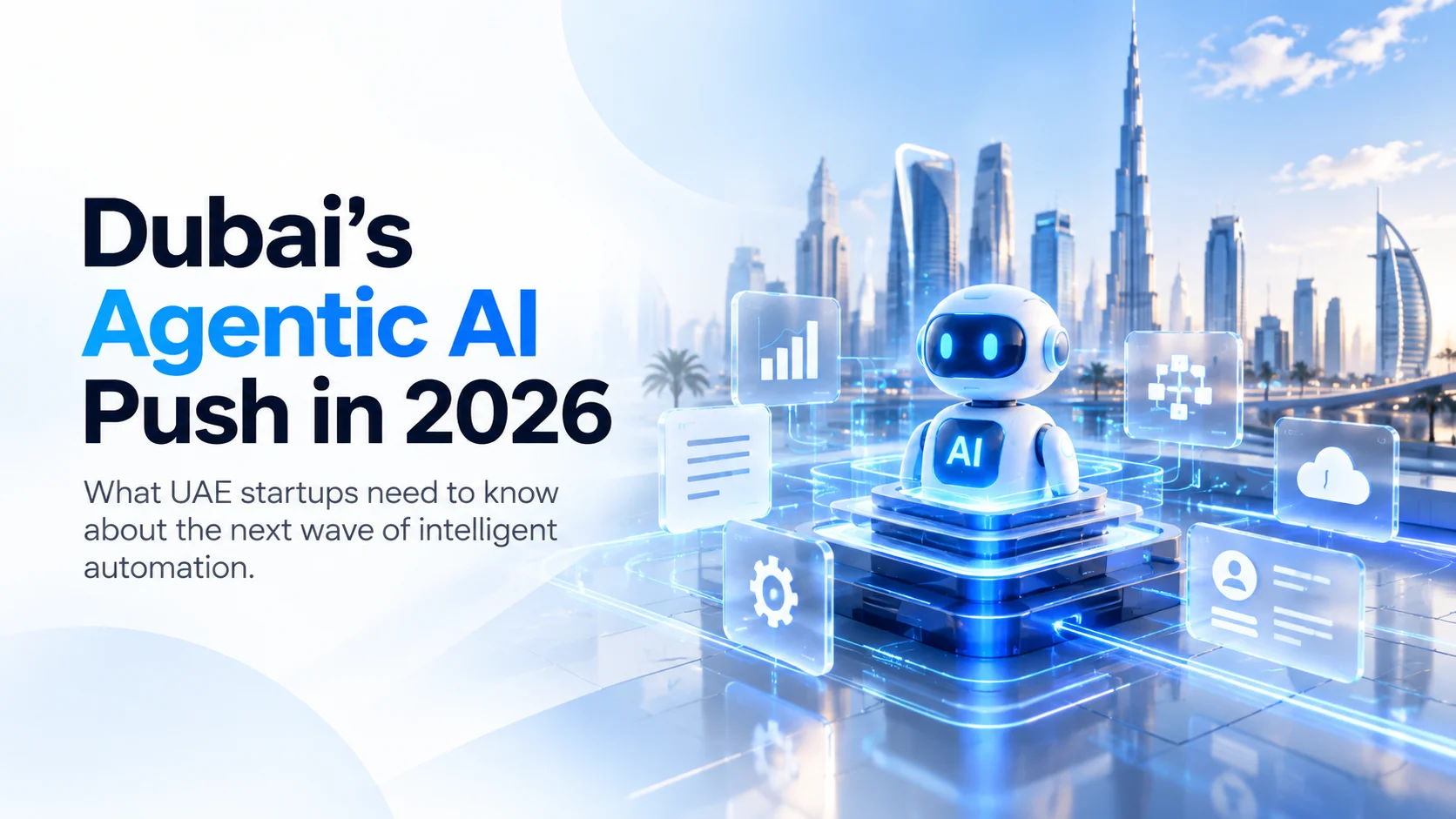
Dubai's Agentic AI Push in 2026: What UAE Startups Need to Know
Dubai's AI transformation initiatives are creating new opportunities for startups and SMEs. Here's what businesses need to know about Agentic AI adoption.
Sections
Dubai's push toward Agentic AI is becoming a practical business initiative rather than just another technology discussion. On October 12, 2026, Dubai Chambers announced that 11 major Dubai-based companies had pledged to integrate Agentic AI into their operations. The announcement is an important signal for startups and small businesses across the UAE: intelligent automation is moving closer to everyday business operations.
The development follows Dubai's wider two-year private-sector Agentic AI transformation programme, launched in May 2026. With specialised training, proposed incubators and support for AI-focused businesses, Dubai is encouraging companies to move beyond experimenting with artificial intelligence and begin applying it to real operational challenges.
For UAE startup founders, the question is no longer simply whether AI can generate content or answer customer questions. It is whether AI systems can reliably complete useful business tasks, connect existing software and reduce repetitive work without creating unnecessary risk.
What Happened in Dubai's Agentic AI Initiative?
According to Dubai Chambers' October 12 announcement, 11 companies from industries including aviation, logistics, finance, healthcare, hospitality and construction committed to integrating Agentic AI technologies. The participating organisations include Emirates, DP World, AW Rostamani Group, Al Ansari Exchange, Dubai Islamic Bank, Kitopi, Dutco Group, Aster DM Healthcare, Innovo, Independent Food Company and HSA Group.
The pledge does not mean that every participating company has already deployed a fully autonomous AI system. It represents a commitment to adoption, supported by Dubai Chambers and its wider private-sector transformation programme.
The initiative also includes training tracks intended to equip more than 14,000 companies represented within Dubai Chamber of Commerce's Business Groups and Business Councils with knowledge and practical capabilities for Agentic AI adoption. Dubai Chambers launched these specialised training tracks in September 2026.
For founders, the significance is the direction of the market. Dubai is encouraging businesses to develop the knowledge, infrastructure and processes needed to use AI beyond isolated experiments.
What Is Agentic AI and Why Does It Matter?
Traditional AI assistants generally respond to a user's request. They can generate text, summarise documents, answer questions and suggest next steps. Agentic AI systems can go further by using tools, following workflows and performing multiple connected actions toward a defined goal.
Consider a startup that receives customer enquiries through its website. A conventional chatbot might answer common questions and provide contact information. An appropriately designed AI agent could collect the customer's requirements, check an approved service database, create a lead in the company's CRM, prepare a follow-up and notify the sales team when human attention is required.
The important difference is not that the AI sounds more intelligent. It is that the software can participate in a business process. However, the level of autonomy should depend on the task, available information, integration quality and potential consequences of an incorrect action.
Why UAE Startups Should Pay Attention in October 2026
1. AI Adoption Is Becoming a Business Priority
Dubai's transformation programme creates a strong public signal that AI adoption is relevant to operational efficiency and business competitiveness. Larger companies have resources to explore multiple technologies, while smaller startups must be selective about where they invest.
That does not mean every startup needs an advanced autonomous agent. A young business may benefit more from automating a single repeated workflow than investing in a large AI platform. The practical opportunity is to identify processes where software can save time, improve consistency or help employees respond faster.
2. AI-Focused Startups May Find New Opportunities
The programme includes plans for specialised incubators, funding support and knowledge-sharing initiatives for companies developing or adopting Agentic AI solutions. These measures could create opportunities for startups building industry-specific AI products, although eligibility, funding availability and programme details must be confirmed through official announcements.
Potential opportunities include customer service automation, internal document processing, logistics coordination, business reporting and workflow management. Startups that understand a specific industry's operational problems may be better positioned than companies offering a generic AI assistant with no clear business application.
3. The Conversation Is Shifting Toward Implementation
With the Dubai AI Festival scheduled for October 26–27, the second half of October provides another opportunity for founders, technology companies and business leaders to discuss practical AI adoption. The more useful conversations will focus on measurable business outcomes, system reliability, implementation costs and the work required to integrate AI into existing operations.
Five Practical Agentic AI Opportunities for UAE Businesses
Customer Enquiries and Sales Follow-Ups
Service businesses often receive enquiries through websites, forms, email and messaging platforms. An AI-enabled workflow can classify requests, retrieve approved information, prepare responses and organise follow-up tasks. Businesses can define when an enquiry should be transferred to a human sales representative, especially when pricing, negotiations or unusual requirements are involved.
Appointment and Booking Operations
Clinics, fitness businesses, salons and other appointment-based companies can explore AI-assisted booking workflows. An agent might help customers find available slots, understand cancellation rules and receive reminders. Actual reservations should be confirmed against the booking system to prevent conflicting appointments or incorrect availability.
Retail and E-Commerce Support
Online retailers can use AI to assist customers with product discovery, order questions and support requests. When connected to reliable inventory and order-management systems, these workflows can reduce repetitive manual checks. Sensitive actions such as refunds, payment changes and order cancellations should follow defined permissions and approval rules.
Internal Reporting and Administration
Founders and managers frequently spend time gathering information from different systems. AI-assisted reporting can help combine approved data sources, identify exceptions and prepare summaries for review. The underlying calculations and records should remain traceable so managers can verify the information before making decisions.
Logistics and Operational Coordination
Logistics businesses can explore AI workflows for classifying service requests, identifying operational exceptions, preparing dispatch information and escalating delays. AI should complement reliable operational systems rather than replace essential transaction records, routing controls or human oversight.
Should UAE Startups Build Custom AI Agents or Use Existing Tools?
Not every company needs to develop an AI agent from scratch. Existing automation platforms and AI products can be suitable when a workflow is relatively standard, integrations are available and the business does not require extensive custom rules.
Custom AI development becomes more relevant when a startup needs to connect several internal systems, enforce industry-specific business rules, create a unique customer experience or maintain greater control over how its AI features operate.
The decision should consider the total cost of ownership, including subscriptions, API usage, integration work, testing, security, maintenance and ongoing monitoring. A low monthly software fee does not necessarily mean a low implementation cost.
For founders considering a tailored solution, AI application development can help connect intelligent features to existing web and mobile products while keeping business rules and reliability requirements central to the design.
What UAE Founders Should Consider Before Building an AI Agent
The first step should be identifying a specific operational problem. For example, a company may discover that employees spend several hours each week answering repetitive customer enquiries or transferring information between disconnected tools. That gives the business a concrete process to evaluate rather than starting with a broad instruction to adopt AI.
Founders should document the existing workflow, identify the data sources involved and decide which actions an agent can perform independently. They should also establish approval requirements, access permissions, audit records and a clear process for handling failures.
Data protection deserves particular attention. UAE businesses should evaluate applicable privacy requirements, contractual obligations, data-processing arrangements and any sector-specific regulations before connecting AI tools to customer or company information.
Finally, the initial implementation should have measurable success criteria. Useful measures may include time saved per task, successful completion rate, escalation frequency, customer response time and operating cost. These metrics help determine whether the system provides genuine value.
What Building Production AI Applications Actually Involves
Building an AI feature that produces a convincing demonstration is different from operating that feature reliably for real customers. Production systems require careful handling of business rules, inconsistent AI outputs, API costs, response times and unexpected user behaviour.
At Next Level Software, our work on the ALIFF AI stylist application illustrates this distinction. The product combines AI-powered outfit recommendations with a digital wardrobe and user-specific modesty requirements. Rather than depending entirely on prompts, the implementation uses a separate rule layer alongside mechanisms such as caching, streaming and quota management.
The broader lesson applies to UAE startups exploring Agentic AI: reliable AI products require more than selecting a language model. They need clear requirements, suitable architecture, controlled workflows, testing and ongoing improvements based on real usage.
What Comes Next for Agentic AI in Dubai?
Dubai's two-year transformation programme suggests that private-sector Agentic AI adoption will remain an important technology and business discussion beyond October 2026. Training initiatives, proposed incubators and the involvement of established companies could encourage more experimentation and practical deployment.
However, the scale and speed of adoption will depend on implementation costs, technical maturity, organisational readiness, regulatory requirements and whether companies achieve measurable returns. Public commitments should not be confused with completed deployments or guaranteed commercial outcomes.
For startups, the strongest opportunity may be to solve narrow but expensive operational problems. An AI system that reliably improves one important workflow can create more value than a complex autonomous platform that is difficult to supervise.
Final Thoughts
Dubai's latest Agentic AI announcements show that the technology is moving into mainstream business planning. The participation of 11 major companies and the wider training initiative provide a timely reason for UAE founders to examine where intelligent automation could fit into their products and operations.
The goal should not be to adopt Agentic AI simply because it is attracting attention. Start with a real business problem, establish the necessary controls and build only what can be tested and measured.
For startups planning to introduce intelligent capabilities into an existing application or new product, explore how Next Level Software approaches AI-powered application development.
Frequently Asked Questions
What is Dubai's Agentic AI initiative in 2026?
It is a two-year private-sector transformation programme launched in May 2026 to encourage businesses in Dubai to adopt Agentic AI. The initiative includes specialised training and plans for incubators and other support measures.
Which Dubai companies pledged to adopt Agentic AI?
On October 12, 2026, Dubai Chambers announced commitments from 11 companies, including Emirates, DP World, Dubai Islamic Bank, Kitopi and Aster DM Healthcare, among others.
Can small UAE businesses use Agentic AI?
Yes. Small businesses can explore narrowly defined AI workflows for customer support, scheduling, reporting and administration. The appropriate solution depends on their processes, data, budget and operational requirements.
Does every UAE startup need a custom AI agent?
No. Existing automation tools may be sufficient for standard workflows. Custom development is more appropriate when businesses require specialised logic, integrations or product-specific functionality.
How should a startup begin adopting Agentic AI?
Start by identifying one repetitive process, documenting its requirements, defining safe actions and human approval points, and testing a limited implementation against measurable business outcomes.
Keep reading
Google Launches Gemini Agent: Is This the Beginning of the End for Scattered SaaS Tools?
Google’s Gemini Agent promises one AI interface across work apps. Here is what it means for AI agents, SaaS consolidation, automation, and the future of business software.
Khubaib Rasheed · · 13 min read

AI Is Not Killing SaaS Yet: Why Software Stocks Are Hitting New 2026 Highs
Software stocks are rebounding in 2026 as earnings improve and enterprises embed AI into SaaS instead of replacing their core systems. Here is what is changing.
Abdullah · · 14 min read
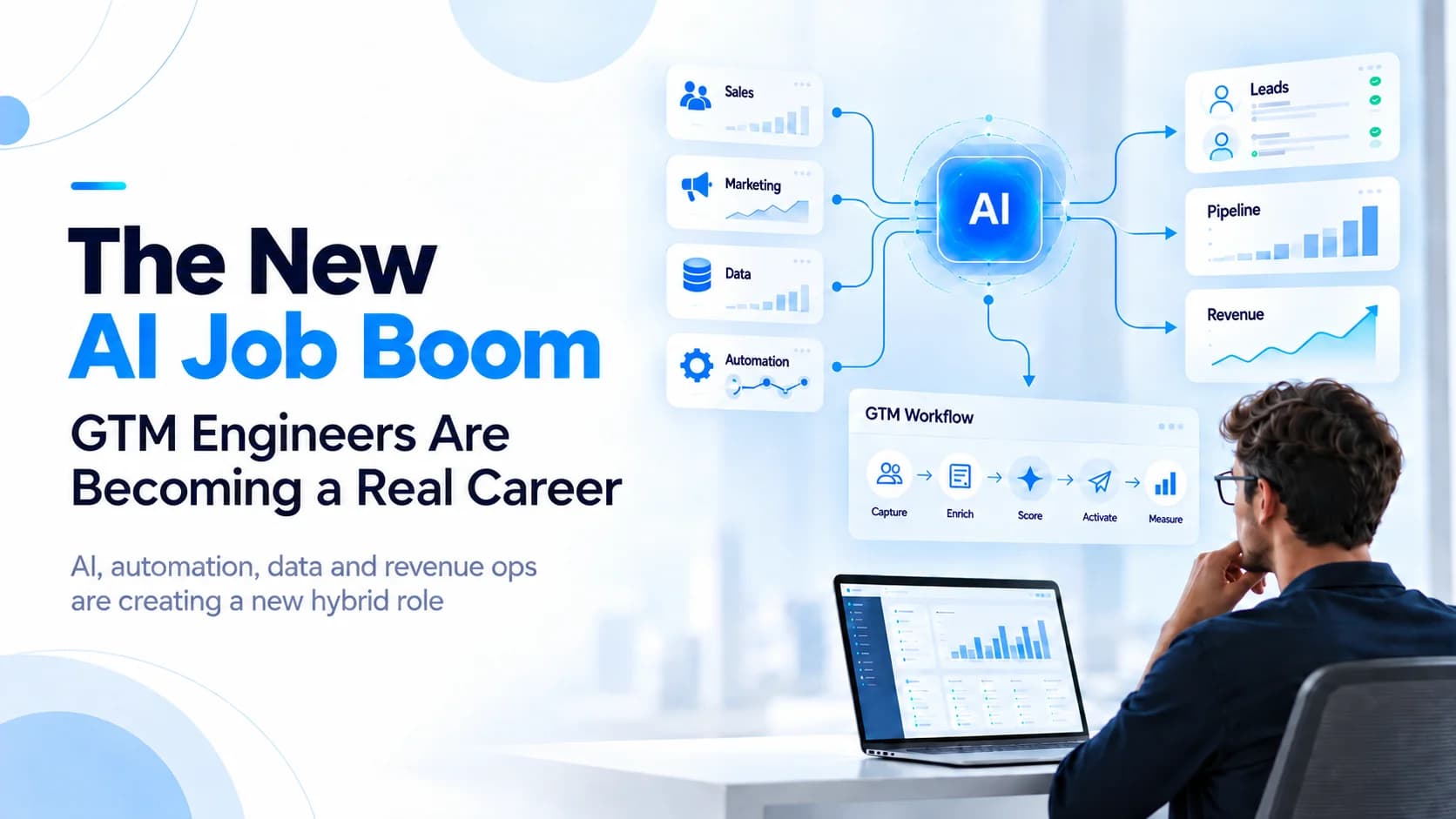
The New AI Job Boom: Why GTM Engineers Are Becoming a Real Career
Discover why GTM engineering is emerging as an AI-era career, what the job involves, the skills employers seek, and how the role differs from RevOps.
Khubaib Rasheed · · 7 min read