IndustryOn-Demand Services · MarketplaceServicesMobile App · Admin Panel

Find, book and track a trusted tradesperson — one app for both sides of the job.

Khadamat connects people in Kuwait with local cleaners, plumbers and handymen. Customers find providers on a map, describe the job and book; providers sign up in the same app to take that work; and an admin panel runs subscriptions and platform activity above both. Live on the App Store and Google Play.

Core Offering
On-Demand Services Marketplace
Status
Live — iOS & Android
Products
1 app, 2 roles · 1 admin panel
Launched
2025
Country
Kuwait
Project Results
2
App stores, live
App Store + Google Play
Public — App Store and Google Play, verified 21 Oct 2026
2
User types, one app
Customer and provider, chosen at sign-up
Public — "Dual Access" on both store listings
2
Gulf payment gateways
KNET · MyFatoorah
Structural fact — gateways integrated
3
Roles on one backend
Customer · provider · admin
Structural fact — roles built

Job volume, provider numbers and revenue are the client's to publish, and they are not on this page. What is on this page is what was built and why it was built that way.

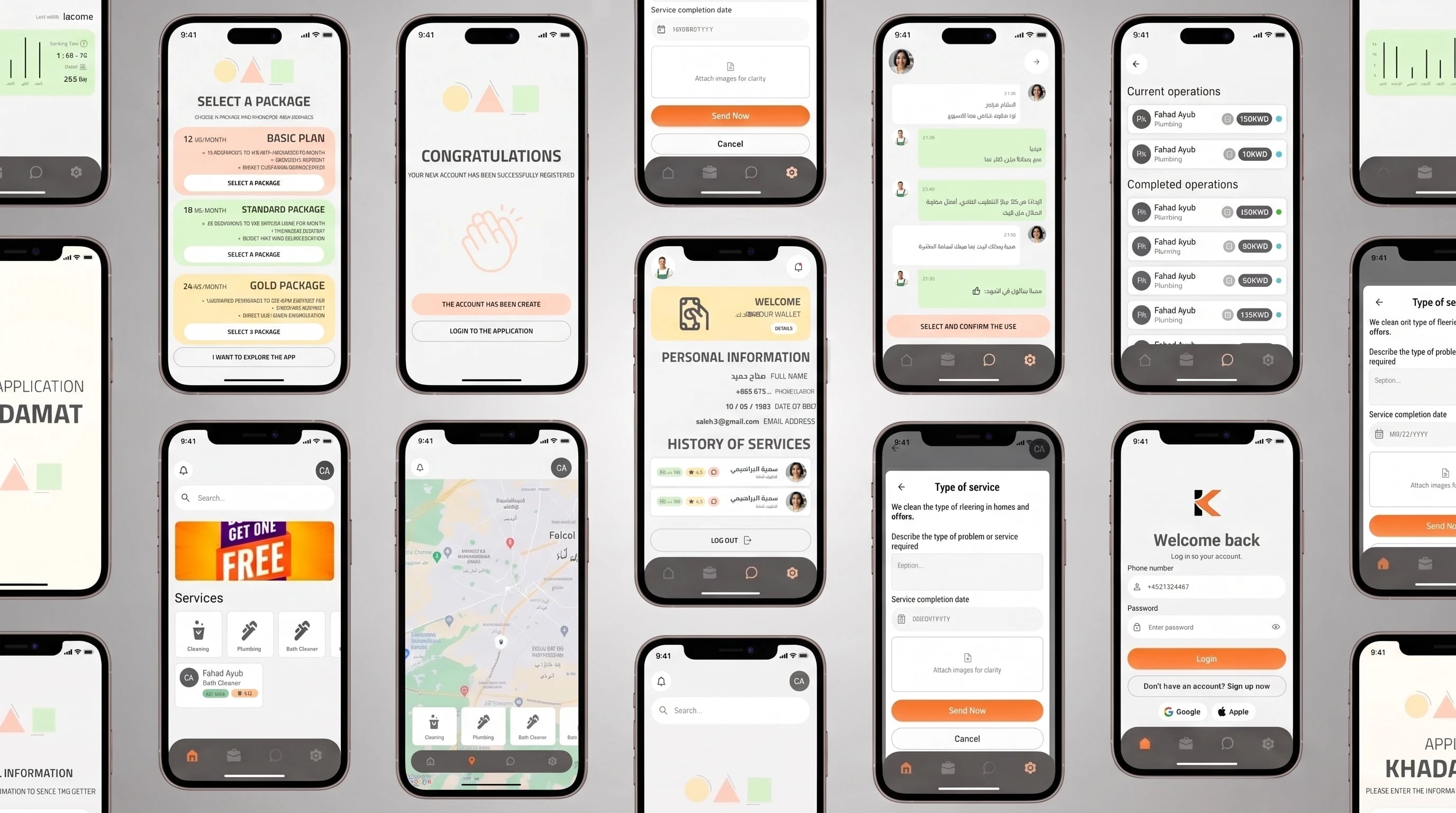
Khadamat screens — provider subscription packages, account confirmation, wallet and service history, Arabic chat, current and completed operations in KWD, and the sign-in screen
The Context

Building a services marketplace for a market that hires by word of mouth.

Khadamat — Arabic for "services" — is a marketplace for everyday jobs in Kuwait: cleaning, plumbing, bathroom work, maintenance and the rest of the list a household or an office needs done once and done properly. A customer opens a map, sees who is nearby, checks a provider's profile and reviews, describes the job with photos and a completion date, and sends the request. From there the two sides chat in real time, the booking is confirmed, and the customer can track the provider on the way.

It was built for VGA, the Kuwaiti client behind Connect and Munasbati on this site. The brief covered both sides of the market and the operator above them: a customer experience, a provider experience, and an admin panel for registrations, subscriptions and platform statistics. It went live on Google Play in May 2025 and on the App Store in June.

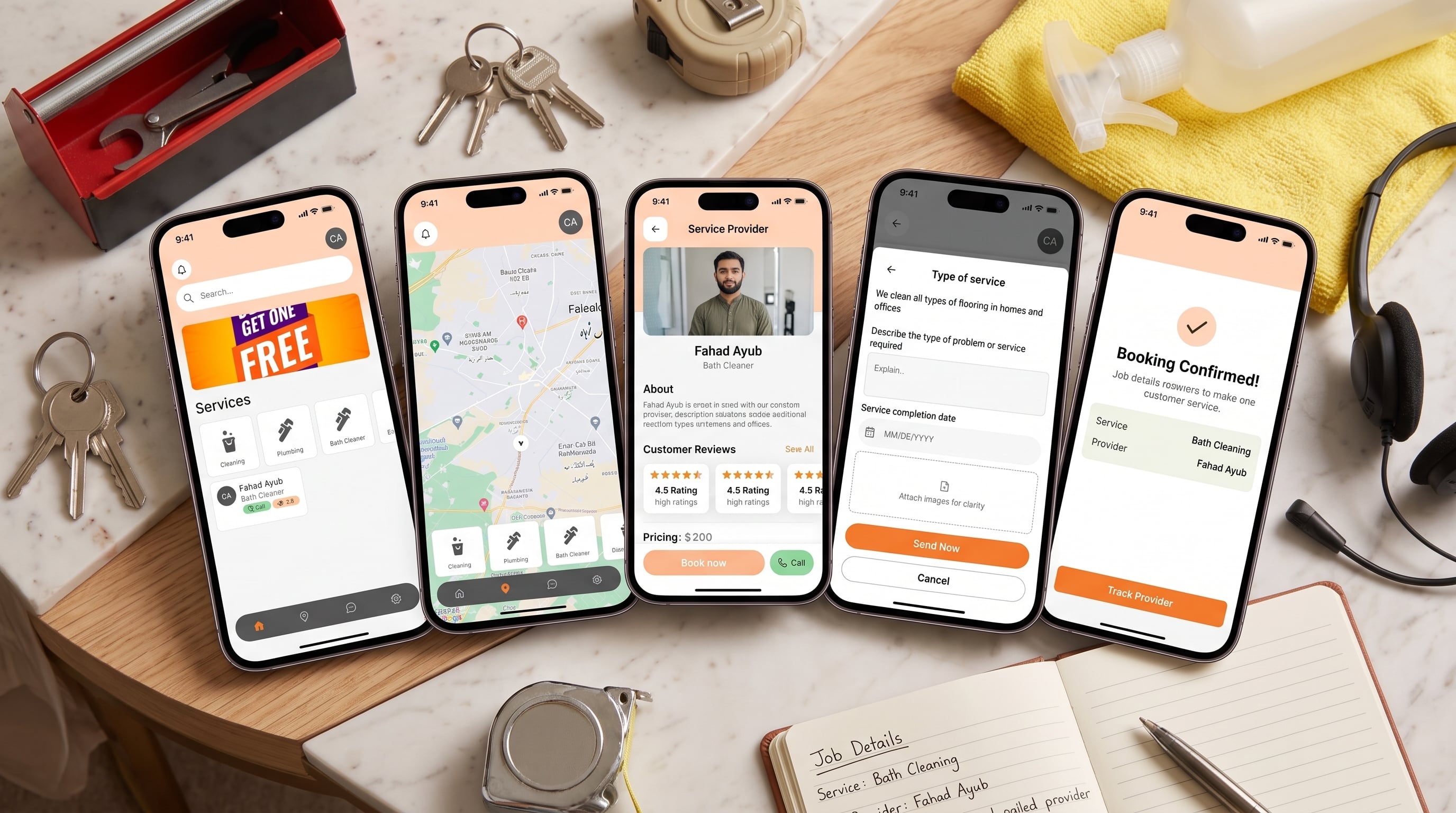
Khadamat app on five phones — home with service categories, map of nearby providers, provider profile with reviews, service request form and booking confirmation
The Challenge

Hiring a tradesperson in the Gulf still runs on phone numbers and favours.

Finding someone to fix a leak or deep-clean a flat usually means asking around, calling a number someone forwarded, and agreeing a price and a time over the phone with no record of either. There is no profile to check, no review history, no way to show the problem before the visit, and nothing to point at afterwards if the job goes wrong.

A marketplace fixes that only if both sides actually use it. Customers will not post a job where no providers are visible, and providers will not maintain a profile where no jobs arrive. The product had to make the first request easy for a customer, make joining easy for a provider, and give the operator enough control to keep the provider side trustworthy — in Arabic and English, and paid for the way Kuwait pays.

Our Approach

One app, a map in front, and the operator in control.

Every decision aimed at the same thing: shorten the distance between "something is broken" and "someone is on the way" for the customer, while keeping the provider side worth joining and the platform worth running.

Two roles, one install.

Customers and providers download the same app and choose who they are at sign-up. One listing to market, one release that ships both sides, and one codebase where a fix to chat or booking reaches everybody at once.

A request that carries the job, not just a time.

The booking form takes the type of service, a written description, a completion date and photos of the problem. The provider sees what they are walking into before they accept, instead of finding out at the door.

Map-first discovery.

The home screen is a map of providers near the customer, filtered by service category. Location is the first thing that decides who can actually do the job, so it is the first thing the customer sees.

Real-time from request to arrival.

Chat, booking updates and provider tracking run over Socket.io, with push, email and SMS carrying the same events when the app is closed. Both sides look at the same booking at the same moment.

Gulf payments and Arabic, built in.

KNET and MyFatoorah are both in the build, and the interface runs right-to-left in Arabic as well as left-to-right in English — not a translation layer added after launch.

An admin panel that runs the marketplace.

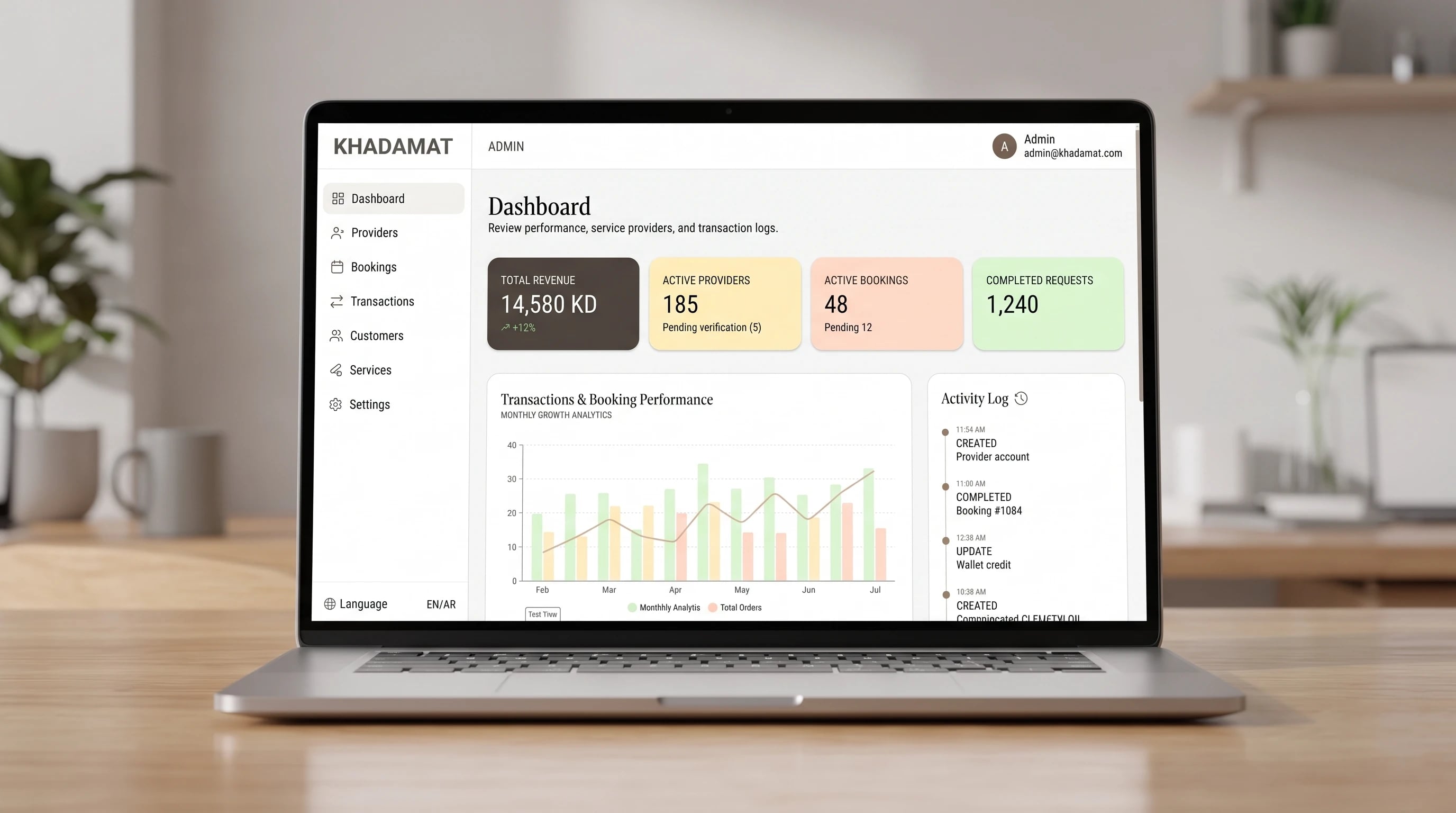
Registrations, provider subscriptions, platform activity and statistics are managed from an Angular dashboard with role-based access, so the client's team operates the platform without a developer in the loop.

Khadamat is one of several products we have built for VGA in Kuwait — the payment, localisation and admin patterns here are shared with Connect and Munasbati.

The Hard Part

Two sides of a marketplace, without shipping two apps.

The standard way to build a two-sided services app is a customer app and a separate provider app. It is what we did for Connect's drivers, and for a fleet it is the right call. For a local services marketplace, where the supply side is a cleaner or a plumber signing up from a link someone sent them, it doubles the work in the wrong places.

A separate app for each side

  • Two store listings, two review queues and two sets of compliance answers for every release
  • A provider has to be told which app to install before they can even look at the platform
  • Chat, booking and notification code is written twice and drifts apart
  • A fix to the booking flow has to land in both apps before either side sees it consistently

One app, the role chosen at sign-up

  • One listing on each store — the same link brings in a customer or a provider
  • Joining as a provider is a choice on the first screen, not a second download
  • Chat, booking, notifications and payments are one implementation serving both sides
  • Every release ships customer and provider changes together, so the two never disagree about a booking

The two sides still get different experiences — a customer sees a map and a booking form, a provider sees packages, requests and operations — but they are configurations of one product rather than two products that have to be kept in step.

Under the Hood

KNET

Kuwait's national debit network at checkout.

MyFatoorah

Payment aggregator for cards and local methods.

Google Maps

Nearby providers on a map, and the provider tracked on the way.

Google & Apple Sign-In

Social sign-in alongside phone number and password.

Building a marketplace where both sides have to show up?

Built for Every Platform

One app for both sides. One panel above them.

The customer and provider experiences ship in a single Flutter app on both stores; the admin panel is internal. All three read the same bookings.

Customer & Provider · Flutter

Khadamat App

01
  • Map of nearby providers, filtered by category
  • Provider profiles with ratings, reviews and pricing
  • Service requests with description, date and photos
  • Real-time chat, booking confirmation and tracking
  • Provider sign-up, packages, operations and wallet
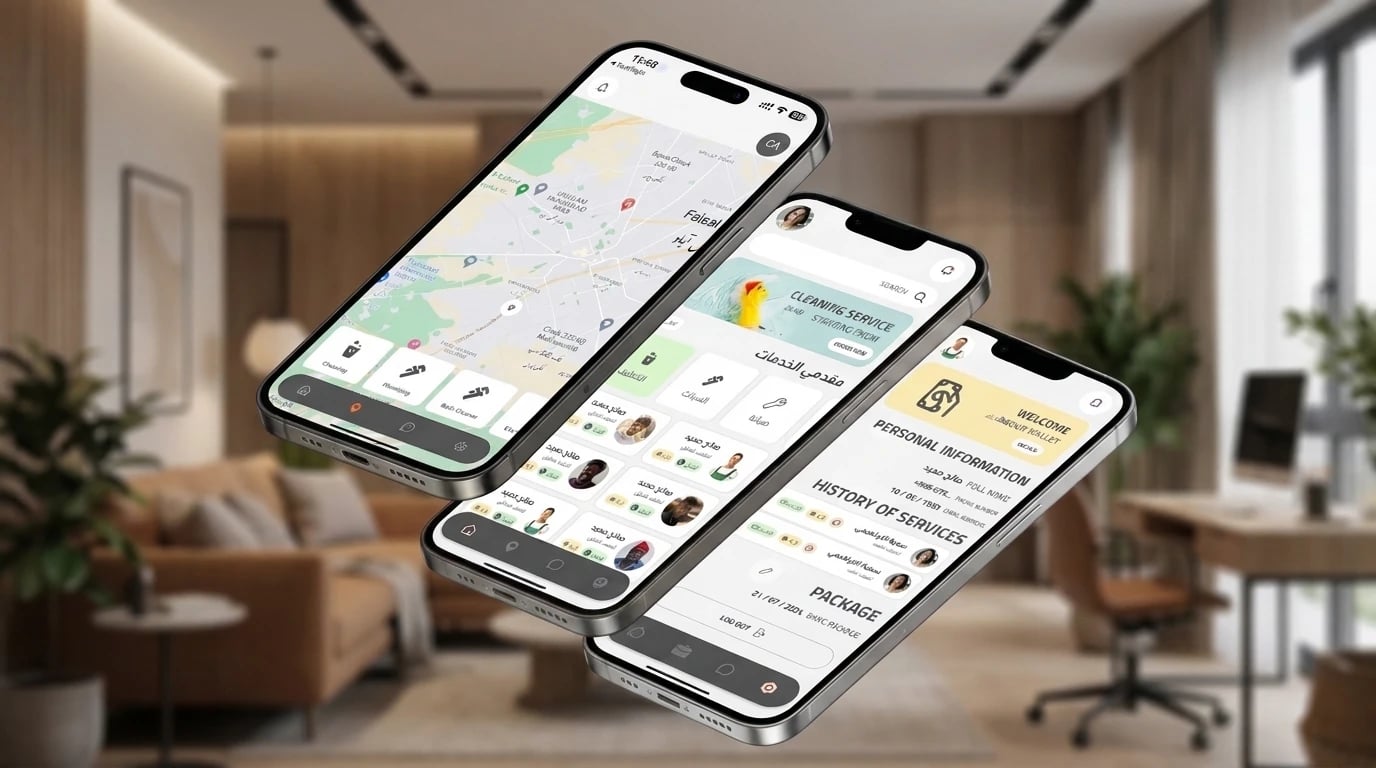
Khadamat app on three phones — map of nearby providers, Arabic provider listing by category, and the provider's wallet, personal information and service history
Web · Angular

Admin Panel

02
  • User and provider registration management
  • Provider subscription administration
  • Platform activity monitoring
  • Statistics, analytics and reporting
  • Role-based access control for the client's team
  • Helpdesk for support requests
Khadamat admin dashboard on a laptop — revenue, active providers, bookings and completed requests, booking performance chart and activity log
FAQ

On-Demand Services & Marketplace Apps — Questions Founders Ask Us

Have a similar project? Talk to us

It depends on who the providers are. For a delivery fleet with shift tools, navigation and earnings, a separate driver app earns its keep — that is how we built Connect. For a local services marketplace, where a cleaner or a plumber joins from a link, one app with the role chosen at sign-up is usually better: one listing, one release, and no second download standing between a provider and their first job. Khadamat ships both sides in one app on both stores.

Yes — Khadamat is that app for Kuwait: customers find providers on a map, send a request with photos and a date, chat in real time and track the provider on the way, while an admin panel runs registrations and subscriptions. The Gulf-specific parts are what usually catch teams out: local payment gateways, Arabic right-to-left layouts, and SMS as a reliable channel alongside push.

Khadamat integrates KNET and MyFatoorah. KNET is the national debit network most Kuwaiti customers pay through, and MyFatoorah covers cards and local methods for merchants already set up with them. We build local rails in from the first sprint rather than adding them after an international gateway fails to convert.

Khadamat uses subscription packages on the provider side, administered from the admin panel, so the platform earns from providers who are present and not only from completed jobs. The packages, their limits and who is on which one are the operator's to manage, not something that needs a developer to change.

It depends on how many sides the marketplace has and what each needs on day one. A Khadamat-style build — customer and provider experiences in one app, real-time chat and tracking, two payment gateways and an admin panel — is scoped in phases and quoted fixed-price after a free scoping call, so you can see the first phase working before funding the rest.

Launching a services marketplace in the Gulf?

One app for both sides, map-first discovery, real-time chat, KNET and MyFatoorah, an admin panel your team runs.
See how we'd scope yours.

Book a Free Consultation
Trusted US-Registered Development Agency✦
5.0 Client Satisfaction on Clutch✦
Recognized Top Rated Plus on Upwork✦
250+ Products Delivered✦
15+ Expert Developers & Designers✦
6+ Years of Development Excellence✦
Serving Clients Across the Globe✦
88% Client Retention Rate✦
Trusted US-Registered Development Agency✦
5.0 Client Satisfaction on Clutch✦
Recognized Top Rated Plus on Upwork✦
250+ Products Delivered✦
15+ Expert Developers & Designers✦
6+ Years of Development Excellence✦
Serving Clients Across the Globe✦
88% Client Retention Rate✦
Logo