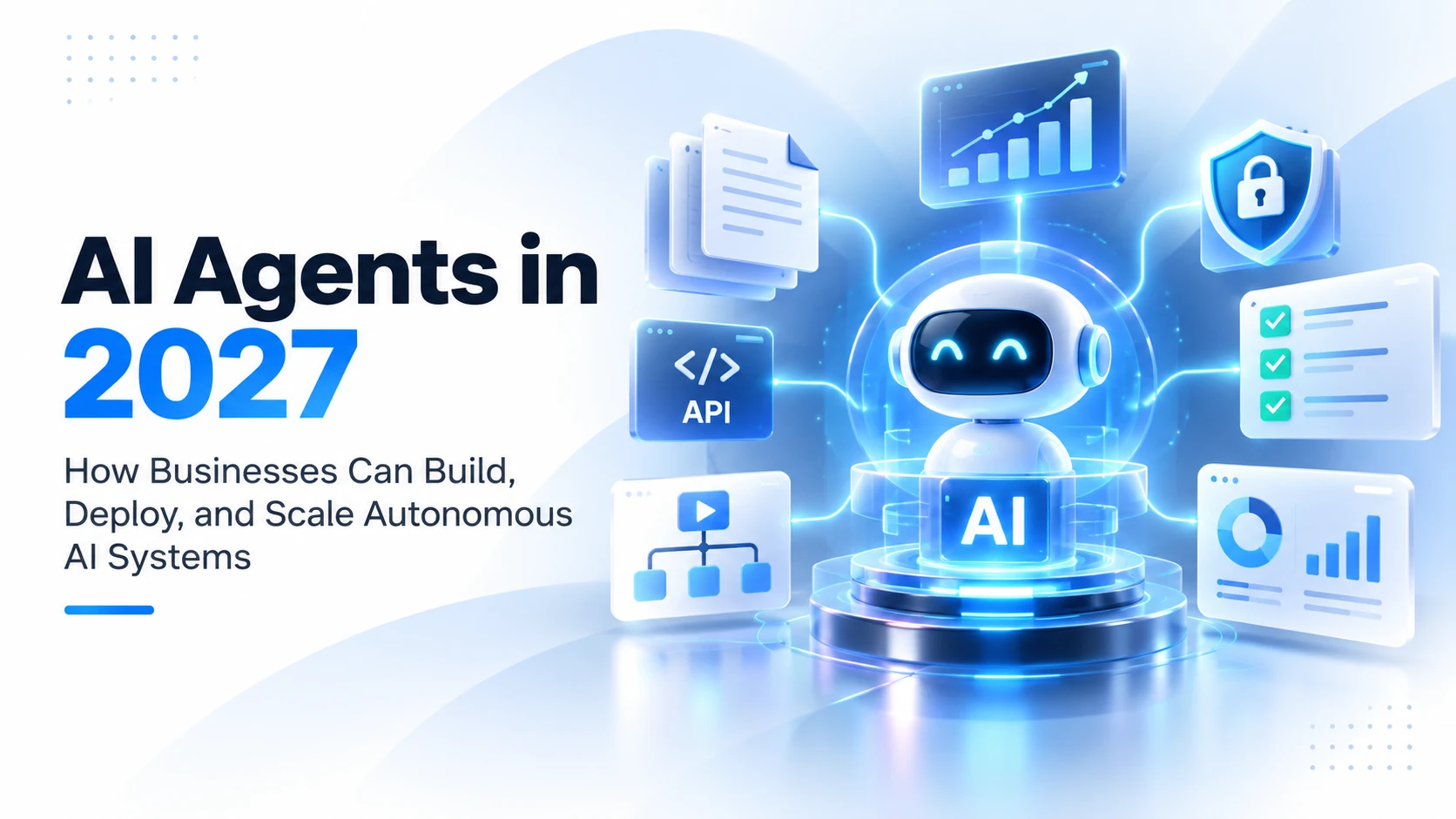
AI Agents in 2027: How Businesses Can Build, Deploy, and Scale Autonomous AI Systems
A practical guide to agentic AI architecture, development frameworks, deployment, security, costs, and enterprise scalability.
Sections
Imagine a business receiving 500 customer requests every day. Some need answers, others require information from a CRM, several involve checking inventory, and a few need approval before a refund or account change. Traditionally, employees switch between systems to complete these tasks. A basic AI chatbot might answer questions, but it cannot reliably complete the entire workflow.
Now imagine an AI system that understands the request, gathers relevant information, checks company policies, updates the appropriate systems, and asks an employee for approval only when necessary. That is the practical opportunity behind autonomous AI agents.
As businesses prepare for 2027, the conversation is moving beyond whether artificial intelligence can generate useful responses. The bigger question is whether AI agents can safely execute business workflows, integrate with existing software, and deliver measurable value at scale.
According to McKinsey's August 2026 State of AI research, 40% of respondents from large organizations reported scaling AI agents, compared with 27% the previous year. However, adoption does not automatically translate into reliable business outcomes. Gartner has also predicted that more than 40% of agentic AI projects may be canceled by the end of 2027, citing costs, unclear value, and inadequate risk controls.
This guide explains what AI agents are, how autonomous AI systems work, where businesses can use them, and how to build, deploy, secure, and scale them for production environments in 2027.
What Are AI Agents?
AI agents are software systems that use artificial intelligence to pursue a defined objective, select appropriate actions, interact with tools or data sources, and complete tasks across multiple steps. Unlike a traditional chatbot that primarily responds to a message, an AI agent can interact with external software and take action within permissions established by its developers and operators.
For example, a traditional customer support chatbot might explain a company's return policy. An AI customer support agent could retrieve an order, check whether the purchase qualifies for a return, prepare a refund request, update the support ticket, and notify the customer. If the refund exceeds a specified threshold, the system can pause for human authorization.
This distinction is central to agentic AI. The goal is not simply generating better answers. It is completing work while respecting business rules, permissions, and operational constraints.
AI Agents vs. Chatbots vs. Traditional Automation
| Capability | AI Chatbot | Traditional Automation | AI Agent |
|---|---|---|---|
| Primary function | Answers and assists | Executes predefined rules | Pursues goals through actions |
| Workflow | Mostly conversational | Fixed and predictable | Can adapt within defined limits |
| Tool access | Optional | Preconfigured integrations | Can select from permitted tools |
| Decision-making | Limited or advisory | Rule-based | AI-assisted, policy-constrained |
| Best application | FAQs and information | Repetitive structured tasks | Variable, multi-step workflows |
These categories are not mutually exclusive. A modern chatbot can use agent capabilities, while an agent may rely on deterministic automation for sensitive operations. In production, the strongest systems often combine AI reasoning with conventional software engineering rather than replacing established business logic.
Why AI Agents Matter for Businesses in 2027
The potential business value of AI agents comes from reducing the manual coordination required to complete tasks across disconnected systems. Many organizations already use CRM platforms, ERP systems, customer support tools, spreadsheets, payment systems, and internal dashboards. Employees spend considerable time moving information between these platforms, checking records, and following routine procedures.
AI agents can help connect these steps into more cohesive workflows. However, the shift toward autonomy introduces requirements that simple AI demonstrations rarely address: identity, permissions, reliable tool execution, auditability, workflow recovery, and performance monitoring.
Enterprise Adoption Is Growing, but Readiness Is Uneven
A June 2026 LangChain survey involving more than 1,300 professionals found that 57% of respondents had agents running in production. The same research identified quality as a leading production barrier, while observability adoption exceeded formal evaluation adoption.
Meanwhile, Deloitte's 2026 enterprise analysis reported that approximately 80% of surveyed organizations lacked mature agentic AI governance capabilities. These include clearly defined decision boundaries, real-time monitoring, and complete audit trails.
The research suggests an important distinction for 2027: businesses may become increasingly capable of building AI agents, but the advantage will come from operating them reliably. Organizations that establish the right controls early will be better positioned to expand automation without exposing themselves to unnecessary operational risks.
How Autonomous AI Agents Work
A production AI agent is not simply a large language model connected to a prompt. It is a software system composed of multiple layers that work together to understand requests, access information, select actions, execute tools, and verify results.
1. The AI Model: Understanding and Reasoning
The large language model (LLM) interprets user intent, understands context, proposes actions, and generates structured outputs. Businesses may use commercial model APIs or self-hosted models depending on performance requirements, privacy policies, availability, and cost.
The best model is not necessarily the largest or most expensive. A classification task may require a smaller model, while a complex research or planning workflow might justify a more capable one. Model selection should be based on evaluation results from actual business tasks.
2. Orchestration: Managing the Workflow
The orchestration layer controls how an agent progresses through a task. It determines when to retrieve data, call tools, request clarification, pause for approval, retry an operation, or stop execution. It also manages state so a workflow can continue after interruptions.
For example, an order management agent might follow a sequence of verifying the customer, retrieving order details, checking fulfillment status, validating refund eligibility, requesting approval when required, and recording the outcome.
3. Tools and APIs: Taking Action
Tools allow the agent to interact with business software. These might include a CRM API, inventory service, booking platform, payment gateway, database query endpoint, email service, or internal administrative system.
Tool access should be narrowly defined. An agent responsible for preparing customer refunds should not automatically receive permission to modify customer bank accounts or delete financial records. Sensitive changes should pass through server-side authorization and business rules rather than relying only on prompts.
4. Knowledge and Memory: Using the Right Information
Retrieval-augmented generation (RAG) allows agents to retrieve relevant business information from documents, knowledge bases, databases, and other approved sources. Vector databases and semantic search can support retrieval where appropriate, while traditional database queries remain preferable for exact transactional data.
Memory can help maintain context across workflow steps or user sessions, but it should be managed carefully. Long-term agent memory requires retention rules, access controls, privacy safeguards, and protection against incorrect or malicious stored information.
5. Governance: Keeping Actions Within Boundaries
Governance determines what the agent is allowed to do, what it must never do, and when a human must intervene. These controls include role-based access, spending limits, approval thresholds, audit logs, validation, rate limits, and emergency shutdown mechanisms.
The important architectural principle is that AI may recommend an action, but trusted application code must validate whether that action is authorized and safe to execute.
AI Agent Architecture: Building a Production-Ready System
A practical enterprise AI agent architecture separates user interaction, AI reasoning, workflow orchestration, data access, and critical business operations. This separation makes the system easier to test, secure, monitor, and scale.
A reference architecture can include the following components:
- Application interface: Web, mobile, chat, or internal dashboard where users submit requests and review outcomes.
- Authentication and API layer: Verifies users, validates requests, enforces access rules, and applies rate limits.
- Agent orchestration service: Coordinates model calls, tools, workflow state, retries, and human approvals.
- LLM gateway: Routes model requests, manages timeouts, and records token usage and costs.
- Knowledge and retrieval layer: Provides approved documents, business records, search indexes, and relevant context.
- Tool execution layer: Exposes narrowly scoped operations through validated APIs and protected execution environments.
- State and queue infrastructure: Maintains workflows, schedules background jobs, and supports safe recovery.
- Monitoring and evaluation: Measures task success, quality, latency, cost, security events, and operational failures.
For a web or SaaS product, this architecture might use a React or Next.js frontend, Node.js or Python backend services, PostgreSQL for application records, Redis for temporary state or queues, and cloud infrastructure for deployment. The AI component can integrate with existing APIs rather than requiring the entire application to be rebuilt.
Businesses exploring this approach can learn more about building AI-powered applications that combine production software engineering with AI capabilities.
Single-Agent vs. Multi-Agent Systems: Which Architecture Is Better?
One of the most important architectural decisions is whether to use a single AI agent or multiple specialized agents. More agents do not necessarily produce a better system. Each additional agent introduces coordination, communication, latency, security, and evaluation requirements.
Single-Agent Architecture
A single-agent architecture uses one primary agent with access to a defined collection of tools. It is usually simpler to implement, test, and maintain. For workflows such as document classification, support ticket triage, FAQ retrieval, or basic CRM updates, one well-designed agent may be sufficient.
Multi-Agent Architecture
Multi-agent systems divide responsibilities between specialized agents. A coordinator may route a request to a research agent, another agent may examine records, and a third may prepare an output. Each specialist operates within a clearly defined scope and returns structured results.
For example, an e-commerce operation could use an inventory specialist to check stock, a support specialist to interpret customer requests, and an order specialist to prepare an approved transaction. The agents communicate through an orchestration layer rather than independently sharing unrestricted access to every business system.
Multi-agent architectures become valuable when tasks require distinct specializations, parallel execution, or clearly separated responsibilities. They should not be introduced merely because several agents appear more advanced than one.
Best AI Agent Development Frameworks and Platforms for 2027
The AI agent development ecosystem includes code-first SDKs, workflow frameworks, managed cloud infrastructure, and enterprise platforms. The appropriate choice depends on application architecture, deployment requirements, integration complexity, operational controls, and engineering expertise.
OpenAI Agents SDK and APIs
The OpenAI Agents SDK supports agents with tools, handoffs, workflow execution, state management, tracing, and guardrails. OpenAI also provides API options for teams that want more direct control over model interactions or managed agent execution. These tools are relevant when building custom agents inside an existing application or developing specialized multi-step workflows.
LangGraph and LangChain
LangGraph is useful for designing stateful agent workflows where developers need explicit control over execution paths, persistence, checkpointing, human intervention, and recovery. LangChain provides integrations and components that can help connect models, retrieval systems, and other tools.
CrewAI
CrewAI focuses on coordinating specialized agents and structured workflows. It can be useful for experimenting with role-based agent collaboration, particularly when multiple agents have clear responsibilities. Production suitability still depends on workflow requirements, operational visibility, and security controls.
Microsoft Agent Framework
Microsoft's agent development ecosystem is relevant to teams building Python or .NET applications and businesses that need integration with Microsoft services. Framework and platform selection should consider runtime maturity, support requirements, hosting options, and compatibility with existing systems.
Amazon Bedrock AgentCore
Amazon Bedrock AgentCore provides managed capabilities for deploying and operating AI agents, including runtime infrastructure, identity, tool connectivity, memory, and observability. It may be suitable for organizations already using AWS or requiring managed infrastructure around agent execution.
There is no universal best AI agent framework. Before making a long-term choice, development teams should build a small representative workflow and evaluate it for reliability, traceability, permissions, integration complexity, infrastructure compatibility, and total operating cost.
MCP and Agent2Agent: Connecting AI Agents to Business Systems
As businesses adopt multiple models and platforms, interoperability becomes increasingly important. Two technologies to understand are the Model Context Protocol (MCP) and Agent2Agent (A2A) protocol.
Model Context Protocol (MCP)
MCP provides a standardized approach for connecting AI applications to external tools, data resources, and related capabilities. Instead of writing entirely different integration mechanisms for every AI client, developers can expose selected capabilities through compatible MCP servers.
The July 2026 MCP specification introduced updates including a stateless protocol core, authorization improvements, and an extensions framework. These developments support the broader goal of integrating agents into scalable, interoperable software environments.
Agent2Agent (A2A) Protocol
A2A focuses on communication and collaboration between different AI agents. An agent might delegate a specialized task to another agent and receive its result without directly managing every internal step of that agent's workflow.
In April 2026, the Linux Foundation reported support for A2A from more than 150 organizations and production use across several industries.
Put simply, MCP is primarily useful for connecting agents to tools and resources, while A2A supports communication between agents. Neither protocol automatically guarantees secure execution, correct business decisions, or regulatory compliance. Authentication, authorization, data handling, and monitoring remain essential.
How to Build an AI Agent for Your Business: Step-by-Step
Successful AI agent development begins with a business process rather than a preferred AI model. Organizations should first identify a repeatable workflow with measurable costs, clear boundaries, and accessible data. The initial implementation should be small enough to evaluate but valuable enough to justify investment.
Step 1: Identify a High-Value Business Workflow
Choose a process where employees repeatedly gather information, make bounded decisions, and take similar actions. Good early candidates include support ticket classification, internal knowledge retrieval, invoice extraction, sales lead qualification, and appointment coordination.
Record the existing workflow's volume, average handling time, error rate, and operating cost. These measurements establish a baseline for evaluating the agent later.
Step 2: Define the Agent's Responsibilities and Limits
Document exactly what the agent should accomplish, which systems it can access, and which actions require approval. An agent might be allowed to draft an email and update a ticket status but prohibited from sending legal notices or issuing payments without authorization.
Define success criteria, escalation rules, exception handling, and conditions that must terminate execution. Autonomy should be an explicit product decision, not an accidental consequence of connecting powerful tools.
Step 3: Prepare Business Data and Integrations
Identify the databases, documents, APIs, and applications required to complete the workflow. Clean up inconsistent records, establish authoritative data sources, and avoid retrieving sensitive information unless it is necessary for the task.
Use structured APIs for transactional changes. For documents and knowledge retrieval, implement search or RAG where it improves information access. Apply user-specific permissions to retrieved content so agents cannot access records outside an authorized scope.
Step 4: Select the Model and Agent Framework
Choose the model based on the actual tasks the agent must perform. Evaluate structured output accuracy, tool-selection performance, latency, reliability, context requirements, and cost. Then select an orchestration framework that fits your hosting infrastructure and desired control over execution.
A small agent with a few well-designed tools may outperform a complicated multi-agent setup because it has fewer opportunities for coordination failures.
Step 5: Build the Minimum Viable AI Agent
Develop a limited workflow that demonstrates the complete business process from request to verified outcome. For example, a support agent MVP could identify the customer's order, retrieve the applicable policy, prepare a recommended resolution, and route the action for human review.
This is more useful than a polished chatbot demonstration because it tests integration behavior, permissions, workflow states, error recovery, and business value under realistic conditions.
Step 6: Add Guardrails and Human Approvals
Implement input validation, output checks, tool argument validation, permission boundaries, and approval gates. Financial transactions, destructive database changes, access control updates, and other consequential actions should receive stronger controls than low-risk information retrieval.
Human-in-the-loop design allows an agent to automate preparation while retaining human authority over important decisions. In many businesses, this controlled approach is more useful than giving agents unrestricted autonomy.
Step 7: Evaluate With Realistic Test Scenarios
Testing should include successful requests, missing information, ambiguous instructions, permission conflicts, invalid tool responses, malicious content, duplicate requests, and integration outages.
Measure whether the system completes the correct business task, not merely whether its answer sounds convincing. Automated evaluation datasets and human review should be used together, particularly for workflows with external consequences.
Step 8: Deploy With Monitoring and Rollback Controls
Begin with a limited production rollout. Monitor execution traces, model costs, latency, tool failures, approval rates, and user feedback. Maintain the ability to disable tools, pause workflows, and revert changes when an unexpected problem occurs.
Only expand the agent's responsibility after it demonstrates stable performance on real workloads. Increased autonomy should follow evidence of reliability, not precede it.
How to Deploy AI Agents in Production
Deploying an AI agent requires more than publishing a Python service or connecting an LLM API. Production systems must manage workflow state, credentials, resource limits, outages, concurrent requests, and business-critical actions.
Choose the Right Hosting Model
Businesses can deploy agents through managed AI platforms, cloud application services, containerized infrastructure, or private environments. Managed services may reduce infrastructure management, while custom deployments can provide greater control over network isolation, execution environments, and integrations.
Hosting decisions should consider data residency, infrastructure cost, expected workload, deployment flexibility, regulatory obligations, and internal engineering capabilities.
Use Queues and Durable Workflow Execution
Long-running agent tasks should not depend on keeping a single web request open indefinitely. A more reliable architecture places tasks into a queue, persists their state, and uses workers to process them. Users can track progress through an application dashboard or notification system.
Durable execution enables a workflow to resume after an interruption. However, retries must be designed carefully. If an agent retries a payment or booking request, the application should use idempotency keys and transaction safeguards to prevent duplicate operations.
Control Concurrency and Resource Usage
Rate limits, worker concurrency limits, timeouts, and workload prioritization prevent traffic spikes from overwhelming models or downstream APIs. Businesses should also define maximum execution steps, tool-call limits, and cost budgets for individual workflows.
These controls matter because an agent can produce multiple model requests and tool calls while completing one user task. An inefficient workflow can become expensive or overload connected services even when the initial request rate is modest.
Implement Observability and Incident Response
Production monitoring should capture task identifiers, execution steps, tool-call results, latency, errors, token consumption, costs, and final outcomes. Logs must be designed to avoid unnecessarily recording sensitive customer information.
When an agent performs an incorrect action, engineering teams should be able to reconstruct what happened, identify the relevant model and tool calls, and determine whether the problem came from the model, retrieved data, permissions, or application logic.
How to Scale AI Agents Across an Enterprise
Scaling autonomous AI systems means increasing the number of reliable tasks they can complete without increasing cost, latency, or operational risk disproportionately. Adding more agents is not itself a scalability strategy.
1. Separate Stateless Services From Persistent Workflow State
Keep short-lived API and worker instances independent of durable workflow storage. Application databases, queues, and checkpoint systems should retain the state needed to recover unfinished tasks. This makes horizontal scaling more predictable.
2. Route Tasks to Appropriate Models
Not every task requires a frontier reasoning model. Use smaller or less expensive models for straightforward classification and extraction when evaluation results support doing so. Reserve more capable models for tasks that demonstrate a clear need for additional reasoning or complex tool selection.
3. Limit Context and Retrieval Overhead
Passing entire documents, long conversation histories, or unnecessary tool results into every model request increases latency and cost. Use selective retrieval, structured summaries, context pruning, and caching where they preserve required accuracy and security.
4. Keep Critical Business Logic Deterministic
AI should not be responsible for inventing tax calculations, payment settlement logic, authorization policies, or inventory consistency rules. Those operations belong in tested application services. Agents should call these services through approved interfaces and handle their structured responses.
5. Monitor Quality as Traffic Grows
An agent that performs well on 100 test cases can still encounter failures at enterprise scale. Increased traffic exposes more unusual requests, inconsistent records, race conditions, third-party outages, and malicious inputs.
Maintain continuous evaluations, track task success by workflow type, and establish operational alerts when error rates or costs move outside acceptable thresholds.
AI Agent Security, Privacy, and Governance in 2027
Autonomous AI introduces additional security challenges because an agent can convert information into actions. A traditional chatbot may provide an incorrect response, but an agent with excessive permissions could also alter data, expose confidential records, or trigger external operations.
The OWASP Top 10 for Agentic Applications 2026 identifies risks including agent goal hijacking, tool misuse, identity and privilege abuse, agentic supply-chain vulnerabilities, memory poisoning, insecure inter-agent communication, and cascading failures.
Protect Against Prompt Injection and Goal Hijacking
Prompt injection occurs when untrusted content attempts to redirect an AI system away from its authorized instructions. This content may appear in web pages, emails, documents, retrieved records, or tool responses.
Businesses should treat external content as data rather than authority. Sensitive actions must be validated by application policies, and retrieved text should never be allowed to grant permissions or override system-level controls.
Apply Least-Privilege Access
Each agent and tool should receive only the permissions necessary for its job. Credentials should be managed through secure infrastructure, with appropriate separation between users, organizations, environments, and workflows.
For multi-tenant SaaS applications, authorization must also prevent one customer's agent from accessing another customer's information. Tenant isolation should be enforced at the API and database levels, not simply described in a prompt.
Require Approval for High-Risk Actions
Human approval is especially important when actions involve financial transfers, account access changes, medical or legal consequences, destructive updates, or communications that create contractual obligations.
Approval interfaces should clearly display the proposed action, relevant evidence, affected records, and potential consequences. Human oversight should be meaningful rather than a routine confirmation that users approve without understanding.
Maintain Audit Trails and Operational Controls
Every consequential tool action should produce a record that identifies the initiating request, applicable user or service identity, authorization decision, operation, and result. Organizations should also define incident response procedures, emergency disablement, and escalation responsibilities.
For regulated industries, governance requirements depend on the jurisdiction, data type, intended use, and applicable laws. Deploying an AI agent framework does not automatically establish compliance with HIPAA, GDPR, financial regulations, or other legal obligations.
AI Agent Development Cost: What Businesses Should Budget for 2027
The cost of building an autonomous AI agent depends on workflow complexity, integrations, custom interfaces, model usage, security requirements, and ongoing operational support. A lightweight internal assistant and a multi-agent enterprise automation platform have very different development and maintenance requirements.
Businesses should consider two distinct cost categories: initial development expenditure and recurring operating costs.
Initial AI Agent Development Costs
Development typically includes workflow discovery, architecture, API integration, data preparation, agent orchestration, permission design, user experience, testing, deployment, and documentation. Complex systems may also require specialist security assessments, legacy system integration, and custom workflow management interfaces.
Instead of relying on a universal AI agent development price, request estimates based on a clearly defined workflow, the number and complexity of external integrations, and measurable acceptance criteria.
Recurring AI Agent Operating Costs
Ongoing expenses can include LLM API usage, model hosting, database infrastructure, search and retrieval, cloud compute, monitoring, storage, third-party API subscriptions, maintenance, and human review.
A useful operating-cost model is:
Monthly agent cost = model usage + tool/API usage + infrastructure + monitoring + human review + maintenance.
For planning purposes, suppose an agent processes 20,000 tasks per month and the combined variable cost of model and tool usage averages $0.08 per task. Direct variable usage would be $1,600 per month. This is a hypothetical calculation, not a market benchmark or provider quotation. Infrastructure, personnel, subscriptions, and other overhead would be additional.
The key is to measure total cost per successfully completed task. A cheap execution that repeatedly fails may be more expensive than a higher-quality model that completes the task correctly the first time.
How to Measure AI Agent ROI
Return on investment should be evaluated against actual business outcomes rather than the number of agent conversations or model calls. An agent that produces thousands of responses may create little value if employees must repeatedly correct its work.
Relevant performance indicators include:
- Task success rate: Percentage of eligible tasks completed correctly.
- Automation rate: Percentage of workflows completed without manual intervention.
- Human escalation rate: Percentage of tasks requiring staff assistance or approval.
- Average handling time: Time needed to complete the workflow before and after implementation.
- Cost per successful task: Total relevant operating cost divided by correctly completed tasks.
- Error and recovery rate: Frequency and cost of incorrect actions, retries, or manual correction.
- Customer or employee satisfaction: Impact on the people using or affected by the workflow.
For example, if a business reduces routine processing time but increases exception handling, the net benefit may be smaller than expected. Calculate savings after accounting for ongoing model costs, maintenance, quality assurance, and human oversight.
AI agent ROI = (measurable benefits - total agent costs) / total agent costs × 100.
The formula is simple, but credible ROI measurement requires a baseline, consistent assumptions, and enough production data to distinguish meaningful improvements from temporary fluctuations.
Real-World AI Agent Use Cases Across Industries
AI agents are most useful when connected to a defined business workflow with accessible information, clear success criteria, and appropriate control over actions. Several industries offer practical opportunities for controlled automation.
Customer Support and Service Operations
Support agents can classify requests, retrieve account details, search approved policies, prepare responses, update tickets, and escalate complex issues. Organizations can gradually expand automation from drafting and triage to low-risk actions when their accuracy and controls are sufficient.
E-Commerce and Retail
Retail AI agents can help customers find products, check availability, compare options, track deliveries, and coordinate returns. Operational agents may assist with stock alerts, product catalog management, and order exception handling.
Payment execution and inventory updates should remain governed by authoritative transaction systems. AI agents can coordinate these operations without replacing the business logic needed to keep orders, stock, and financial records consistent.
Healthcare and Wellness
Healthcare organizations may explore agents for appointment coordination, administrative documentation, patient communication workflows, and internal knowledge retrieval. Wellness applications can also use AI for personalized recommendations and contextual assistance.
Clinical decision-making and sensitive health workflows require stronger validation, privacy protections, qualified human oversight, and applicable regulatory review. Administrative automation should not be confused with independently validated medical diagnosis or treatment.
Fintech and Financial Operations
Financial businesses can use agents to assist with transaction research, customer onboarding document review, payment exception triage, financial reporting preparation, and internal reconciliation workflows.
However, authoritative ledgers, transaction authorization, balance calculations, and settlement controls should remain within deterministic financial systems. Agent access must follow strict permissions, approval policies, and audit requirements.
SaaS and Internal Business Operations
SaaS companies can build AI agents for onboarding assistance, support automation, account configuration guidance, document analysis, and internal administrative tasks. Multi-tenant architecture makes permission isolation especially important.
Businesses may also embed agent capabilities directly into existing web applications, allowing customers to complete tasks through natural-language interfaces while the backend executes validated operations.
Sales, Marketing, and CRM
Sales agents can research accounts, organize CRM records, prepare personalized outreach drafts, summarize meetings, identify missing information, and recommend follow-up actions. Automated communications should respect recipient preferences, applicable marketing requirements, and company approval policies.
Logistics and Supply Chain
Logistics agents can help investigate delivery exceptions, summarize shipment statuses, identify inventory discrepancies, and prepare recommended operational actions. These workflows become more valuable when agents integrate with authoritative scheduling, inventory, and fulfillment APIs.
What Existing AI Products Teach Us About Production Reliability
A reliable AI product needs more than an impressive model response. It must account for real user requirements, changing data, API costs, application performance, and operational control.
One relevant example is ALIFF, an AI-powered styling application developed by Next Level Software. The product combines AI-generated outfit recommendations with user wardrobe information and a rule layer that reflects practical styling constraints. Its architecture also incorporates AI usage quotas, caching, and streaming.
ALIFF is an example of an AI-powered application rather than evidence of an autonomous multi-agent deployment. However, the engineering lesson applies to agentic systems: model output alone is insufficient when business rules, predictable costs, and consistent user experiences matter.
As businesses develop more autonomous AI applications, they will need to apply the same principles to every action the agent performs, including tool permissions, validation, reliability, monitoring, and recovery.
Common Mistakes Businesses Make When Building AI Agents
Building an Agent Without a Clear Business Objective
An AI agent should solve a measurable problem. Starting with a framework or model and searching for a use case afterward often leads to demonstrations that are difficult to justify commercially. Define expected business outcomes before developing the system.
Giving Agents Too Many Permissions
Broad access increases the potential consequences of model errors and malicious inputs. Each workflow should use restricted tools and server-enforced authorization rather than unrestricted access to business applications.
Using Multi-Agent Systems for Simple Workflows
Multiple agents can create additional model calls, handoff failures, and debugging complexity. Start with a single agent or deterministic workflow when it can meet the requirement. Introduce specialization only when it provides measurable benefits.
Testing Responses Instead of Outcomes
A fluent answer does not guarantee that an agent updated the correct customer, selected the proper order, or followed the applicable policy. Tests must inspect resulting application states, tool actions, permissions, and recovery behavior.
Ignoring Costs Until Production
Complex reasoning loops, repeated retries, excessive retrieval, and oversized context windows can produce unpredictable operating expenses. Implement budgets and usage monitoring early, and compare cost per successful task across different configurations.
Assuming Full Autonomy Is the Goal
For many processes, the best solution is a hybrid workflow in which AI prepares information and recommends actions while humans approve consequential decisions. A system that completes 80% of a workflow reliably can be more valuable than one that attempts 100% autonomy but introduces unacceptable errors.
AI Agents in 2027: Key Trends Businesses Should Prepare For
Although 2027 is still ahead, developments observed during 2026 provide a useful foundation for identifying where enterprise agentic AI may be heading. The following are forward-looking expectations, not confirmed outcomes.
1. Greater Focus on Reliability and Measurable Outcomes
Businesses are likely to place more emphasis on successful task execution, cost control, and business impact instead of measuring progress by the number of agents deployed. Organizations will increasingly need evidence that agents are better than conventional software or human-led workflows for the selected task.
2. More AI Agents Embedded Inside Existing Software
Rather than replacing every business application with an AI interface, companies may add agent capabilities to established CRM, ERP, e-commerce, SaaS, and mobile platforms. This approach preserves existing data models and business operations while introducing new interaction and automation capabilities.
3. Stronger Governance and Agent Identity Management
Agent permissions, identity, auditability, and policy enforcement are likely to become central architecture concerns. Organizations will need to understand which agent performed an action, who authorized it, and whether the action complied with applicable business rules.
4. Growth in Interoperability Standards
Protocols such as MCP and A2A may reduce integration friction between AI tools, platforms, and specialized agents. However, adoption and interoperability will continue to depend on implementation maturity, compatibility, and secure deployment practices.
5. Model Routing and More Efficient Execution
Companies may increasingly combine models of different sizes and capabilities. Straightforward tasks can use lower-cost execution paths, while complex tasks can be routed to more capable models. This makes evaluation and intelligent routing important parts of cost optimization.
6. More Human-Agent Collaboration
Business workflows are likely to combine automated preparation with selective human review. Employees may spend less time collecting information and more time handling exceptions, approvals, customer relationships, and high-impact decisions.
7. Greater Demand for Production Engineering
As agent frameworks simplify prototypes, the difficult work will increasingly involve secure integration, durable workflows, permissions, evaluation, observability, and operating agents at scale. Engineering discipline will remain essential even as model capabilities improve.
When Should a Business Build Custom AI Agents Instead of Buying Software?
Businesses do not always need to develop autonomous AI systems from scratch. Existing AI products and automation platforms may already solve common requirements such as meeting summaries, internal search, email classification, and basic customer support.
Buying an established solution may be appropriate when the workflow is standardized, integrations are available, security requirements can be satisfied, and the product delivers acceptable results at a predictable cost.
Custom AI agent development becomes more attractive when the business requires proprietary workflows, deep integration with internal software, complex authorization, specialized data handling, distinctive product features, or control over long-term architecture.
Before deciding, compare the cost and limitations of buying, integrating, extending, or building. The goal is not to own AI infrastructure for its own sake. It is to create a reliable capability that meets the organization's requirements.
A Practical Roadmap for Preparing Your Business for AI Agents in 2027
Businesses can approach AI agent adoption through a staged roadmap that prioritizes measurable value and reduces deployment risk.
- Assess workflows: Identify repetitive tasks, available data, current bottlenecks, and potential business value.
- Select a pilot: Choose one bounded process with manageable integrations and measurable outcomes.
- Design controls: Establish permissions, approval rules, failure handling, privacy requirements, and evaluation criteria.
- Build and validate: Implement a limited agent, connect the required tools, and test realistic scenarios.
- Deploy gradually: Start with supervised production use, monitor results, and compare performance with the original process.
- Expand selectively: Increase task coverage and autonomy only where reliability, security, and business value justify it.
This approach helps organizations build operational confidence before making larger investments in enterprise-wide AI automation.
Final Thoughts: The Future of AI Agents Is Controlled Autonomy
AI agents in 2027 could play a larger role in customer support, business operations, software products, financial workflows, healthcare administration, and enterprise automation. However, the most valuable systems will not necessarily be the ones making the most independent decisions.
The strongest implementations will combine capable AI models with secure APIs, reliable workflow orchestration, accurate business data, human approval mechanisms, and measurable performance. They will treat autonomy as something to be earned through testing and operational evidence.
For founders and business leaders, the practical starting point is a well-defined workflow that AI can improve. For engineering teams, the priority is building systems that remain dependable when requests become complex, data changes, integrations fail, or traffic grows.
At Next Level Software, we help businesses develop AI-powered web and mobile applications that integrate intelligent features with the software infrastructure needed for real-world use. Whether you are exploring an internal AI assistant, an automation workflow, or an AI-enabled SaaS product, the right architecture starts with understanding the business problem.
Planning an AI agent project? Discuss your project with Next Level Software and explore how to turn your requirements into a practical, scalable AI application.
Keep reading
Can Your AI Automation Handle Daylight Saving Time Changes?
Daylight saving time can silently disrupt AI automations, from missed reminders to duplicate workflows. Learn what breaks during clock changes and how businesses can prevent it.
Abdullah · · 11 min read
Vibe Coding Is Not a Product Strategy: Why Startups Still Need Software Engineering
Vibe coding makes software easier to build, but hidden security risks, weak architecture, and scattered features can undermine startups. Learn why a focused, engineering-led MVP is a smarter investment.
Khubaib Rasheed · · 15 min read
AI Agents for Business Automation: Why Startups Are Moving Beyond Chatbots
AI agents are changing how startups automate business operations. Explore the difference between chatbots and AI agents, practical use cases, benefits, costs, and implementation risks.
Abdullah · · 20 min read