 Khubaib Rasheed
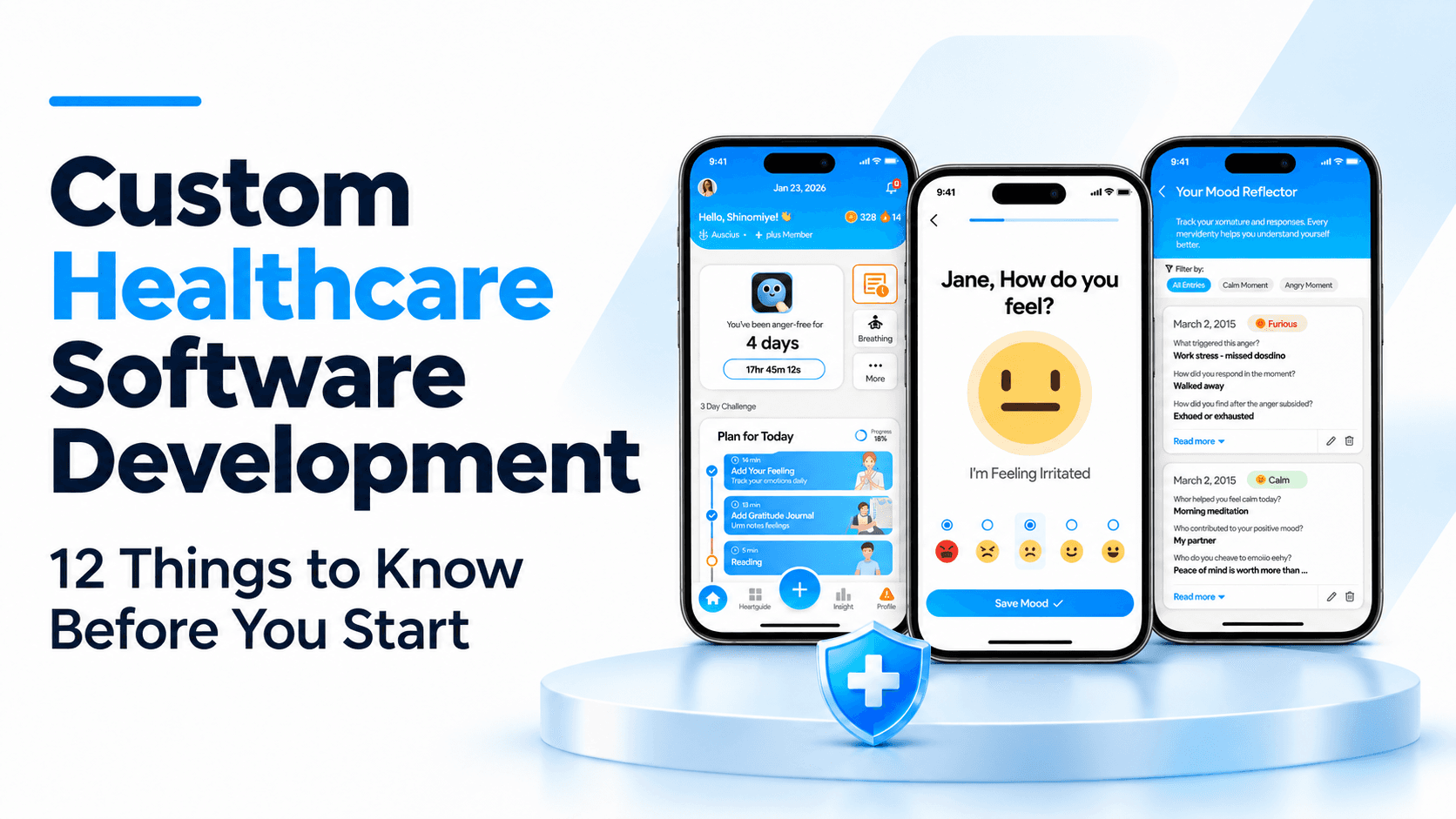
Custom healthcare software development means building an application around a specific care, administrative, or wellness workflow. Before you start, define its purpose, data responsibilities, integrations, budget, and support plan. These decisions should shape the first release before development begins.
This guide is for clinic owners, healthcare startups, and wellness founders comparing a custom build with existing software. We cover 12 decisions to make before hiring a development partner, with a real wellness project as an example.
1. Do you need custom software or an existing healthcare platform?
Build custom software when a specific workflow cannot be handled well by an existing product. First, check whether configuration or a focused integration could solve the problem.
Standard appointments and reminders: evaluate an existing booking platform.
A useful system with one missing workflow: explore an extension or integration.
A distinctive patient or staff experience: scope a focused custom application.
An entirely new clinical platform: investigate regulatory and operational requirements first.
We recommend describing the problem before listing features: who does what, where work stalls, and what should improve. Our custom software development service starts with those workflows.
2. Is your product administrative, wellness-focused, or clinical?
Define what the software actually does and what users will rely on it for. A booking tool, mood journal, and treatment recommendation feature need different planning.
The Federal Trade Commission’s (FTC) Mobile Health App Interactive Tool explains that certain diagnostic or treatment software functions may fall under US Food and Drug Administration (FDA) medical-device oversight. Federal Trade Commission
Write an intended-use statement describing users, functions, and claims. If a feature could influence clinical decisions, arrange a specialist regulatory assessment before setting its delivery plan. Calling a feature “wellness” should never replace that assessment.
At Next Level Software, our health app development service includes wellness products with a clear boundary: AI informs, never diagnoses.
3. Which privacy rules apply to your healthcare software?
Determine which rules apply to your organisation and relationships before choosing infrastructure. Handling health information does not automatically settle whether HIPAA, the US Health Insurance Portability and Accountability Act, applies.
According to the FTC’s tool, HIPAA covers specified healthcare entities and their business associates. A business associate handles protected health information for a covered entity in a qualifying relationship.
A consumer health app outside HIPAA may still face FTC privacy and breach-notification obligations. Medical-device status and HIPAA applicability are separate questions. Federal Trade Commission
These are US examples. For your product and launch markets, check with your compliance advisor. Our healthcare and wellness development approach uses HIPAA-aware architecture alongside the client’s advisor.
4. Where will patient data travel, and who can access it?
Create a data-flow map covering every service that receives sensitive information. Include hosting, messaging, video calls, analytics, support tools, and AI providers.
For each destination, record what is sent, why, storage location, retention, and permitted access. Decide how exports, corrections, account closure, and legally required retention will work.
The US Department of Health and Human Services (HHS) explains that HIPAA-regulated relationships require business associate agreements, including relevant subcontractor arrangements. A business associate agreement, or BAA, documents responsibilities for protecting information. HHS.gov
We recommend using invented test records during prototyping and keeping health details out of notification previews, analytics events, and routine error logs.
5. What security controls must be designed from the beginning?
Base security decisions on a documented risk assessment. HHS describes administrative, physical, and technical safeguards for electronic protected health information, including risk analysis and management. HHS.gov
Our recommended engineering starting point includes:
Individual accounts, access limited by role, and multi-factor authentication.
Encryption for stored information and network connections.
Audit logs showing access and changes without copying unnecessary health details.
Separation between clinics when multiple organisations share a platform.
Backup restoration tests, incident procedures, and access removal when staff leave.
Ask how each control will be verified. For example, changing a patient identifier in a request must not expose someone else’s record. Security should be demonstrated through behaviour and evidence.
6. How will the software connect to existing EHR systems?
Confirm the exact electronic health record, or EHR, system and the information your application must exchange. Ask separately about reading records and writing updates.
The US health IT agency ASTP/ONC describes FHIR, Fast Healthcare Interoperability Resources, as a standard for representing and exchanging health information. An application programming interface, or API, is the connection software uses to exchange that information. healthit.gov
Before committing to an integration, request:
Supported API documentation, versions, and available data.
A test environment and the production-access process.
Permission requirements, vendor charges, and an accountable contact.
Rules for patient matching, duplicates, failed transfers, and conflicting updates.
We recommend proving one representative exchange in the test environment before estimating the complete integration.
7. Will patients and staff be able to use it comfortably?
Test the proposed workflow with the people who will use it. Include patients, reception staff, clinicians, and administrators where relevant.
We recommend checking text size, contrast, keyboard navigation, screen-reader use, language, and weak internet connections. Explain unfamiliar terms and make the next action clear.
For staff, walk through interruptions: a patient changes an answer, an appointment moves, or someone opens the wrong record. Decide how the interface helps them recognise and correct the situation.
A useful prototype lets people complete realistic tasks. Ask them to book, reschedule, or review an intake form while you observe where they hesitate.
8. What belongs in the first release?
Build one complete workflow with a measurable purpose. A minimum viable product, or MVP, is the smallest useful release you can evaluate with real users.
For a clinic intake product, that might mean registration, intake submission, staff review, and a clear appointment status. Payments, wearables, and advanced reporting can wait unless they are essential.
Define permissions, failure handling, and acceptance criteria within that scope. Choose a measure such as staff time per intake or completion rate, and record a baseline.
Our development process covers requirements, design, delivery planning, testing, and launch, with weekly demos during development.
9. Where can AI help, and where does it need boundaries?
Choose a specific AI task and decide how its output will be reviewed. Treat it as a feature with failure cases, data access, and running costs.
For a document-summary feature, we would ask: can the reviewer inspect the original? What happens when information is missing? How will unsupported statements be detected?
Before sending sensitive data to a provider, verify its contract, retention settings, permitted uses, and suitability for the project. Budget for evaluation and ongoing monitoring.
For wellness products, define when the assistant should stop and direct users to appropriate human support. Any diagnostic or treatment function needs the specialist assessment described earlier.
10. How will you test, migrate, and launch safely?
Agree on release evidence before development begins. We recommend functional, security, integration, and usability testing, followed by a limited pilot with named owners.
Include uncomfortable scenarios: the wrong patient is selected, a connection fails halfway through, permissions change, or a backup must be restored. Use qualified clinical reviewers for clinical workflows.
If records are moving, rehearse the migration. Reconcile counts, patient identifiers, attachments, and dates. Define how changes made during the transfer will be handled.
Set launch criteria, a rollback plan, staff training, and a downtime procedure. Our guide to a demo versus a production-ready app explains why a working demonstration is only one milestone.
11. How much will it cost, and how long will it take?
Price the defined product and its dependencies. A wellness application and an integrated clinical system should have separate estimates.
For context, these are NLS starting points and scope examples:
Focused mood-tracking and journaling MVP: starts from $5,000.
AI wellness platform like Angivore: typically $12,000–$25,000, depending on scope.
Custom clinical workflows or EHR integrations: quoted after a scope check; no standard published price.
Our health service describes care platforms as typically taking 3–4 months. The final schedule depends on the agreed scope, access, reviews, and dependencies; this is not a medical-device approval timeline.
We provide the final price through a fixed-scope, fixed-price written proposal after a free scoping call. Our pricing and engagement models explain that approach.
Also request an operating budget covering hosting, messaging, third-party services, support, and security reviews.
12. Who owns the software and keeps it running after launch?
Put ownership, access, support responsibilities, and handover deliverables in writing. Confirm who controls the repository, infrastructure accounts, domains, documentation, and deployment process.
Ask a prospective partner for evidence of relevant work and an example of how they document permissions, testing, and integrations. Have your advisor review the contractual and compliance responsibilities.
NLS clients own the code, design files, and third-party accounts, with repository access from the first sprint. Our builds include 45 days of post-launch support; ongoing support options are available afterward.
Agree who monitors failures, responds to incidents, patches dependencies, and helps another team take over if needed.
How we did it: Angivore
Angivore is a mental wellness example of a defined product scope. We built mood check-ins, text and audio journaling, an AI chatbot, gamification, subscriptions, and an admin panel.
The scope covered both the user-facing app and the administration work behind it. That is a useful planning lesson: include both when defining the product. Angivore demonstrates wellness-product experience; a clinical EHR implementation requires its own assessment and evidence.
The results recorded in our company facts are: “3 months concept to both stores; 2 products (app + admin).” Next Level Software
See the Angivore wellness app case study for the project overview. Its delivery time is a project result, not a promise for a different healthcare product.
What should you prepare before requesting a proposal?
Prepare a short brief that lets potential partners assess the same scope. Include:
The workflow, users, and intended use.
Launch markets and your compliance advisor.
Data categories, access roles, and existing systems.
First-release requirements and acceptance criteria.
Budget, dependencies, and support expectations.
Next Level Software builds health and wellness applications around an agreed product plan. Explore our health app development service to start with a scoping conversation and a written proposal.
Frequently asked questions
How much does custom healthcare software development cost?
The price depends on scope, integrations, and the product’s responsibilities. At NLS, a focused mood-tracking and journaling MVP starts from $5,000; clinical software needs a separate estimate and a fixed-scope written proposal.
How long does it take to build healthcare software?
Our health service describes care platforms as typically taking 3–4 months, subject to scope and dependencies. Angivore took “3 months concept to both stores”; your schedule needs its own assessment.
Does every health app need to be HIPAA compliant?
No. The FTC explains that HIPAA applicability depends on covered-entity and business-associate relationships. Consumer apps outside HIPAA may still have other privacy obligations; check with your compliance advisor. Federal Trade Commission
Can custom software connect to our existing EHR?
It may be possible, but the exact system, supported interfaces, permissions, and intended data exchange need verification. Ask for a test integration and production-access plan before accepting a firm estimate.
Do we have to replace our current healthcare system?
No. We recommend evaluating whether a focused extension, patient portal, or integration can address the gap. Replace the wider system only after assessing workflows, migration, and long-term ownership.
How do we choose a healthcare software development company?
Look for relevant project evidence, clear scoping, and practical explanations of data access, testing, integrations, and support. Ask who owns compliance decisions and what evidence you will receive before launch.
Written by Khubaib Rasheed, Founder & CEO, Next Level Software.