The AI Spending Bubble: Why Wall Street Is Questioning Billions in AI Investment
Big Tech is pouring hundreds of billions into AI infrastructure. But investors are asking whether the revenue and returns can justify the spending.
Sections
Artificial intelligence has become one of the largest investment opportunities in modern technology. From Nvidia GPUs and massive data centers to advanced AI models and autonomous agents, the world's biggest technology companies are spending extraordinary amounts of money to build the infrastructure behind the AI revolution.
But a major question is now spreading across Wall Street: Will the returns from artificial intelligence justify the billions being invested?
As of October 30, 2026, that question is no longer theoretical. Big Tech's latest earnings have triggered sharp market reactions, with investors increasingly concerned about AI capital expenditure, negative free cash flow, rising debt, and the time it may take to turn AI infrastructure into sustainable profits.
The debate around the AI spending bubble is not necessarily about whether artificial intelligence works. It is about whether companies are investing faster than the market can generate enough revenue to support their ambitions.
How Big Has the AI Spending Boom Become?
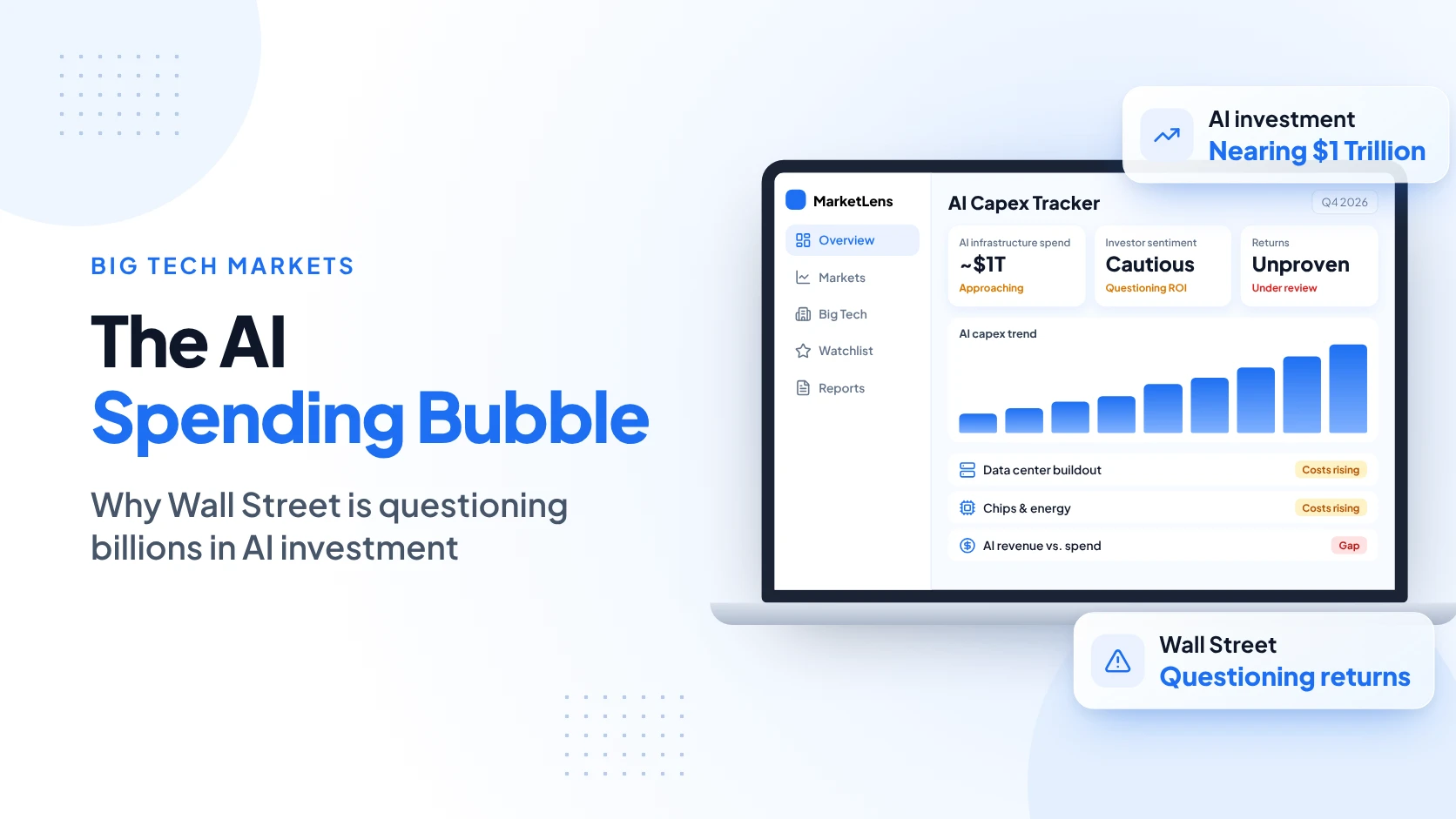
The scale of global AI investment has reached a level that would have seemed extraordinary only a few years ago. In August 2026, Goldman Sachs Research estimated that global artificial intelligence investment would exceed $1 trillion in 2026, including approximately $581 billion in the United States.
Meanwhile, an October 19 report from J.P. Morgan Global Research projected that five major US hyperscalers, Amazon, Alphabet, Meta, Oracle, and Microsoft, could spend approximately $900 billion on AI-related capital expenditure in 2026 alone. The bank also projected cumulative global AI capex of approximately $5.5 trillion through 2030.
These estimates use different methodologies and scopes, but they illustrate the same trend: AI infrastructure spending is growing at an unprecedented scale.
Capital expenditure, commonly called capex, refers to investments in long-term assets. In the AI industry, this includes advanced GPUs, data centers, networking equipment, cooling infrastructure, power systems, and servers needed to train and operate increasingly sophisticated models.
Sources: Goldman Sachs Research and J.P. Morgan Global Research.
Why Wall Street Is Starting to Question the AI Spending Bubble
For much of the AI boom, investors rewarded companies announcing aggressive infrastructure investments. Spending heavily on artificial intelligence was widely interpreted as positioning for future growth. The expectation was that stronger models, expanding cloud demand, and enterprise adoption would eventually translate into substantial profits.
That assumption is now facing greater scrutiny. Investors increasingly want to know how much money AI products actually generate, when infrastructure investments will recover their costs, and whether the growth in computing demand will justify the scale of spending.
The pressure became particularly visible during the late-October 2026 earnings season. According to the Financial Times, major technology companies lost nearly $900 billion in combined market value as investors reacted to sharply rising AI infrastructure costs and weaker cash-flow trends. The report said combined capital spending by Amazon, Meta, Microsoft, and Alphabet increased to approximately $207 billion during the third quarter, compared with $113 billion a year earlier.
The stock market reaction highlights a changing attitude. A large AI budget is no longer enough to impress investors on its own. Companies must increasingly demonstrate how that investment creates measurable economic value.
The Biggest Warning Sign: AI Spending Is Growing Faster Than Cash Flow
One of the most important indicators behind concerns about the AI bubble is free cash flow, the cash a company generates after accounting for capital expenditure. A company can report growing revenue and operating profits while still experiencing significant pressure on the cash available after infrastructure investments.
Reuters reported in July 2026 that Microsoft, Alphabet, Amazon, Meta, and Oracle were expected, based on LSEG consensus estimates at the time, to spend more on combined capital expenditure than they generated in free cash flow by 2027.
That analysis estimated that between 2025 and 2027, the companies' annual operating cash flow would increase by approximately $340 billion, while capital expenditure would rise by around $534 billion. In other words, the projected additional investment exceeded the projected additional operating cash generated during that period.
More recent earnings have made the concern even more visible. Amazon reported negative free cash flow of approximately $42.4 billion for the twelve months ending September 30, 2026, compared with positive free cash flow of $14.8 billion for the previous twelve-month period. The company attributed much of the change to increased spending on property and equipment associated with AI investments.
Negative free cash flow does not automatically mean a company is financially unhealthy. Infrastructure investment is often concentrated upfront, while revenue can arrive over many years. However, when spending continues to accelerate, investors naturally question how long businesses can maintain the same investment pace.
AI Infrastructure Debt Is Becoming Another Major Risk
The AI investment boom is also changing how technology companies finance expansion. Instead of relying exclusively on existing cash reserves and operating profits, businesses are increasingly turning to debt markets, equity issuance, and external infrastructure financing.
According to S&P Global Market Intelligence data reported by Axios on October 29, Alphabet, Amazon, Meta, Microsoft, and Oracle had raised approximately $326 billion through stock and bond issuance so far in 2026. That was more than three times the amount raised during 2025.
Borrowing can support growth when future earnings are strong enough to cover interest, repayments, and infrastructure costs. But it also creates additional financial risk if demand slows, customers reduce spending, or AI computing becomes less expensive than originally expected.
This is particularly important for specialized AI cloud providers, sometimes called neoclouds. These businesses often invest heavily in GPU infrastructure and depend on continued customer demand to recover their costs. If demand growth slows or financing becomes more expensive, highly leveraged providers may find it difficult to maintain expansion.
The concern is not simply that companies are borrowing money. It is that some are committing enormous amounts of capital today based on revenue expectations that may take years to materialize.
Is AI Really a Bubble, or Is Wall Street Overreacting?
Calling the current investment cycle an AI bubble is tempting, especially when stock prices respond sharply to spending announcements. However, an important distinction must be made between speculative valuations and genuine technological demand.
Artificial intelligence already supports real products and business activities, including software development, document processing, customer service, fraud detection, enterprise search, personalized recommendations, and workflow automation. Businesses are using AI for tasks that previously required significant manual effort.
J.P. Morgan Asset Management has also highlighted strong demand for computing infrastructure. Its 2026 analysis reported that more than 80% of data center capacity under construction had already been leased, while major cloud providers continued to report capacity constraints and substantial contracted customer demand.
These figures support the argument that the AI boom is not purely speculative. There are real customers purchasing cloud computing, AI services, and infrastructure capacity.
However, strong demand does not guarantee that every investment will generate attractive returns. Companies can build valuable infrastructure and still overpay for equipment, underestimate operating costs, or face declining prices as competition intensifies.
How the AI Spending Boom Compares With the Dot-Com Bubble
The comparison with the late-1990s dot-com bubble is becoming increasingly common. During that period, investors poured substantial capital into internet businesses and telecommunications infrastructure based on expectations of future digital growth. Many companies failed, even though the internet ultimately transformed the global economy.
The AI investment cycle shares some similarities, including aggressive spending, ambitious revenue forecasts, infrastructure expansion, and high expectations for future adoption. Yet there are important differences. Several of today's largest AI investors are already profitable, established technology companies with substantial cloud operations and existing enterprise customers.
The lesson from the dot-com era is not that every emerging technology boom must collapse. It is that a transformative technology can succeed while individual businesses, projects, and investors still experience significant losses.
The $300 Billion AI Revenue Question
The economics of AI infrastructure are becoming more important than the excitement surrounding new model releases. In September 2026, Goldman Sachs analysts estimated that major US hyperscalers would need approximately $300 billion in annual AI revenue in the coming years to break even on their investments.
The same analysis estimated that approximately $1 trillion in annual AI application spending by end users could be necessary for hyperscalers to earn solid returns. These are model-based estimates rather than guaranteed financial thresholds, but they illustrate the challenge facing the industry.
The central question is whether businesses will ultimately spend enough on AI applications, automation, enterprise software, and AI agents to support the enormous infrastructure being created.
AI adoption may continue growing rapidly, but monetization could develop at a different pace. Some organizations are still experimenting with AI products, while others are struggling to translate prototypes and pilots into production systems with measurable financial benefits.
That creates a potential mismatch between short-term infrastructure investment and longer-term enterprise adoption.
What This Means for AI Startups and Software Businesses
Although the AI spending bubble is attracting attention primarily because of Big Tech earnings and stock market volatility, the implications extend to startups, SaaS companies, and businesses building AI-powered products.
For smaller companies, the most important lesson is that AI development should not begin with expensive infrastructure or unnecessary technical complexity. It should begin with a clearly defined problem, a realistic business model, and an understanding of what customers are willing to pay for.
Building an AI product using large language models can involve multiple ongoing costs, including model API usage, cloud hosting, vector databases, storage, background processing, monitoring, and human review. These costs can grow as user adoption increases, especially when applications process large prompts, documents, images, or repeated automated workflows.
For example, an AI SaaS application might attract substantial user activity while remaining unprofitable if each customer generates more infrastructure and model costs than their subscription revenue covers.
That is why AI unit economics should be part of product planning from the beginning. Businesses should measure cost per request, cost per active customer, gross margin, retention, and the financial value delivered by each AI feature.
How Businesses Can Avoid Overspending on AI Development
Businesses do not need to spend heavily on artificial intelligence to benefit from it. In many situations, a carefully designed AI feature integrated into an existing application can produce more value than building a large, complicated AI platform.
1. Start With a Real Business Problem
Identify the process that needs improvement before selecting an AI model or technology stack. It could involve reducing customer support workloads, automating repetitive document processing, improving product recommendations, or helping employees access information more efficiently. The potential business value should be understandable before development begins.
2. Build a Focused MVP Before Scaling
Instead of developing a complete AI ecosystem immediately, focus on a minimum viable product that tests the most important assumptions. A well-scoped MVP development process allows teams to evaluate usability, customer demand, operational costs, and revenue potential before making larger commitments.
3. Choose the Right AI Model for Each Task
Not every feature requires the most advanced or expensive model. Smaller models, carefully designed prompts, retrieval systems, and deterministic business rules can often handle routine tasks effectively. More capable models should be reserved for tasks where their additional quality produces a measurable benefit.
4. Monitor Usage and Infrastructure Costs
Implement cost tracking, request limits, caching, usage quotas, and appropriate monitoring from the beginning. Applications should also account for unusual traffic patterns, retries, long prompts, and automated workflows that can trigger repeated API calls.
5. Measure Return on Investment, Not Just AI Usage
A successful AI implementation should be evaluated using business outcomes rather than the number of prompts processed or models integrated. Useful measurements can include time saved, lower processing costs, increased conversion rates, improved customer retention, and revenue generated by paid AI features.
A Practical Example: Building AI With Cost Controls
At Next Level Software, AI product development is approached as a combination of user experience, software architecture, business rules, and operational cost management.
Our ALIFF AI stylist application demonstrates how intelligent features can be designed around actual user needs. The product combines AI-generated styling recommendations with digital wardrobe functionality, user feedback, and specific styling constraints.
The implementation also includes practical engineering measures such as caching, streaming, and AI quota management. These mechanisms help control how AI services are used and how requests are handled within the application.
This does not mean every AI product will achieve the same economics. It shows why reliable AI application development requires more than connecting a frontend to a language model. Developers must consider cost, product behavior, operational safeguards, and long-term maintainability alongside model quality.
What Happens Next to the AI Market?
The next phase of the AI investment cycle will likely depend on the relationship between infrastructure spending and actual revenue growth. Several possible outcomes deserve attention.
Scenario 1: AI Revenue Catches Up With Infrastructure Spending
If enterprise adoption accelerates, cloud utilization improves, and more businesses begin purchasing production AI services, the current investment cycle could support significant long-term growth. Companies with efficient infrastructure and strong customer relationships would be better positioned to benefit.
Scenario 2: AI Spending Slows, but Adoption Continues
Another possibility is that technology companies moderate infrastructure expansion while businesses continue adopting AI tools. This would not necessarily indicate that AI is failing. It could represent a transition from aggressive capacity building toward more disciplined spending and stronger financial performance.
Scenario 3: The AI Market Experiences a Significant Correction
If expected revenue fails to materialize, financing becomes more expensive, or infrastructure capacity exceeds demand, some AI companies could face financial pressure. Highly leveraged infrastructure providers and businesses without sustainable unit economics would be particularly exposed.
Even in this scenario, artificial intelligence could continue advancing. Lower computing prices and stronger competition might benefit software companies that use AI services without owning large amounts of infrastructure.
Final Thoughts: The Future of AI Depends on Value, Not Spending
The debate surrounding the AI spending bubble reveals an important change in how investors and businesses are evaluating artificial intelligence. The conversation is moving beyond model performance, computing power, and ambitious infrastructure announcements toward revenue, sustainability, and measurable returns.
Wall Street is not necessarily questioning whether AI has a future. It is questioning whether today's enormous investment commitments can deliver the financial outcomes investors expect, and how long those outcomes may take to arrive.
For founders and business owners, the lesson is equally important. Successful AI adoption does not require following every technological trend or building the most expensive infrastructure. It requires choosing problems worth solving, controlling operating costs, developing reliable products, and ensuring that the value created justifies the investment.
The companies that succeed in the next phase of AI may not be the ones spending the most. They may be the ones turning AI into sustainable business value.
If you are planning an AI-powered application or considering adding intelligent features to an existing product, explore how Next Level Software develops AI-assisted applications with practical product architecture, usage controls, and business requirements in mind.
Keep reading

AI Virtual Try-On Is Changing Beauty E-commerce Apps. What Should Brands Build Next?
AI virtual try-on is reshaping beauty e-commerce. Explore the latest 2026 trends and discover which AI features beauty brands should build next.
Abdullah · · 18 min read

Stablecoin Payment Apps and New US Regulations: What Changes in 2027
New US stablecoin regulations are changing how fintech payment apps are built. Explore the GENIUS Act, 2027 requirements, USDC payments, compliance, and development opportunities.
Abdullah · · 20 min read

Gemini 4 Carbon vs Argon: Why Google Released Two Powerful AI Models in One Month
Google released Gemini 4 Carbon weeks after Argon. Explore their key differences in cybersecurity, agentic coding, safety, benchmarks, pricing, and availability.
Khubaib Rasheed · · 20 min read