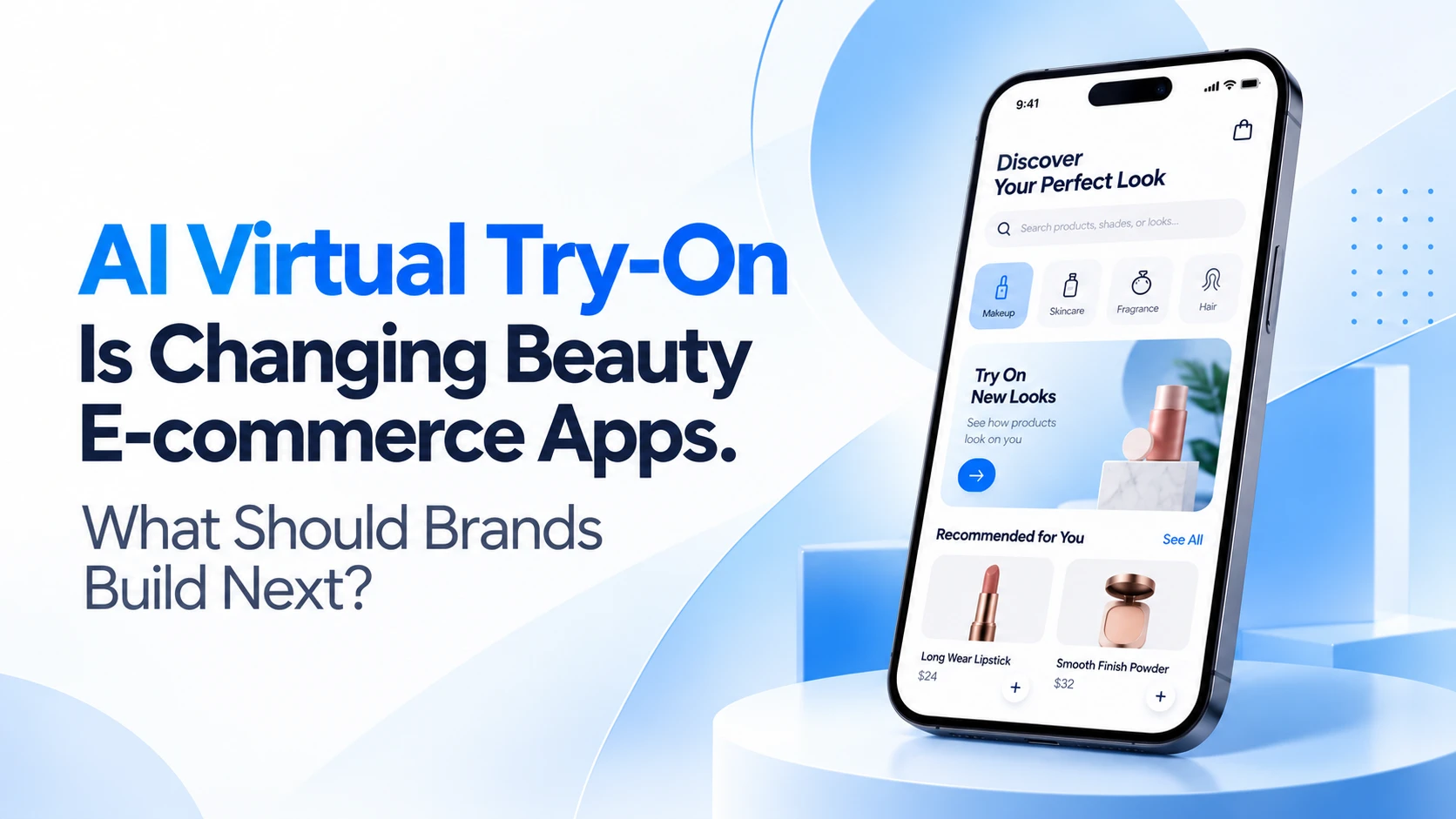
AI Virtual Try-On Is Changing Beauty E-commerce Apps. What Should Brands Build Next?
From AI shade matching and skin analysis to personalized beauty advisors and agentic shopping, discover what beauty brands should build next.
Sections
Buying beauty products online has always involved some guesswork. A lipstick shade can look different on every skin tone, foundation colors may appear inaccurate under different lighting, and a skincare product that works for one person may not suit another. Product photos, influencer videos, and customer reviews help, but they cannot fully answer the question customers care about most: "Will this work for me?"
AI virtual try-on is changing that experience. Shoppers can preview makeup on their own faces, explore different looks, compare products, and receive recommendations before making a purchase. But the biggest change is no longer just the ability to apply a digital lipstick filter. Beauty e-commerce is moving toward connected shopping journeys where AI helps customers discover, evaluate, visualize, and purchase products.
In 2026, major beauty retailers and technology companies are expanding AI-powered shopping. L'Oréal has announced plans to bring Maybelline virtual makeup try-on into ChatGPT, Sephora has introduced personalized shopping experiences through ChatGPT, and Ulta Beauty is bringing AI-assisted discovery and commerce into Google's ecosystem. These developments point toward a new question for beauty brands: What should a beauty e-commerce application offer beyond virtual try-on?
Why AI Virtual Try-On Is Becoming Important for Beauty E-commerce
Traditional beauty e-commerce applications are usually organized around product categories, search filters, promotional banners, and checkout. Customers browse a catalogue, select a product, and rely on images and descriptions to decide whether to purchase it. This experience works well for straightforward purchases, but beauty products introduce a more personal challenge. Customers need to understand color, appearance, skin compatibility, and how different products work together.
Virtual try-on helps address the visual part of that challenge. Using augmented reality, facial landmark detection, image processing, and AI models, an application can display a simulated makeup look on a customer's face. Depending on the technology, shoppers may be able to preview lipstick, blush, eyeshadow, eyeliner, lashes, or hair color through a live camera or uploaded photograph.
Google demonstrated a broader approach in March 2025 when it introduced virtual beauty looks combining multiple makeup products. Rather than selecting one lipstick at a time, shoppers could experiment with complete looks inspired by beauty trends. The development matters because customers often shop for an occasion or desired appearance, not just an individual product.
According to a 2026 Ulta Beauty-commissioned NielsenIQ study, 73% of surveyed Gen Alpha beauty consumers use personalization tools while shopping. However, 77% also seek real-world validation. This suggests that digital discovery is becoming more personalized without eliminating the need for confidence, realistic expectations, and trusted product information.
Source: Google Shopping's AI beauty try-on announcement and Ulta Beauty's 2026 NielsenIQ research.
Five AI Beauty Commerce Trends Reshaping Shopping in 2026
1. AI Beauty Shopping Is Moving Into Conversational Platforms
On June 17, 2026, L'Oréal announced a collaboration with OpenAI that included plans to bring Maybelline New York's makeup virtual try-on capabilities into ChatGPT using ModiFace technology. The announcement connected product discovery, conversational AI, and virtual visualization within a single emerging shopping experience.
Sephora also announced a ChatGPT app in March 2026, initially piloting in the United States. Its experience focuses on personalized beauty discovery, curated product guidance, and loyalty-related benefits, with checkout capabilities identified for future development. These announcements show that beauty shopping is no longer limited to searches within a retailer's own website or mobile application.
For brands, the opportunity is to make product data and recommendations available across multiple discovery channels. A shopper might ask an AI assistant for a long-lasting lipstick suitable for a particular occasion, explore recommended products, preview their appearance, and continue to a purchase. A strong commerce system needs accurate product information, current inventory, shade variants, pricing, and a reliable purchase flow to support that journey.
Sources: L'Oréal and OpenAI announcement and Sephora's ChatGPT launch.
2. Virtual Try-On Is Evolving Into Complete Makeup Look Discovery
Early virtual try-on experiences often focused on applying an individual product to a photograph. The next step is allowing customers to visualize a combination of products. Someone preparing for a wedding, a professional event, or a casual evening might want to compare complete looks rather than testing lipstick, blush, and eyeshadow separately.
Google's multi-product beauty try-on experience illustrates this direction. A brand could build a similar journey where a customer chooses an occasion, previews several curated looks, changes individual shades, and adds the selected products to a shopping cart. The application could also save favorite looks and reconnect them with available products later.
The commercial opportunity is not simply making the experience entertaining. It is connecting inspiration directly to actual products. If a customer selects a makeup look, the application should know which items create that look, whether they are available, what the combined price is, and whether suitable alternatives exist.
3. AI Skin Analysis and Shade Matching Are Becoming Connected Services
Foundation matching is difficult because skin tones, undertones, lighting conditions, and product formulations vary. AI-based shade matching can help customers narrow their options by analyzing visual information and comparing it with a brand's available shade range. Related beauty technologies can also evaluate visible skin characteristics and guide users toward relevant product categories.
At VivaTech 2026, Perfect Corp. presented an AI Beauty Agent approach that combines skin analysis, foundation shade matching, personalized recommendations, and virtual try-on in connected workflows. In August 2026, the company also announced an integration involving 28 YouCam APIs across makeup, skin, hair, and other appearance-related categories.
These developments make a strong case for building one connected beauty profile rather than separate tools that do not communicate with each other. A customer should not have to repeat the same information every time they move from foundation matching to a skincare consultation or makeup recommendation.
However, brands must distinguish cosmetic analysis from medical diagnosis. Camera-based skin assessments can be affected by lighting, image quality, device differences, and model limitations. Applications should explain what the technology can assess, avoid unsupported medical claims, and offer appropriate alternatives when a result is uncertain.
Source: Perfect Corp.'s VivaTech 2026 beauty AI developments.
4. Agentic Commerce Is Bringing Shopping Closer to AI Recommendations
On April 22, 2026, Ulta Beauty and Google announced new Gemini-enabled shopping experiences. Their plans included making Ulta Beauty products shoppable through Google's AI experiences and launching Ulta AI, a conversational shopping assistant intended to help customers discover and compare products.
This is an important development for the next generation of beauty apps. A traditional recommendation engine suggests products and leaves the customer to complete the journey manually. An agentic commerce experience can connect recommendations with actions such as checking product availability, comparing prices, preparing a cart, or supporting a purchase through an authorized checkout flow.
Beauty brands do not need to introduce fully autonomous purchasing immediately. A more practical starting point is an assistant that understands product preferences, displays available options, explains recommendations, and helps customers complete checkout. Any action involving payment, personal information, or order confirmation should include clear user authorization and reliable transaction handling.
Source: Ulta Beauty and Google announcement.
5. Beauty Personalization Is Becoming a Long-Term Customer Experience
Most e-commerce personalization focuses on recent searches, browsing history, and previous purchases. Beauty personalization can go further because product preferences often develop over time. A customer may have favorite lipstick shades, preferred finishes, recurring skincare purchases, and different makeup choices for specific occasions.
A beauty application can use consented preferences, purchase history, and explicit feedback to provide more relevant recommendations. Features such as saved makeup looks, shade preferences, personalized collections, replenishment reminders, and loyalty rewards give customers practical reasons to return.
The goal should be to reduce repeated decision-making rather than collect unnecessary personal data. Customers should be able to edit preferences, reject recommendations, and decide whether their facial images or analysis results are saved.
What Should Beauty Brands Build Next?
AI virtual try-on should be treated as one component of a larger product experience. For most brands, the next investment should depend on the problems customers face during discovery, shade selection, product comparison, and repeat purchasing. The following capabilities offer a practical roadmap.
1. An AI-Powered Makeup Try-On Studio
A virtual makeup studio allows shoppers to test products on their own faces through a camera or uploaded image. The experience should support realistic shade previews, quick product switching, before-and-after comparison, and direct access to product details. For a brand with a broad makeup catalogue, customers could also save complete looks and revisit them later.
The most important design decision is keeping the experience connected to actual inventory. Every displayed shade should map to a real product variant with accurate pricing and availability. A visually impressive result becomes less useful when the product cannot be identified or purchased.
2. A Personalized Foundation and Shade Finder
A foundation shade finder can combine optional camera analysis with questions about undertone, desired coverage, finish, and existing shade preferences. Instead of returning one supposedly perfect result, the application can present a small number of suitable candidates with explanations and confidence indicators.
This is especially valuable for brands selling foundation, concealer, tinted moisturizers, and complexion products. Testing should include diverse skin tones, lighting environments, and mobile devices. Where results are uncertain, the application should offer manual shade selection, comparison swatches, or in-store verification.
3. An AI Beauty Advisor Connected to the Product Catalogue
A beauty advisor can translate conversational requests into useful shopping results. A customer might ask, "I need a natural makeup look for a daytime event, and I prefer lightweight products." The assistant could identify suitable catalogue items, explain their differences, and assemble an editable shopping list based on available inventory.
To make this reliable, recommendations must be grounded in verified product information. The system should use structured catalogue data, product attributes, shade information, and approved descriptions rather than allowing a general-purpose language model to invent ingredients, benefits, prices, or product claims.
Brands exploring this capability can consider AI application development to connect recommendation logic with existing e-commerce services and customer workflows.
4. AI-Assisted Skincare Discovery
Skincare shopping usually involves a different decision process from makeup shopping. Customers want to understand ingredients, product types, routines, and compatibility with their stated preferences. A skincare discovery feature can combine a short questionnaire, optional image-assisted observations, product information, and structured recommendation rules.
For example, the application could help customers compare moisturizers, cleansers, or sunscreen products based on their preferences and the brand's verified product data. It should explain the reasoning behind recommendations and avoid promising treatment outcomes. Medical concerns should be directed to qualified professionals rather than handled as definitive AI diagnoses.
5. Shoppable Makeup Looks and Routine Bundles
Many beauty customers shop for an outcome rather than a standalone product. A soft-glam look, everyday routine, or festive makeup collection may involve several products purchased together. An application can turn these collections into shoppable experiences where users preview a complete look, inspect each item, replace individual products, and add the selected bundle to their cart.
For brands, this creates opportunities to improve product discovery and encourage relevant cross-category purchases. But the backend must manage product variants, promotions, discounts, and stock accurately. Bundle pricing shown in a recommendation should match the final checkout calculation.
6. Personalized Replenishment and Loyalty
Beauty products are often purchased repeatedly, making replenishment a useful feature for existing customers. An application can estimate when a customer may need to reorder based on purchase timing, product size, and user preferences. Reminders should be adjustable rather than presented as guaranteed predictions of product consumption.
Loyalty rewards can be connected to these journeys through purchase points, exclusive offers, or personalized collections. The result is a shopping experience that helps customers return to products they already trust while making it easier to discover appropriate alternatives.
Which Beauty App Features Should Brands Prioritize?
Not every beauty business needs the same AI capabilities. A makeup retailer with hundreds of shades faces different problems from a skincare company with a small product catalogue. Feature selection should follow customer needs, product characteristics, and operational readiness rather than a desire to include as many AI functions as possible.
FeaturePrimary Customer ProblemSuggested PriorityMobile product catalogue and reliable checkoutDifficulty discovering and purchasing productsFoundationVirtual makeup try-onUncertainty about appearance and colorsHigh for makeup brandsFoundation shade matchingDifficulty selecting complexion shadesHigh for complexion brandsAI beauty advisorToo many products and limited guidanceHigh for broad cataloguesShoppable makeup looksDifficulty combining productsSecond phaseAI-assisted skincare discoveryUncertainty about product suitabilityHigh for skincare brands, with safeguardsPersonalized loyalty and replenishmentRepeated searching and reorderingSecond phaseExternal AI shopping integrationsDiscovery outside the brand's own appGrowth phase
These priorities are product recommendations, not universal rankings. Brands should validate them against customer behavior, catalogue complexity, development cost, and technical feasibility.
Why AI Alone Cannot Fix a Weak Beauty E-commerce App
A sophisticated virtual try-on experience cannot compensate for unreliable pricing, incorrect inventory, confusing navigation, or a checkout process that does not match local purchasing habits. A beauty application is still a commerce product, and customers ultimately need to find the right item, trust the information, and place an order successfully.
This becomes especially important in markets with specific language and payment requirements. For example, an Arabic-speaking customer may expect a native right-to-left interface, while customers in some regions prefer cash on delivery or locally supported payment methods. These requirements influence product adoption independently of any AI feature.
What Piano, a Cosmetics E-commerce Platform, Demonstrates
At Next Level Software, we developed Piano, an Arabic-first cosmetics e-commerce application for Iraq. The platform includes a mobile shopping application and an admin CMS designed around the customer's actual retail experience.
Piano supports Arabic and English, cash-on-delivery checkout, product variants, promotional campaigns such as Buy-3-Pay-2, flash sales, inventory management, and a loyalty points ledger. The admin CMS lets the business team manage campaigns and product information without requiring a developer for every promotion.
The lesson is directly relevant to brands considering virtual try-on. Before adding advanced visualization, a product must maintain reliable connections among its catalogue, pricing, inventory, offers, and checkout. If an AI feature recommends a particular lipstick or foundation, the shopping system still needs to identify the correct product, calculate the right price, and complete the order.
Piano is an example of cosmetics commerce infrastructure, not a claim that the platform currently includes AI virtual try-on. Its relevance is the operational foundation that beauty AI features would need to integrate with.
What AI Personalization Can Learn From ALIFF
Another relevant Next Level Software project is ALIFF, an AI-powered fashion styling application. ALIFF combines a digital wardrobe, clothing tagging, AI outfit recommendations, and user preferences to help people select clothing suited to their needs. Its implementation also uses business rules, feedback mechanisms, caching, and AI usage management.
Although ALIFF is a fashion styling product rather than a cosmetics virtual try-on application, it illustrates an important AI product principle: useful personalization requires more than generating attractive images. Recommendations need to respect user constraints, incorporate feedback, and operate reliably within the application's technical and commercial limits.
That same principle applies to beauty apps. A beauty advisor should understand product availability, customer preferences, shade limitations, and the purpose of each recommendation instead of generating visually appealing but impractical results.
How Should Developers Build an AI Beauty E-commerce Application?
A production-ready beauty commerce application needs several connected components. The customer-facing mobile or web application handles product browsing, image capture, try-on previews, and checkout. AI services provide appropriate visual analysis, virtual makeup rendering, or recommendations. Backend services manage product records, customer preferences, availability, promotions, payments, and orders.
Start With a Reliable Commerce Backend
Product records should contain structured attributes such as brand, product category, shade, finish, skin-related claims, image assets, availability, and price. Each AI recommendation must connect to an identifiable product or variant. The backend should remain responsible for inventory, promotional logic, order totals, and checkout, rather than delegating these decisions to a generative AI model.
Choose the Right Virtual Try-On Technology
Brands can evaluate specialized AR and beauty AI SDKs or APIs instead of training their own computer-vision models from scratch. The right choice depends on supported product categories, rendering accuracy, mobile performance, integration requirements, commercial licensing, and user privacy expectations.
Live AR rendering is useful when customers want immediate visual feedback while moving their face. Photo-based or generative rendering can support richer visual experimentation, but may require additional processing time and stronger safeguards against misleading changes to facial features, lighting, skin texture, or product appearance.
Connect AI Recommendations to Verified Product Data
A conversational beauty advisor should retrieve current product details from approved catalogue records and use those records to generate recommendations. Rules can prevent suggestions involving unavailable shades, incompatible product selections, unsupported claims, or products outside the customer's stated budget.
A good system also allows customers to correct the AI. If a recommended product is too expensive, too bold, or unsuitable for their preferences, the user should be able to refine the result without repeating the full shopping journey.
Build Privacy and Inclusion Into the Experience
Facial images and inferred skin characteristics can be sensitive information, especially when they are used for personalization or retained in customer profiles. Brands should request clear consent, explain image handling, minimize retention, secure processing and storage, and provide meaningful deletion controls. Applicable privacy and biometric-data obligations depend on the operating market and the specific data being processed.
Models should also be tested across different skin tones, ages, lighting conditions, camera qualities, and supported devices. Customers need realistic previews rather than an AI-generated idealized version of their appearance. Where the technology cannot confidently assess a feature, the application should be transparent and offer another path.
How Can Beauty Brands Measure Whether Virtual Try-On Works?
Virtual try-on should be measured as a product investment, not simply as a feature that attracts attention. High engagement does not automatically mean the experience improves revenue or customer satisfaction. Brands should establish baseline metrics, test user journeys, and compare results across meaningful customer segments.
Useful performance indicators include the percentage of shoppers who start and complete a try-on, product-detail views after a preview, add-to-cart rates, conversion rates, average order value, repeat purchases, and return or refund reasons. Teams should also monitor technical indicators such as preview latency, failed sessions, API costs, and performance across different devices.
These metrics should be interpreted carefully. Customers who choose to use virtual try-on may already be more interested in purchasing, so a higher conversion rate among those users does not prove the technology caused the increase. Controlled A/B tests or other appropriately designed experiments provide stronger evidence of business impact.
A Practical Roadmap for Launching AI Features in a Beauty App
For a brand that already has an e-commerce application, the first step is identifying where customers hesitate. Foundation shade uncertainty may justify shade matching, while a complex makeup catalogue may benefit more from virtual try-on and an AI product advisor. The goal is to test one valuable customer journey before developing a full AI beauty ecosystem.
Phase 1: Build or Strengthen Core Commerce
Establish a structured product catalogue, working search and filters, accurate variants, reliable checkout, order management, and an admin dashboard. Without this foundation, personalization cannot connect consistently to real purchasing activity.
Phase 2: Launch One Focused AI Experience
Introduce a virtual lipstick or foundation try-on flow, a specialized shade finder, or a catalogue-connected AI beauty assistant. Test accuracy, usability, image-processing behavior, and customer feedback with a clearly defined group of users.
Phase 3: Connect Personalization With Shopping
Allow customers to save preferences, compare suitable products, build routines, and add recommendations directly to their cart. Measure whether the feature improves product discovery and completed purchases before expanding its scope.
Phase 4: Expand Into Connected Beauty Commerce
Once the experience demonstrates value, brands can consider complete makeup looks, personalized replenishment, loyalty integration, multi-category beauty recommendations, and external conversational shopping channels. More advanced agentic workflows should be introduced with reliable commerce integrations and explicit customer authorization.
The Future of Beauty E-commerce Is More Than a Digital Mirror
The latest developments from L'Oréal, Sephora, Ulta Beauty, Google, and Perfect Corp. indicate that beauty commerce is moving toward connected AI experiences. Virtual try-on helps customers visualize a product, but the broader opportunity is to help them make a confident decision and move smoothly from inspiration to purchase.
For beauty brands, the most valuable next feature will not always be the most advanced AI model or the most realistic digital filter. It may be a reliable foundation shade finder, an advisor that understands the actual catalogue, a shoppable makeup routine, or a better way to connect personalized recommendations with checkout and loyalty.
The brands that benefit most from this shift will likely be those that combine useful AI capabilities with accurate product information, inclusive design, trustworthy privacy practices, and strong e-commerce infrastructure. The technology should make beauty shopping simpler and more relevant, rather than adding another layer of complexity.
Build a Beauty Shopping Experience That Goes Beyond Virtual Try-On
Whether you are launching a cosmetics marketplace or upgrading an existing beauty application, the right starting point is a clear customer problem and a product architecture that can support growth. Next Level Software develops mobile and AI-assisted applications that connect customer experiences with the backend systems needed to operate them reliably.
Explore our Piano cosmetics e-commerce case study to see how market-specific commerce requirements can shape a retail product. If you are planning an AI-powered beauty experience, discuss your application with our team to identify the most useful features and a practical first phase.
Keep reading

Stablecoin Payment Apps and New US Regulations: What Changes in 2027
New US stablecoin regulations are changing how fintech payment apps are built. Explore the GENIUS Act, 2027 requirements, USDC payments, compliance, and development opportunities.
Abdullah · · 20 min read

Gemini 4 Carbon vs Argon: Why Google Released Two Powerful AI Models in One Month
Google released Gemini 4 Carbon weeks after Argon. Explore their key differences in cybersecurity, agentic coding, safety, benchmarks, pricing, and availability.
Khubaib Rasheed · · 20 min read

OpenAI Launches GPT-6.1 Terra: Features, Pricing, Benchmarks & AI Agent Capabilities
OpenAI launched GPT-6.1 Terra on October 26, 2026, with faster computer use, improved visual reasoning, lower API pricing and stronger coding performance. Here's what developers and businesses need to know.
Khubaib Rasheed · · 18 min read